
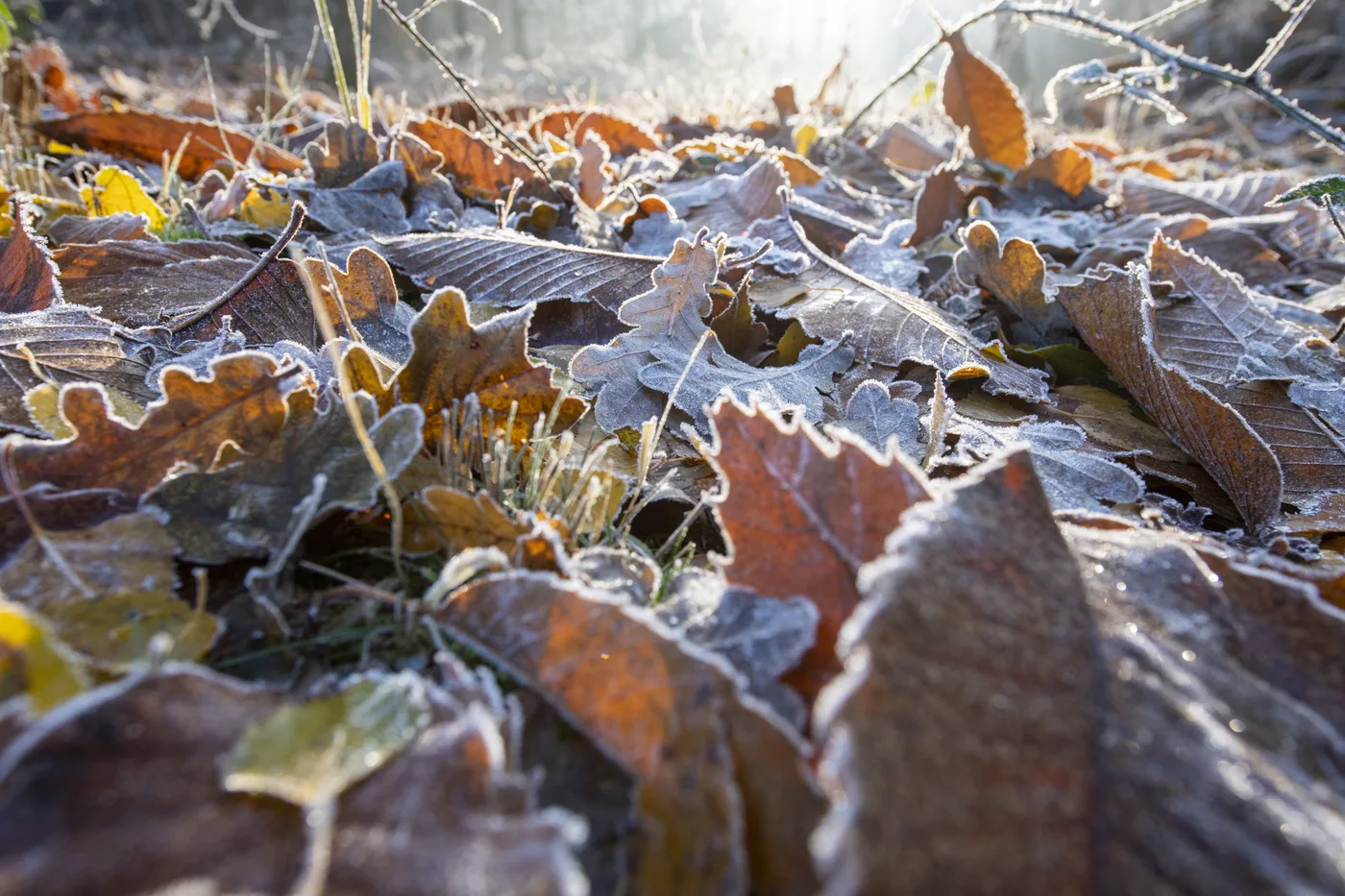
By the middle of October the sound of a Long Island Saturday is not geese overhead or a ballgame on a porch radio. It is the leaf blower, three yards over, pushing every scrap of what the trees spent a season making toward the curb. The bags line up, the truck comes, and the yard is pronounced clean. It is worth asking, just once, what exactly was removed, and for whom. Because the leaf layer you are paying to haul away is not litter in any sense but the legal one. It is the blanket a yard pulls over itself before sleep, and a surprising number of lives are counting on it staying put until spring.
Where the bare yard came from
Nobody decided, exactly, that a lawn in November should look like a lawn in June. The habit arrived with the postwar suburb, when the yard became the house's public face and tidiness became a neighborly duty. Leaves read as neglect, the way a full sink reads as neglect, and so the fall cleanup joined the calendar somewhere between the last mow and the first string of lights.
But a woodland, which is what most of this island was, has no cleanup. The oaks and maples drop their year's work exactly where it can do the most good, and the whole system below them depends on the delivery: the soil that drinks it, the roots it insulates, the small animals that winter inside it. A forest floor is not an unraked lawn. It is a working surface, and the work happens all winter, out of sight.
The bare yard, in other words, is not neutral. It is a choice to interrupt that cycle and then to buy back, in April, much of what was carted off in October: mulch by the bag, fertilizer by the spreader, compost by the cubic yard. There is a quiet comedy in paying twice for the same material, once to remove it and once to return.
Who is sleeping in the pile
The case for leaving leaves gets most vivid when you learn who uses them. The luna moth, that pale green visitor people photograph against their screen doors in June, spends the winter on the ground, wrapped in a cocoon spun into fallen leaves. Rake the leaves to the curb and the next June's moth goes with them. The woolly bear caterpillar, the one children stop for on the sidewalk in fall, is not going anywhere warm. It is looking for a leaf pile to freeze inside, which it survives, remarkably, and emerges from in spring.
Bumblebee queens pass the winter alone, each in a burrow hardly deeper than your thumb, and the leaf layer above is the insulation that keeps the frost from reaching her. Fireflies, whose summer displays Long Islanders keep saying are thinner than they remember, spend their long larval stage in moist leaf litter, eating and growing for a year or more before a single flash. In the wooded corners of a yard, red-backed salamanders shelter under the same cover, working the mild spells for whatever the litter holds. And when the towhees and white-throated sparrows come through, you can watch them do what they have always done: kick the litter backward, two-footed, for everything living underneath.
None of this is exotic. It is the ordinary population of a yard, and the fall cleanup is, for much of it, simply the end. A yard stripped to bare turf and bedded in dyed mulch can look immaculate and hold almost nobody.
What the soil does with a leaf
Underneath the wildlife story is a plainer one about soil. A fallen leaf is the tree's own fertilizer program: the minerals its roots pulled up all summer, returned to the surface to be broken down and drawn back in. Fungi start the work, earthworms continue it, and by midsummer the leaf is topsoil. Leave the layer on a garden bed and it holds moisture through dry spells, keeps the freeze from heaving shallow roots, and shades out the early flush of weeds. This is everything a bag of mulch promises, delivered free, in a texture the soil life actually recognizes.
The fear that leaves will ruin a lawn has a true version and a false one. The true version: a thick, wet mat of whole leaves, left for months on turf, can smother the grass under it. The false version: that any leaf anywhere on the lawn is a problem. A moderate scattering, run over with the mower so the pieces fall between the blades of grass, disappears into the turf and feeds it. Where the drifts are deep, the answer is not the curb. It is the flowerbed six feet away.
How to leave them without losing the yard
This is not an argument for surrendering the property. It is an argument for moving the leaves instead of removing them, and the practice is simple enough to finish in an afternoon.
Rake or blow the lawn's leaves onto the beds, under the shrubs, around the trees: a few inches deep, whole, not shredded. Shredding makes a tidier texture, but the shredder does not distinguish leaf from cocoon, so where you can stand the rougher look, the whole leaf is the better one. Let the hedgerow and the back fence line keep their drifts. If there is a corner of the yard nobody performs in, let it go entirely; one wild corner is worth more than a whole tidy acre.
Where lawn must stay lawn, mow the leaves in rather than bagging them. Leave the perennials standing while you are at it: the hollow stems overwinter their own tenants, and the seed heads feed the finches through the cold. The one honest exception is disease. Leaves from a tree you watched suffer fungal trouble all summer are better composted hot or removed, not tucked around the same plant's feet.
And because a yard is also a neighborhood document, keep the edges deliberate. A crisp line where the bed meets the lawn, a swept walk, a mowed strip along the sidewalk: these say, louder than any sign, that the leaves are where they are on purpose. Most objections to a natural yard are really objections to ambiguity. Remove the ambiguity and the leaves stop reading as laziness and start reading as what they are, which is husbandry.
The patience part
The practice has a second half, and it comes in spring, when the cleanup itch returns with the first warm Saturday. Everything that wintered in the layer is still in it through those first bright weeks, waiting on steadier warmth to emerge. The March impulse to strip the beds undoes the whole winter's shelter at the last hour. Wait until the days are reliably warm and the yard is visibly awake, then thin the layer gently where seedlings need the light, leaving what has already begun to vanish into the soil.
There is a larger instruction folded into this one small practice, and it may be the real reason to take it up. Most of what we do to our yards is effort spent making nature look unlike itself. Leaving the leaves is the opposite kind of act: a decision to do less, made with more knowledge, on behalf of lives that cannot petition you. The yard will not look like June in November. It will look like November, which has its own browns and its own stillness, and under that stillness, all winter long, it will be quietly full.



Loading comments…