
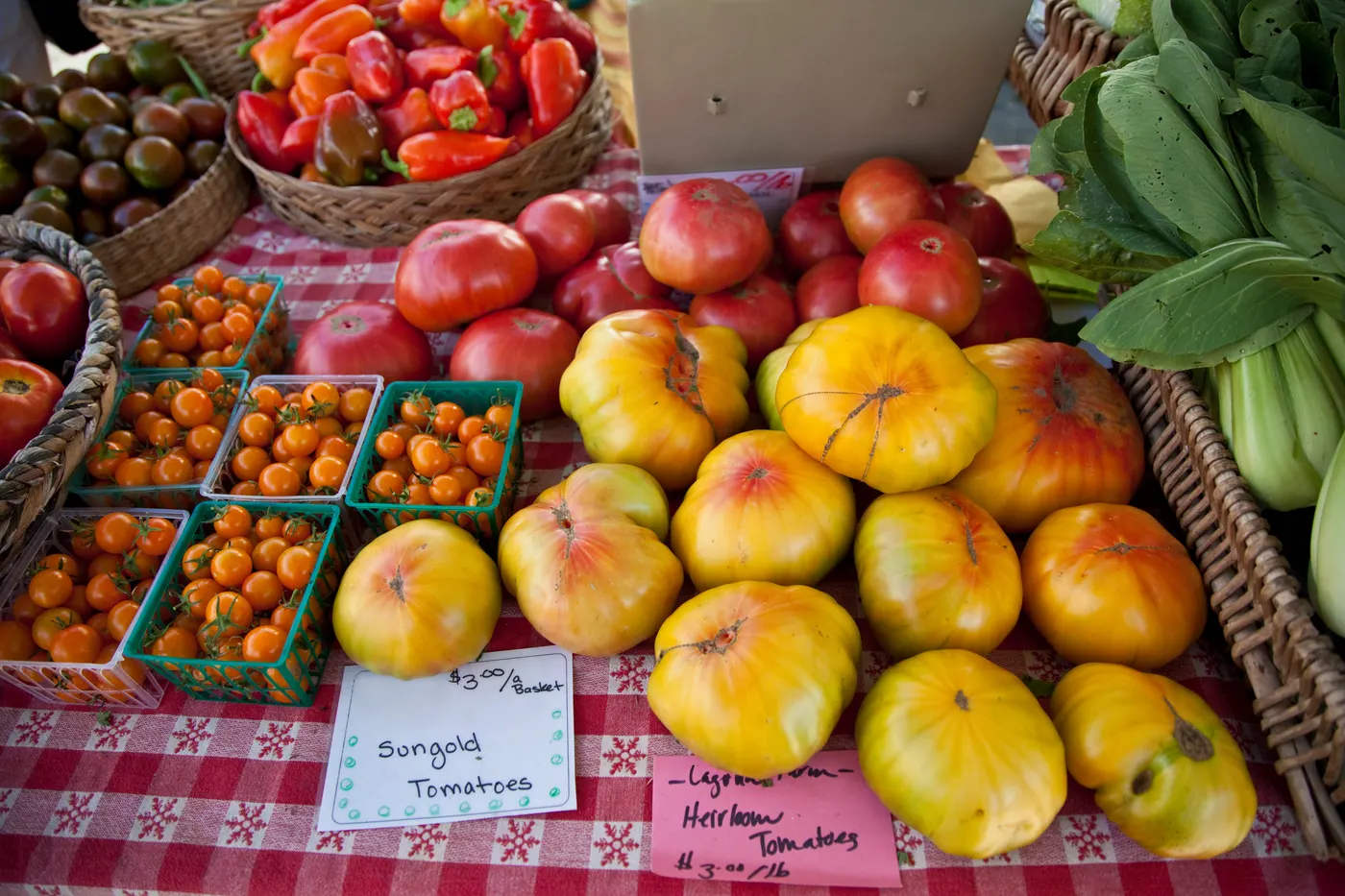
There is a stretch of weeks, somewhere between the last of July and the middle of September, when Long Island produces more food than it can reasonably move. Corn arrives faster than it can be eaten. Tomatoes reach the point where they cannot be shipped anywhere because they will not survive the trip. Peaches sit in flats at the roadside with the smell doing most of the selling. This is the easiest time of year to eat well here, and the easiest to let pass unnoticed.
An Agricultural Island
It surprises people who know Long Island only as suburbs and parkways, but this is serious farm country and has been for centuries. Suffolk County has long ranked among New York State's leading counties by the market value of what it grows, and the East End in particular remains a working agricultural landscape rather than a decorative one. The soil is the reason. Glacial outwash left behind a sandy, well-drained loam that suits potatoes, sweet corn and vine crops, and the surrounding water moderates the temperature at both ends of the season.
What this means practically is that a great deal of what appears at a farm stand in August was in the ground that morning, a few miles from where you are standing. That is not a marketing claim. It is a logistical fact about a crop that does not travel.
What the Season Is Actually Offering
Late summer on Long Island is dominated by a handful of things at their absolute best.
Sweet corn is the local religion, and the argument about which farm grows the best of it has been running for decades without resolution. The relevant point for a cook is that its sugars begin converting to starch from the moment it is picked, which is the entire reason a roadside ear in August tastes like a different vegetable than a supermarket ear in February.
Tomatoes arrive in real volume from roughly August into October, and the varieties worth seeking out are the ones with no commercial future: the ones that split, that ripen unevenly, that will be soft by Thursday.
Peaches run from mid-July through early September, and the good ones are picked ripe rather than firm, which is why they cannot be stacked more than two deep.
Eggplant, peppers, summer squash and beans all hit their stride now, along with basil, which is at its most fragrant just before it goes to flower.
Then, near the end of August, the first apples appear at the same stands, which is the season quietly telling you what comes next.
Cooking With the Season Rather Than Against It
Eating seasonally sounds like a discipline and is really the opposite. It is mostly a matter of doing less.
Food at its peak wants very little from a cook. A tomato picked that morning needs salt and possibly olive oil, and any further ambition tends to be a subtraction. Corn wants a few minutes in water and some butter. The whole logic reverses in February, when the vegetables are travel-hardened and a cook has to work to make them interesting. In August, restraint is the technique.
It also asks you to plan differently. Seasonal shopping means arriving without a fixed list and letting the stand decide, which is a small but genuine reversal of how most of us have learned to shop. You buy what looks best and figure out dinner on the way home. People who cook this way tend to describe it as more relaxing rather than less, though it takes a few weeks to trust it.
What Is Worth Preserving
Since the glut is the whole point, some of it should be pushed forward into the winter. None of this requires equipment.
Corn can be cut off the cob raw and frozen flat in bags, and it will be better in January than anything you can buy. Tomatoes can be halved, roasted slowly with oil and salt until they collapse, and frozen in small containers. Peppers roast and freeze well. Basil does not dry into anything worth having, but blended with oil and frozen in an ice cube tray it holds most of what makes it good. Peaches freeze in slices with a little lemon.
An hour of this on a Sunday in late August is a genuinely disproportionate gift to yourself in the middle of winter.
The Part That Is Not About Food
There is a quieter argument for shopping this way, and it has less to do with nutrition than with attention.
A supermarket is designed so that the season is invisible. Everything is available, always, at a consistent and unremarkable quality, which is a genuine achievement and also a kind of sensory flattening. You can live an entire year in it without ever noticing what month it is.
A farm stand cannot hide the calendar. It sells what exists right now, which means it will disappoint you in April and overwhelm you in August, and in doing so it keeps you in some relationship with where you actually live. Buying corn from the person who grew it is not a moral achievement. But it does place you, for a few minutes, in the middle of a season rather than above it.
The stands are open now, and they will not be for long. That is rather the point of them.



Loading comments…