
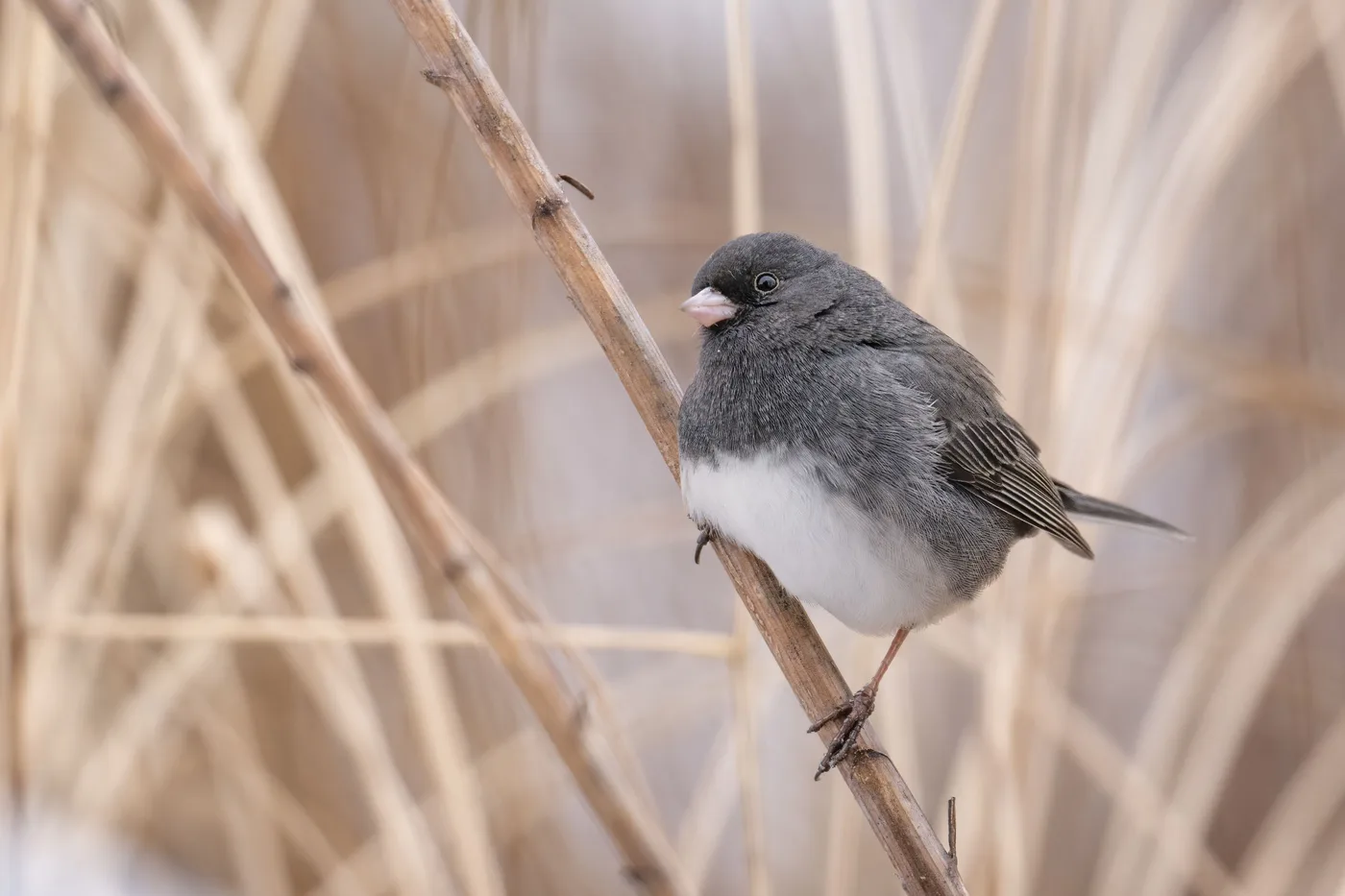
They come in low, a small flock of gray birds dropping out of the hedge onto the frozen lawn, hopping and pecking at whatever the wind has left there. When something startles them, they flush all at once, and for a split second each tail flashes two bright white edges before they vanish back into the shrubs. If you have seen this on a cold morning on Long Island, you have met the dark-eyed junco, the bird many people grew up calling the snowbird. They are not here in summer. They arrive with the cold, and they are one of the quiet gifts of the season.
The bird named for winter
The junco's scientific name, Junco hyemalis, comes from a Latin word for winter, and the common name snowbird says the same thing in plainer terms. For generations, people across the eastern half of the country noticed that these birds showed up in their yards around the time the weather turned, and left again as spring arrived. The bird and the season became the same thing.
In summer, juncos nest in the cool coniferous and mixed forests of Canada and the northern states, and farther south along the high ridges of the Appalachians. Around October they begin moving south, and by late autumn they are settled into wintering grounds across much of the country, including every corner of Long Island. Most will stay until about April, then head north again to breed.
Juncos are among the most numerous birds in North America, which is part of their charm. You do not need a refuge, a spotting scope or a dawn alarm to see one. You need a yard with a few shrubs, a park edge or a hedge along a parking lot, and the habit of looking down.
How to know one
The form you will see here is the slate-colored junco: dark gray on the head, back and chest, with a clean white belly, as if the bird had been dipped in ink from the top and pulled out before it reached the bottom. Females and young birds are often browner and softer in tone than adult males. The bill is short, conical and pale pink, built for cracking seeds, and stands out against the gray face.
The surest sign is the tail. Juncos have white outer tail feathers that are almost hidden when the bird is on the ground and suddenly obvious when it flies. That flash of white edges, low and quick, is often the first thing you see.
Listen, too. Juncos keep in touch with a sharp, dry ticking note, and on milder days in late winter you may hear a male trying out a musical trill from a branch, a sound some people mistake for a chipping sparrow or even an insect. Once you know the tick, you will start hearing juncos before you see them.
A life lived at ground level
Juncos are ground birds in winter. They forage under hedges, along the edges of lawns and among fallen leaves, picking up the seeds of grasses and weeds that most of us never notice. You will often see them hopping rather than walking, and kicking back at the leaf litter to uncover what lies beneath.
They travel in loose winter flocks, sometimes alongside sparrows, chickadees and titmice, and within a flock there is a working pecking order. Older, more dominant birds take the best feeding spots, and you can sometimes watch the small displays that settle disputes, a quick flare of the white tail, a short chase. Studies have also found that many juncos return to the same wintering area year after year, so the birds under your hedge this winter may be the same individuals that were there last year.
There is one more quirk. Researchers have found that female juncos, on average, migrate farther south than males, and that the birds wintering farthest north are disproportionately adult males. One explanation is that males benefit from staying close to the breeding grounds so they can claim territory early in spring. Whatever the reason, it means a winter flock is not a random sample of the species. It is a particular community that has made a choice about where to spend the hard months.
What a yard can offer
If you want to see more of them, the best thing you can do is make the ground hospitable. A few simple habits help, and none of them require much.
Feed low. Juncos prefer to eat on or near the ground. A little white millet or a mixed seed scattered on a flat tray, a cleared patch of ground or a low platform suits them better than a tall hanging feeder. Many will also pick up what other birds drop below a feeder.
Leave some mess. Seed heads on last summer's flowers, a corner of fallen leaves and a stretch of unmown grass at the edge of the yard all hold food and shelter for winter birds. A tidy yard in November is often an empty one.
Give them cover. A brush pile, a dense evergreen shrub or a hedge near the feeding area gives juncos somewhere to dart when a hawk passes over. Birds will feed more confidently when safety is a short hop away.
Keep it clean and safe. Rake out old, wet seed so it does not spoil, wash trays now and then, and keep cats indoors. Ground-feeding birds are especially exposed to both disease and predators, so these small chores matter more for them than for birds that eat from a perch.
Offer water. In a cold snap, open water is often harder to find than food. A shallow dish kept clear of ice, refreshed each morning, can draw birds you would never see otherwise.
Watching the season arrive
Part of what makes juncos worth knowing is not the bird itself but what it marks. Their arrival is one of the clearest natural signals that the year has turned. You can feel the shift in the air and see it in the bare branches, but there is something especially satisfying about watching it hop across the lawn.
If you keep a simple record, a date in a notebook or on the calendar when you see your first junco each autumn and your last one each spring, you will have, in a few years, your own small almanac of the season. Many birders do exactly this, and the habit has a way of tying you more closely to the place you live.
The next cold morning, look low along the hedge before you look up at the sky. Watch for gray backs and white bellies moving through the leaves, and wait for the flash of white as they lift. Winter has its own residents. Some of them came a long way to be here, and they will stay with you until spring.

Loading comments…