
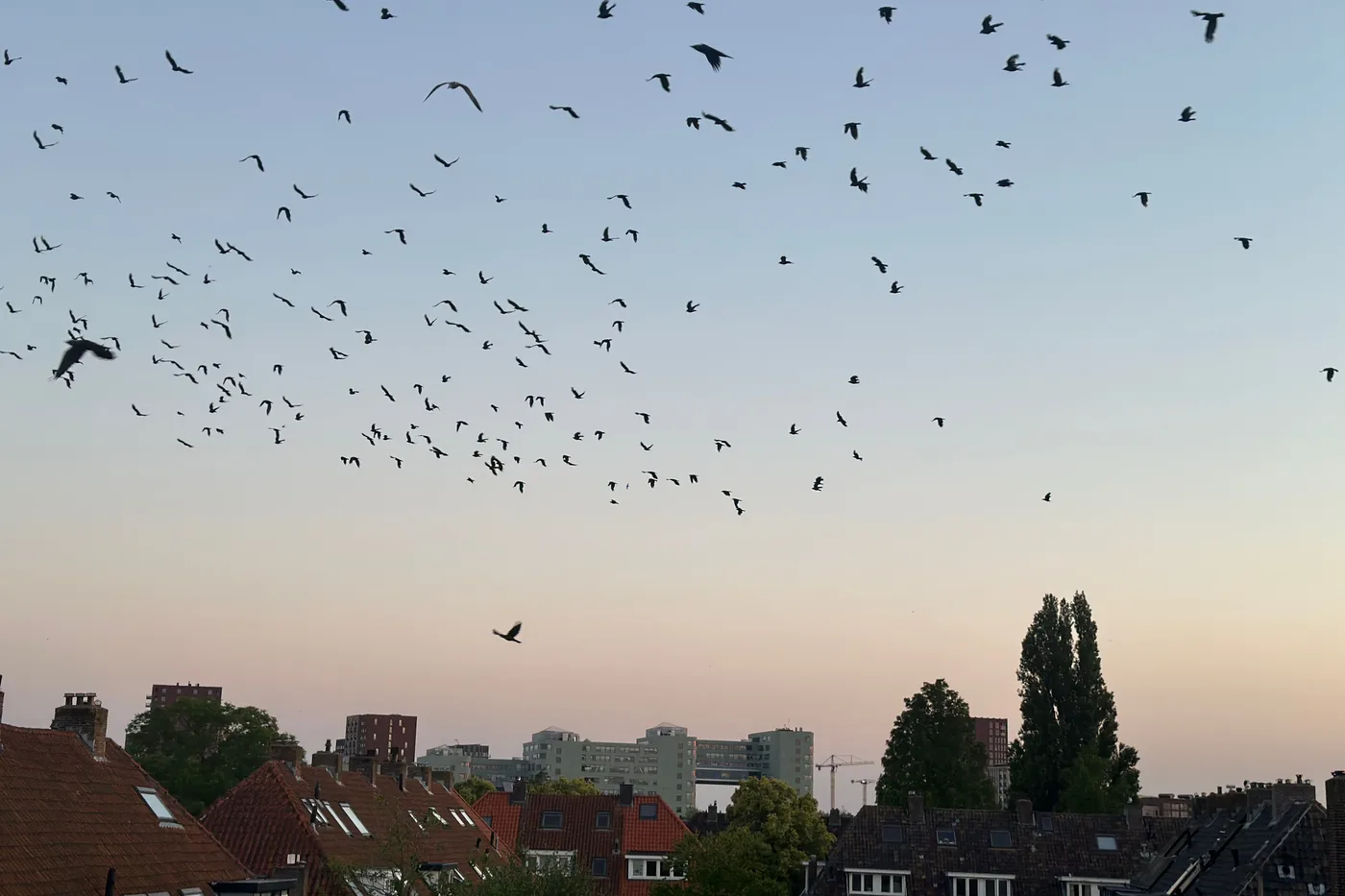
Some afternoon this month, around four o'clock, look up. If you are anywhere near open sky, you may see crows, not one or two, but a loose, steady stream of them, all flying the same way, low and unhurried, as if they had somewhere to be. They do. They are going to the place they will spend the night with hundreds or thousands of others, and they have been making the same trip at the same hour since the leaves came down.
The other half of a crow's year
For most of the warm months, crows live as families. A breeding pair holds a territory, a stretch of neighborhood or farmland or park, and raises its young there. Crows are unusual among birds in that the young often stay on with their parents for a year or more and help raise the next brood, so a crow family can be several generations moving around together. If you have watched the same few crows patrol your street all summer, you were probably watching one household.
When fall comes, something changes. The families keep much of their daytime life, foraging through the same yards and fields. But as evening approaches, they leave. They join a larger movement of crows from miles around, all heading toward a communal roost, and they will make that journey every evening until late winter, when the roosts break up and the pairs go back to their territories to nest.
Some roosts hold a few hundred birds. Others hold many thousands. The largest winter roosts in North America have been counted in the tens of thousands, a single gathering of crows drawn from a wide circle of countryside.
How the evening unfolds
The flight in has a pattern you can learn to read. In mid-afternoon, crows begin to drift in the direction of the roost, often following the same lines across the sky day after day, along rivers, highways or the edge of a shoreline. Watch from the same spot two days running and you will likely see them pass over in the same place.
They do not go straight in. First they gather at staging areas near the roost, a stand of tall trees, a playing field, the roofs of an office park, where they settle, call, squabble, take off and land again. The noise at a staging area can be remarkable, a long rolling chorus that carries for blocks. If you have ever wondered why a particular stretch of trees fills with crows every winter evening, you may be standing near one.
Then, as the light goes, they move into the roost itself, often in a rush, and the sound slowly settles. By full dark they are quiet. At first light they leave again, streaming outward in every direction, back to the families' daytime ground, and the cycle begins over.
Why gather at all
Nobody is completely certain why crows roost together in winter, and the likely answer is that several reasons work at once. Numbers offer safety: the crow's main nighttime predator is the great horned owl, and a thousand wary birds are harder to surprise than one. Shared roosts may also be places where information passes, where birds that ate poorly follow birds that ate well to the next day's food. And winter nights are long and cold, and a sheltered spot shared with many others is a warmer place to wait them out.
In recent decades, many roosts have moved into towns: parking lots, hospital grounds, shopping centers, corporate campuses. Researchers have suggested reasons for that too. Built-up areas are a few degrees warmer at night. Their lights may make it easier to spot an approaching owl. And there are fewer owls in town to begin with. Whatever the mix, many people now live within sight of a winter roost without ever knowing it is there.
What to look for on Long Island
Long Island has two kinds of crow, and in winter you may see both. The American crow is the larger, with the familiar flat, carrying caw. The fish crow is a little smaller, more often near water, and its call is different: a short, nasal sound, like a two-note complaint. Fish crows also gather in winter, and the two species sometimes share a roost. If the evening stream overhead sounds oddly nasal, you are hearing fish crows.
The flights are easiest to catch in the hour before sunset, which in the middle of November arrives a little before half past four. A clear afternoon is best, but crows fly in gray weather too, and a stream of dark birds against a low, pale sky is its own kind of beautiful.
A week of watching
You do not need binoculars or a field guide to do this. You need fifteen minutes in the late afternoon and a little patience.
Pick a spot with a wide view of the sky, a park, a beach parking lot, the end of your street. Go out about forty-five minutes before sunset and simply look up.
Note the direction. When the crows come, which way are they heading? Write it down, or just remember. Come back the next day and see if they follow the same line.
Count for one minute. Pick a minute and count the crows that pass. Ten is a trickle. A hundred tells you a large roost lies somewhere ahead of them.
Follow, if you are curious. On another day, drive or walk a little way in the direction they fly and watch where they begin to drop and gather. You may find the staging area, and from there, perhaps, the roost. Keep a respectful distance. A roost is where the birds rest, and crows are well known for recognizing individual human faces and remembering the ones that bothered them.
Then listen. At the staging area, stand still for a few minutes as the light fades. Let the noise rise and then fall. It is one of the great everyday spectacles of a northern winter, and it happens in parking lots.
The long way home
There is something steadying about the crows' evening trip once you have noticed it. Every afternoon all winter, without fail, they set down whatever they were doing and travel together to the place where they will be safe for the night. They do it in the cold and the rain, in every kind of weather, and they come back out together in the morning.
It is worth thinking about how you end your own days in this dark season. What is your version of the roost, the place, the people or the ritual that you return to as the light goes? This week, when you see the crows going over, let it be a small signal: the day is turning, and it is time to head home.

Loading comments…