
Some Septembers you notice it underfoot before you notice it overhead: the sidewalk has developed a gravel of acorns, the driveway pops under the tires, and a hard rain of them on the shed roof punctuates the afternoon. Other Septembers, under the same trees, almost nothing. It would be easy to assume the difference is a good year or a bad one, rain or drought, the tree having a strong season the way a garden does. But the oaks are not merely having a year. Across your neighborhood, and often across half the region, they are acting together, on a rhythm ecologists call masting, and the crunch under your shoes is one of the more remarkable coordinated events in the natural world.
The Boom and the Bust
Mast is an old word for the fallen harvest of the forest floor, the acorns and beechnuts that once fattened pigs turned loose among the trees. A mast year is a season when the trees produce that harvest in staggering surplus: a single large oak can drop thousands upon thousands of acorns, and a wooded street can carpet itself in a week. The startling part is not the abundance but the pattern. Oaks do not produce this way annually. A heavy year is followed by several lean ones, sometimes almost empty ones, and then the forest swings back to surplus, and the swing is synchronized. The oaks on your block, the oaks two towns over, and oaks across a wide stretch of the Northeast will often boom in the same autumn and rest in the same autumns between.
That synchrony is the puzzle. A tree that simply made as many acorns as each summer's resources allowed would drift along near some average, and every tree would follow its own private weather. Instead the whole population saves and splurges together, as if the forest kept a common calendar. Stand under an oak in a heavy September and you are looking at the visible edge of a decision made, in some sense, by thousands of trees at once.
The Case for Feast and Famine
Why would a tree evolve to skip reproduction for years at a stretch? The leading explanation is elegant, and it turns on the animals doing the eating. An acorn is a package of food, and the woods are full of parties interested in it: squirrels, chipmunks, mice, deer, turkeys, blue jays, weevils. If the oaks produced a steady, predictable crop, those populations would settle at a size that consumes essentially all of it, every year, and almost no acorn would ever get to be a tree.
The boom-and-bust rhythm defeats this arithmetic. The lean years starve the seed-eaters down to modest numbers. Then the mast year arrives and buries them in more food than their reduced ranks can possibly eat, and in the surplus, some fraction of acorns lies untouched long enough to sprout. Ecologists call the strategy predator satiation, which is a technical way of saying the trees win by flooding the market. It only works if everyone floods at once, which is precisely why a lone generous oak in a lean year would be wasting its effort: its whole crop would be eaten. The synchrony is not a curiosity on top of the strategy. It is the strategy.
How a Forest Agrees
Trees have no way to confer, so the agreement needs a mechanism, and researchers have assembled most of the picture. Part of it is shared weather: oaks over a wide region experience the same warm spring or late frost, and the state of the season, especially around the time of flowering, helps set the size of the crop, so the same sky nudges thousands of trees in the same direction. Part of it is pollination itself. Oaks are wind-pollinated, and a spring in which the whole population flowers heavily is a spring in which pollen is everywhere and nearly every flower is fertilized, which amplifies a good start into a great crop; a sparse flowering year fizzles for everyone at once. And underneath both runs the ledger: acorns are expensive, and a tree that has just spent lavishly needs seasons to rebuild its reserves, which keeps the rhythm swinging rather than settling. Weather as the metronome, pollen as the amplifier, starch as the governor. No intention anywhere, and yet the forest behaves as one organism.
The details are still being argued over, as good details are, and masting keeps some of its secrets. But it is worth pausing on what the explanation already implies: the acorns on your driveway were set in motion months ago, by a spring you have half forgotten, operating on trees you have never seen.
The Ripple
A mast year does not end when the acorns land. It moves through the food web for years, and ecologists working in northeastern oak forests have traced the wave with some care. The winter after a big crop, squirrels and chipmunks and white-footed mice go into the cold fat and numerous, and the following summer the woods are loud with their offspring. The animals that eat them, the hawks and owls and foxes, prosper a season behind. The wave has a darker crest too: in this region, more mice has been observed to mean more of the ticks they host and infect, a couple of summers downstream of the acorns, which is a sobering thought to have while standing on a crunching sidewalk. An acorn autumn is not just a mess on the patio. It is next year's woods being decided now.
And some of the ripple is planting. Blue jays and squirrels cache acorns by the thousands, buried singly, and every forgotten cache is an oak given a start its parent could never provide by simply dropping seed in its own shade. The oak's flood does not merely overwhelm its predators. It recruits the most industrious of them as gardeners.
Reading Your Own Trees
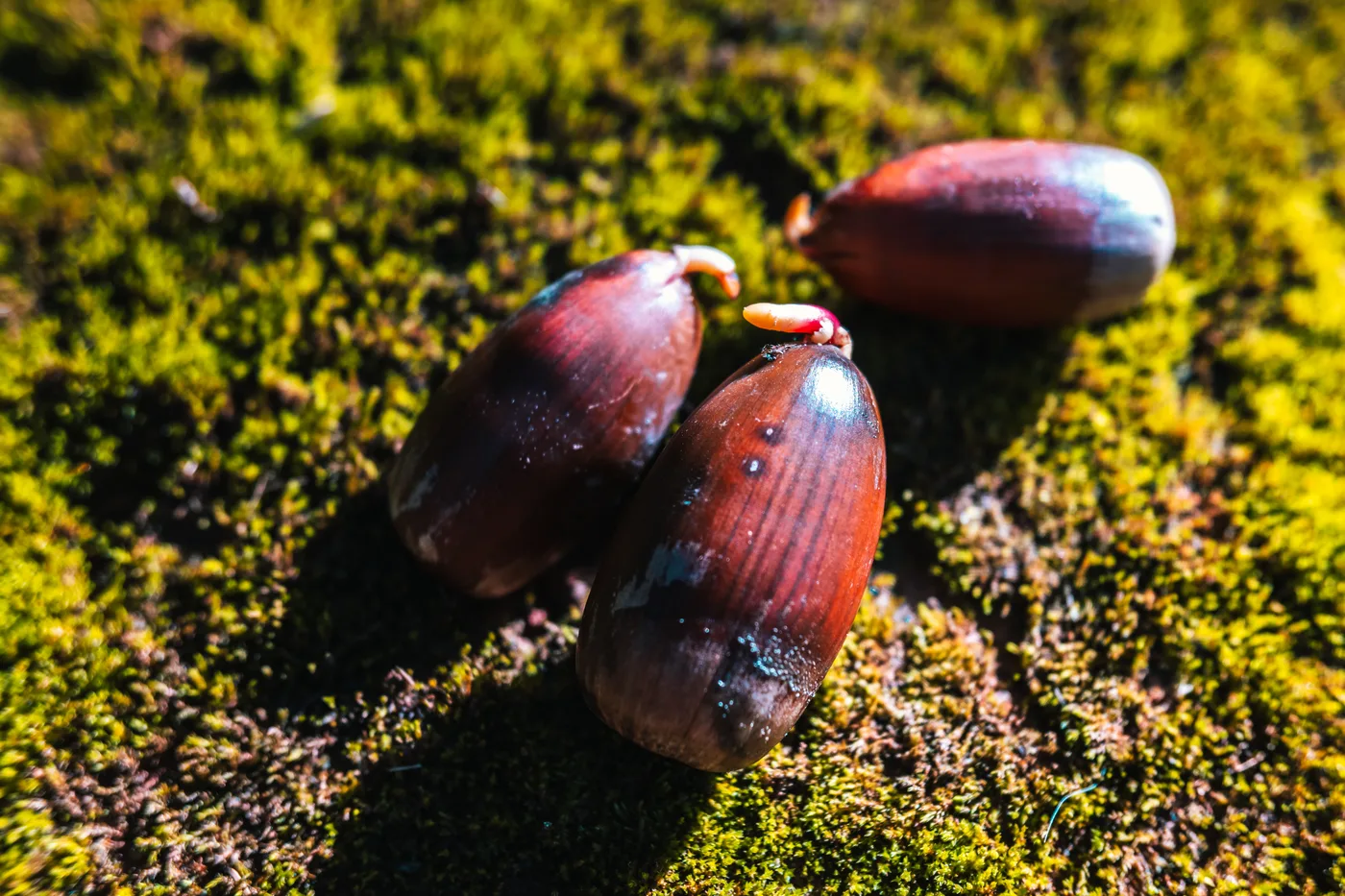
All of this is on display to anyone with an oak on the block, and Long Island, whose woods run heavily to oak from the Queens line to the pine barrens, is a fine gallery for it. A few things to look for, this month and after. Notice whether your neighborhood is loud or quiet underfoot this year, and start keeping the crude tally; a run of quiet Septembers is not decline, it is the saving between splurges. Look at who shows up: a heavy year draws deer to the fence line and keeps the squirrels too busy to bicker. And look closely at the acorns themselves. The oaks split into two great families, and you can read the difference in your hand: the white oak group, with rounded leaf lobes, makes acorns that sprout almost as soon as they land, sometimes with the root already emerging in November; the red oak group, with bristle-tipped lobes, makes acorns that wait out the winter before growing, and each of those acorns took two seasons on the branch to mature. The acorn you pick up under a red oak this fall was begun in the spring of last year.
Which is, perhaps, the thing to carry back inside. The tree by the driveway is not scenery having weather. It is an economy, running on a ledger years deep, coordinating with a forest you cannot see from your yard, feeding a cast of thousands, and hiring its own planters. In a heavy year, take one acorn from the sidewalk and hold it a moment before you sweep the rest. Every oak on the street was once exactly this, plus a squirrel's forgetfulness, plus time.

Loading comments…