
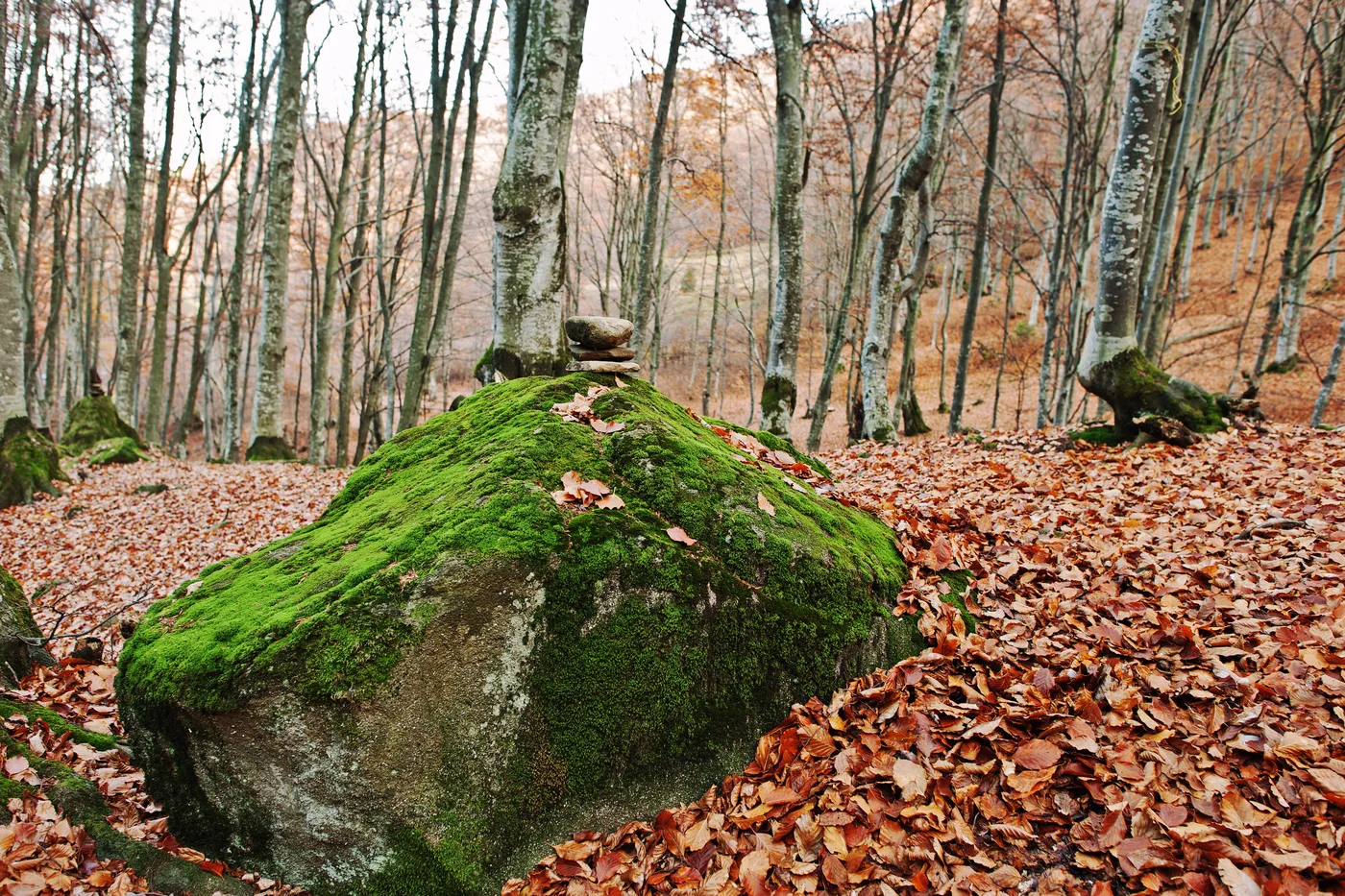
Somewhere in the woods near you, there is a boulder that has no business being there. It sits among oaks on ground that is otherwise sand and pebbles, a rock the size of a car or a garden shed, mossed over, half sunk, older than everything around it. No river could have carried it. No one hauled it there. If you have ever stopped beside one and wondered, the answer is the same answer that explains the hill your street climbs, the pond that has no stream feeding it, and the flat miles running south to the beaches: ice brought it, and Long Island is what the ice left behind.
An island made of leavings
Most places stand on their own bedrock, the deep bones of the continent showing through. Long Island, almost uniquely, does not. Nearly everything underfoot here, from Brooklyn to Montauk, is loose material: sand, gravel, clay and stones, carried from somewhere else and set down in a geological instant. The carrier was a continental ice sheet, the great Laurentide ice that covered the northern half of the continent during the last ice age, flowing slowly south over what is now New England, grinding bedrock as it came and dragging the rubble with it.
An ice sheet works like a conveyor that melts at its far end. The front edge sat roughly where Long Island now is, and while it stood there, everything the ice had picked up across hundreds of miles came off the end of the belt. Where the front held steady the longest, the rubble piled into long ridges called moraines. Long Island has two running down its length like a wishbone: one forms the island's hilly middle spine and continues out to become the South Fork and the bluffs of Montauk, and a second, from a later stand of the ice, runs along the North Shore and out to Orient Point. The high ground where towns put their water towers, the ridge your legs notice on a bicycle, the overlooks of the North Shore: that is not land that rose. It is cargo that was dropped.
Everything south of the spine tells the other half of the story. Meltwater pouring off the ice front carried the finer material away, fanning it out in broad, gentle sheets of sand. That outwash plain is the flat South Shore, the farm country that became suburbs precisely because it was so easy to build on, running level all the way to the bays. And the sand kept going: the barrier beaches, the dunes of Fire Island and Jones Beach, are that same glacial sand, reworked and still being reworked by the ocean every winter. The beach you walked in August is the ice age, ground fine and handed back by the waves.
Reading the ground
Once you have the pattern, the island becomes legible, and the legibility is the pleasure. The boulders first: geologists call them glacial erratics, rocks rafted in from the bedrock country to the north and stranded when the ice melted out from under them. Some are famous enough to have names, like Shelter Rock on the North Shore, one of the largest on the island, a piece of New England that has been sitting in Manhasset for longer than there have been people here to wonder at it. Most are anonymous, holding up a corner of the woods off a trail in a county park. Every one is an immigrant, and the gray gneiss or granite it is made of matches cliffs a hundred miles away, not anything below it.
The ponds next. Here and there the retreating ice left huge stranded blocks buried in the outwash. When a block finally melted, centuries later, the ground above it slumped into a bowl. Those bowls are kettle holes, and where they reach the water table they hold kettle ponds: round, often streamless, inexplicably deep for their size. Lake Ronkonkoma, the island's largest freshwater lake, is the textbook example, a hole where a mountain of buried ice quietly ceased to exist. The next small, round, spring-fed pond you pass, look for the stream feeding it. If there is none, you may be looking at the grave of an ice block.
Even the shoreline keeps the ledger. The North Shore's bluffs, dropping to stony beaches, are the moraine being taken apart by the Sound, every winter storm sorting out another season's pebbles from the old glacial till. The necks and harbors, the deep bays like Port Jefferson and Huntington, follow the lumpy, unfinished topography the ice left. South Shore sand is fine and pale; North Shore beaches are cobbled with stones in a dozen colors, because one coast is sorted outwash and the other is raw moraine. Two beaches, an hour apart, made by two different parts of the same machine.
The walk this earns
All of this is checkable on foot, this week, without equipment. Pick any walk you already take and read it once as glacier country. Notice whether the ground under you is spine or plain: if the road rolls and the yards are studded with boulders, you are on the moraine; if it runs flat and the soil is sand two inches down, you are on the outwash. Find the nearest erratic, in the woods or sitting in someone's front yard too large to have ever been moved, and put a hand on it. It is likely the oldest thing you will touch all year, bedrock from another state, delivered by a wall of ice that stood where you are standing.
There is a reason this is worth an hour of an ordinary week, beyond the trivia. Places feel different when they have a story, and Long Island's story is usually told as if it began with farms and ended with parkways. The longer story is stranger and more settling: the entire island is a recent arrival, a ridge of borrowed ground barely older than human memory of it, still being rearranged by every nor'easter. The ocean is slowly moving the barrier islands. The bluffs give up a little more moraine each winter. The ground is not finished.
Seen at that scale, the island stops being a backdrop and becomes a process you are briefly inside. The hill, the boulder, the round pond, the two kinds of beach: they stop being scenery and become sentences in a story you can now read, written in a single long winter tens of thousands of years ago and never quite concluded. You live on the period at the end of an ice age. It is a good thing to know about a place, that it was delivered, and that the delivery is still settling.


Loading comments…