
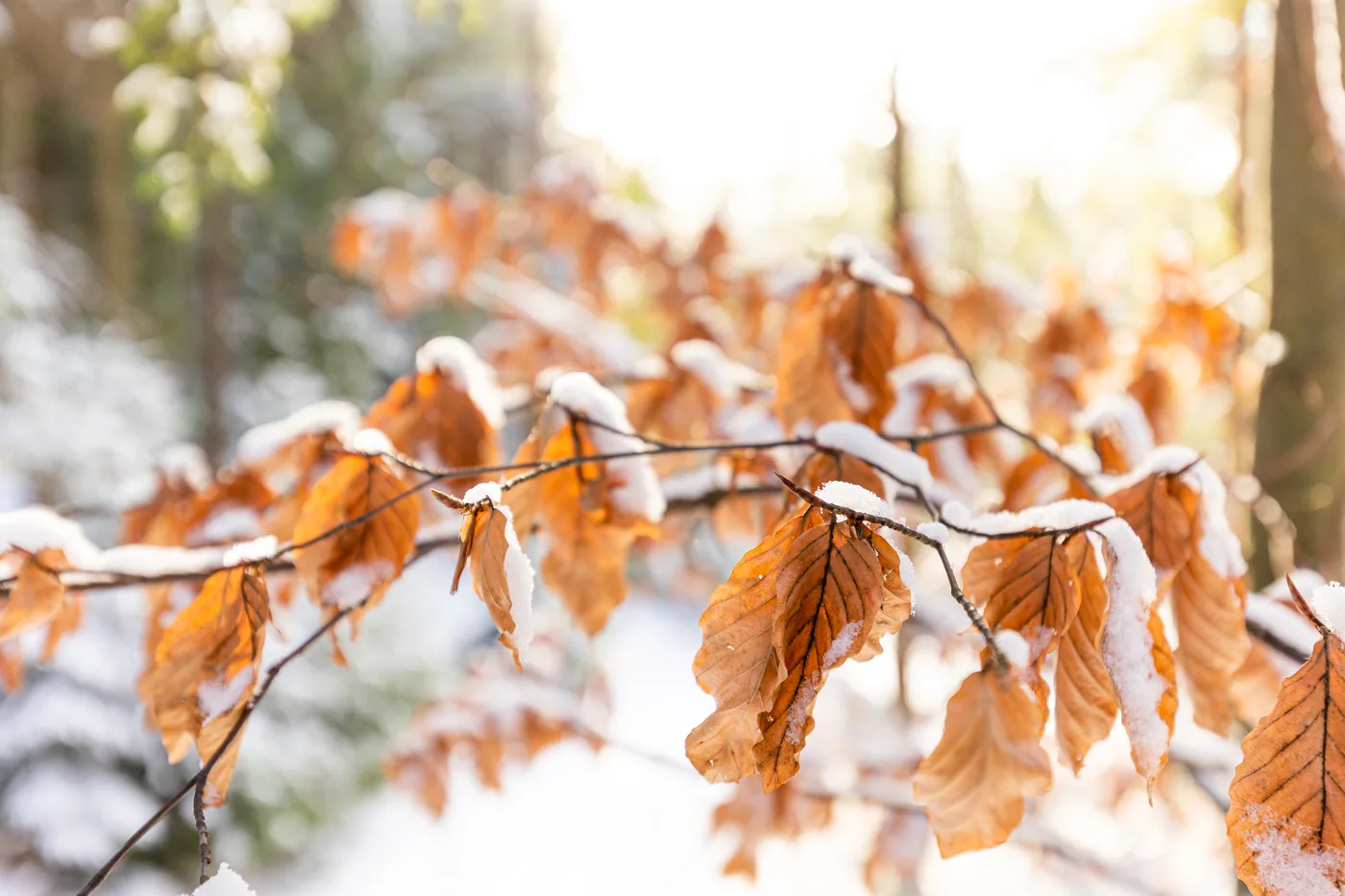
By the middle of winter the woods have gone gray and bare, the floor packed with brown leaves and the canopy open to the sky. Then you notice a small tree near the path still dressed in pale copper, its leaves dry as paper and rattling in the wind. Everything around it has let go. This one has not, and it will hold on until spring. It is not sick and it did not miss the season. It is doing something deliberate, and it has a name.
A word for holding on
Botanists call it marcescence, from a Latin word for withering. A marcescent tree is one that keeps its dead leaves through the winter instead of dropping them in autumn. The leaves turn brown, dry out completely and stop doing any work for the tree, but they stay attached, sometimes until the new buds push them off in April or May.
Once you know to look for it, you see it everywhere. In the Northeast the two great holders-on are the American beech and the oaks. Young beeches are the most striking: their leaves bleach in the cold to a light tan, almost parchment, and catch the low winter sun so that a whole understory seems to glow. Oaks hold theirs in darker shades of russet and leather brown, and the sound they make in a winter wind, a dry hiss across a hillside, is one of the signature sounds of a Long Island woodland in January. Hornbeam and witch hazel often do it too.
Look closely and you will notice a pattern. It is the young trees that hold on most, and on older trees it is usually the lower branches. The tops of mature oaks and beeches are often bare while the bottom of the crown is still fully leaved. That clue matters, and it points toward why the habit might exist.
How a tree lets go, or does not
For most deciduous trees, dropping leaves is an active process. As the days shorten in autumn, the tree builds a thin layer of specialized cells where each leaf stalk meets the twig. This abscission layer works like a perforated line: it seals off the leaf's plumbing and weakens the joint until wind or rain snaps the leaf free, leaving a neat scar behind.
In marcescent trees that layer does not fully finish its work in the fall. The leaf dies and dries but stays fastened, held by a joint that was never completely cut. Over the winter wind, snow and ice wear at it, and many leaves come down a few at a time. The rest hang on until spring, when the swelling buds and the first growth of the season finally push them away.
Why bother
Here is the honest part: nobody is entirely sure. Marcescence has been studied for a long time and there is still no single settled explanation. There are several good ideas, and it may be that more than one is true.
The first is protection. Deer and other browsers love the tender buds of young trees in winter, when there is little else to eat. Dry, papery leaves wrapped around a twig are unappetizing and may make a browsing animal move on. That would explain why the habit is strongest on young trees and low branches, exactly the parts within reach of a deer.
The second is timing. A leaf that falls in autumn starts breaking down in the cold and loses some of its nutrients to winter rain. A leaf that falls in spring lands just as the tree's roots are waking and hungry, giving the soil a fresh layer of material at the right moment. On poor, sandy soil, the kind much of Long Island sits on, that small advantage could count for something.
The third involves snow and water. Leaves held on branches catch snow that would otherwise blow away, and when it melts it drips onto the ground right at the base of the tree. Others suggest the dry leaves shield buds from drying winter winds. All are plausible. None has been proven to be the whole story, which is a good reminder that the woods still hold questions nobody has answered.
A walk to take this winter
You do not need a forest preserve for this. Any patch of mixed woods, a park edge, or even a suburban street with a few old oaks will do.
Go on a gray day. Marcescent leaves are easiest to spot when everything else is bare, and they glow in flat winter light. Late afternoon, when the sun comes in low, is the most beautiful time.
Look low first. Scan the understory and the bottom branches of big trees. That band between your knees and a little above your head is where the held leaves concentrate.
Learn the beech. It is the easiest to identify in winter: smooth, pale gray bark like an elephant's leg, and long, slender, sharply pointed buds that look like tiny cigars. Once you know the bark you will find beeches you have passed for years. In summer, if you see beech leaves with dark stripes between the veins, that is a sign of beech leaf disease, which has been spreading through the region; local forestry and extension services track it and are glad to hear of new sightings.
Listen. Stand still in the wind near a stand of young oaks or beeches and close your eyes. The sound of held leaves is distinct from anything else in winter woods, a papery chatter that is absent in every other season.
Come back in spring. Find the same tree in late April and watch the old leaves give way as the new ones open. The handoff takes only days. Seeing it once makes the whole winter make sense.
What the holding teaches
It is tempting to read the woods as a lesson in letting go, and autumn is often written about that way. Release what you no longer need. Drop what is dead. There is truth in it.
The marcescent tree offers a gentler and more interesting idea. Some things are not ready to fall when everything around them is falling, and that is not failure. The beech is not clinging out of fear. It is holding something that still has a job to do, a bit of shelter for the buds, a delivery timed for spring, and it lets go when the new growth is ready to take its place.
You may be carrying something like that yourself: a habit, a role, an old way of doing things that everyone around you seems to have shed. Sometimes the right moment to let it go is not the season's moment, but your own. Watch the young beech this winter, papery and bright among the bare trunks. It will let go. Just not yet, and not before it is ready.

Loading comments…