
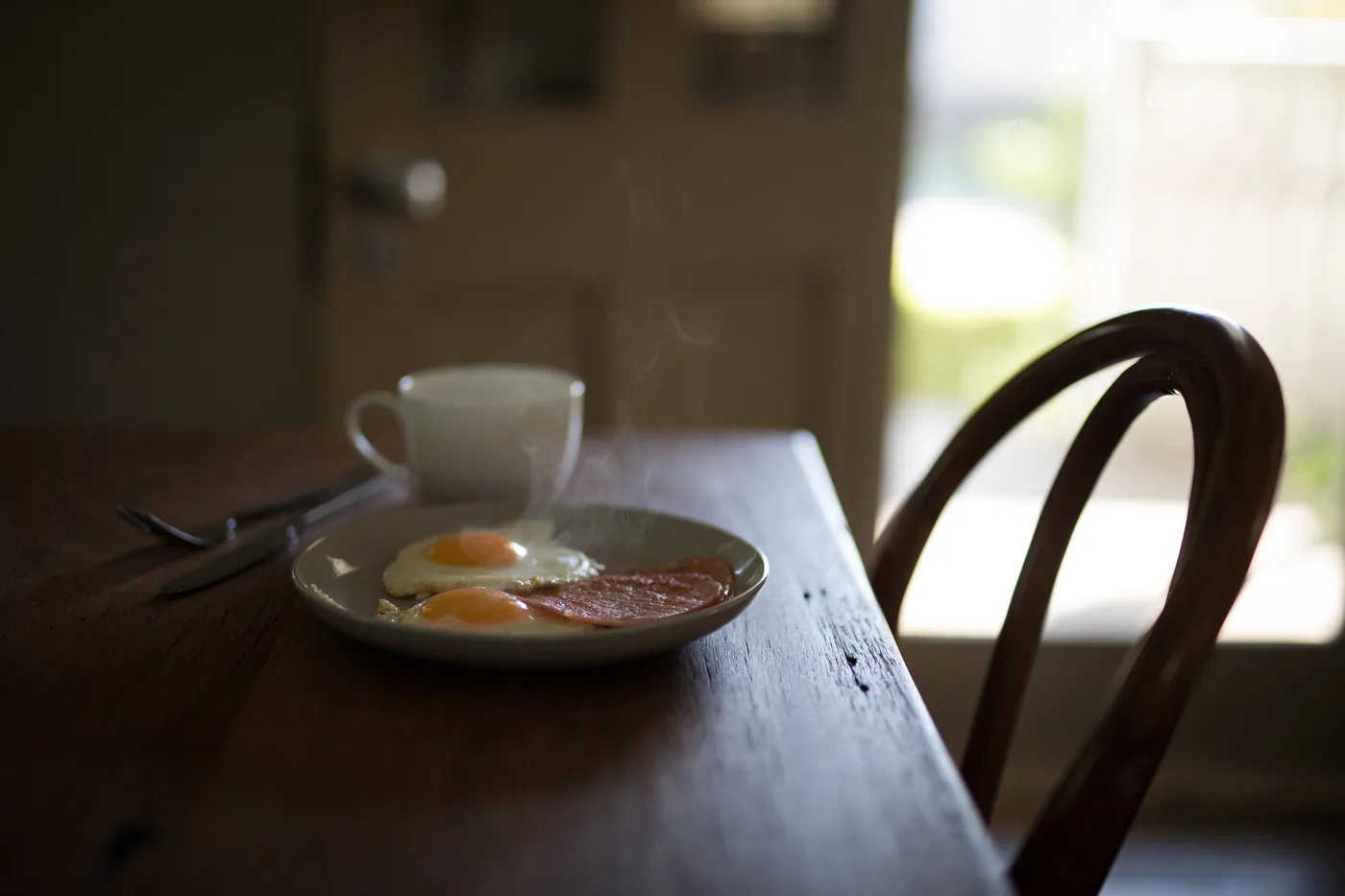
Think of the last meal you can actually remember eating. Not the last meal you ate, which was probably a few hours ago, but the last one you could describe afterward: what was on the plate, what the first bite was like, the moment you noticed you had eaten enough. For a lot of us the honest answer is a while back, a restaurant maybe, or a holiday table. Everything since has been eaten over a keyboard, in front of a show, in the car, or standing at the counter sorting the mail. The food went somewhere. The meal never quite happened.
Appetite Keeps Records
It is tempting to think of hunger and fullness as pure chemistry, a gauge in the stomach that fills and empties. The reality is stranger and more interesting: how much you want to eat later in the day is shaped partly by your memory of what you ate earlier. Researchers who study eating behavior have shown this in careful ways. People given a meal while their attention was absorbed by a screen or a game later reported vaguer memories of the meal, and then ate more at the next opportunity than people who had eaten the same food with nothing else going on. Reviews of dozens of these studies point the same direction: distraction while eating tends to increase how much people eat, both in the moment and afterward, while paying attention to a meal modestly reduces it.
In other words, satiety is partly record keeping. A meal you did not attend does not get filed properly, and a few hours later the body consults the file, finds it thin, and suggests a snack. This is not weakness of will. It is a filing error, and it starts at the table, not at the cupboard.
The Tenth Bite Problem
There is a second mechanism, and you can watch it work tonight. The first bite of almost anything good is vivid. The fourth is pleasant. By the tenth, the flavor has quietly stepped back, and by the end of the plate you are mostly finishing because the plate is not empty yet. That fading is real, not imagined. The pleasure a specific food gives declines as you keep eating it, one of the body's gentler ways of saying enough of this one. Scientists call it sensory-specific satiety, and it is part of why a varied buffet can carry you far past full while a single dish cannot.
Here is the catch: the signal only helps if someone is listening. Eat in front of a screen and every bite arrives half noticed, a first bite that never quite registers, so the decline never registers either. The quiet enough gets said to an empty room. You stop when the food stops, which is a very different thing from stopping when you have had enough.
The Practice
The practice is almost embarrassingly simple, which may be why so few of us do it. One meal a day, undivided. Not every meal, and not forever as a vow. One meal, most days, taken with nothing else going on.
That means sitting down, at a table, with the food on a plate rather than in the container it came in. No phone at the elbow, no show, no article, no mail. Company is not a violation: conversation has been part of eating for as long as there have been tables, and a shared meal counts fully. What you are removing is the third thing, the glowing rectangle that turns both the food and the company into background.
If you are eating alone, you just eat. Look at what is on the plate before you start. Taste the first bite the way you would taste something at a friend's house when they are watching your face. Put the fork down now and then, not as a discipline but because you are not in a hurry. A meal like this takes fifteen or twenty minutes, which is roughly what you would spend scrolling anyway.
What to Expect
The first few days feel odd. Sitting with only a plate of food can feel like sitting in a waiting room without your phone, and the itch to reach for something is informative. It says more about the habits you have built than about the meal. Let it itch. It fades faster than you expect.
Then the noticing starts. Most people notice their speed first: how fast the fork was moving all along, how much of a meal was gone before they had really arrived at it. Some notice they stop earlier, leaving a few bites without ceremony, because the enough signal finally had a quiet room to speak in. And some notice something more useful still: that a meal they have eaten on autopilot for years does not actually taste very good, and never did. That discovery alone can change a grocery list.
Be careful what you promise yourself here. This is not a weight-loss method, and it would be dishonest to sell it as one. The research suggests attention nudges intake down for many people, but the honest claim is smaller and better: you will know what you are eating, and how much, and whether you like it. Decisions made with that information tend to be better than decisions made without it, and that is all this practice claims.
The Meal as a Seam
There is one more thing the undivided meal gives you, and it has nothing to do with food. A day spent switching between tasks has no seams in it, no place where one thing ends before another begins, and days like that blur together even when they were full. A meal taken as a meal is a seam. For fifteen minutes the day has a shape: there was the morning, then there was lunch, then there was the afternoon. People who eat this way often describe the effect in terms that sound like rest, even though nothing restful happened. Something did, though. Attention got to do one thing at a time, which is the condition it was built for and almost never gets.
You do not need a philosophy for this, or a course, or anything you do not already own. Three times a day, the world hands you a built-in pause with food in the middle of it. Take one of them back. The food will be the same food it was going to be anyway. The difference is that this time you will have been there for it, and a meal you were present for turns out to be a slightly different thing than fuel: it is a small proof, repeated daily, that your attention still belongs to you.



Loading comments…