
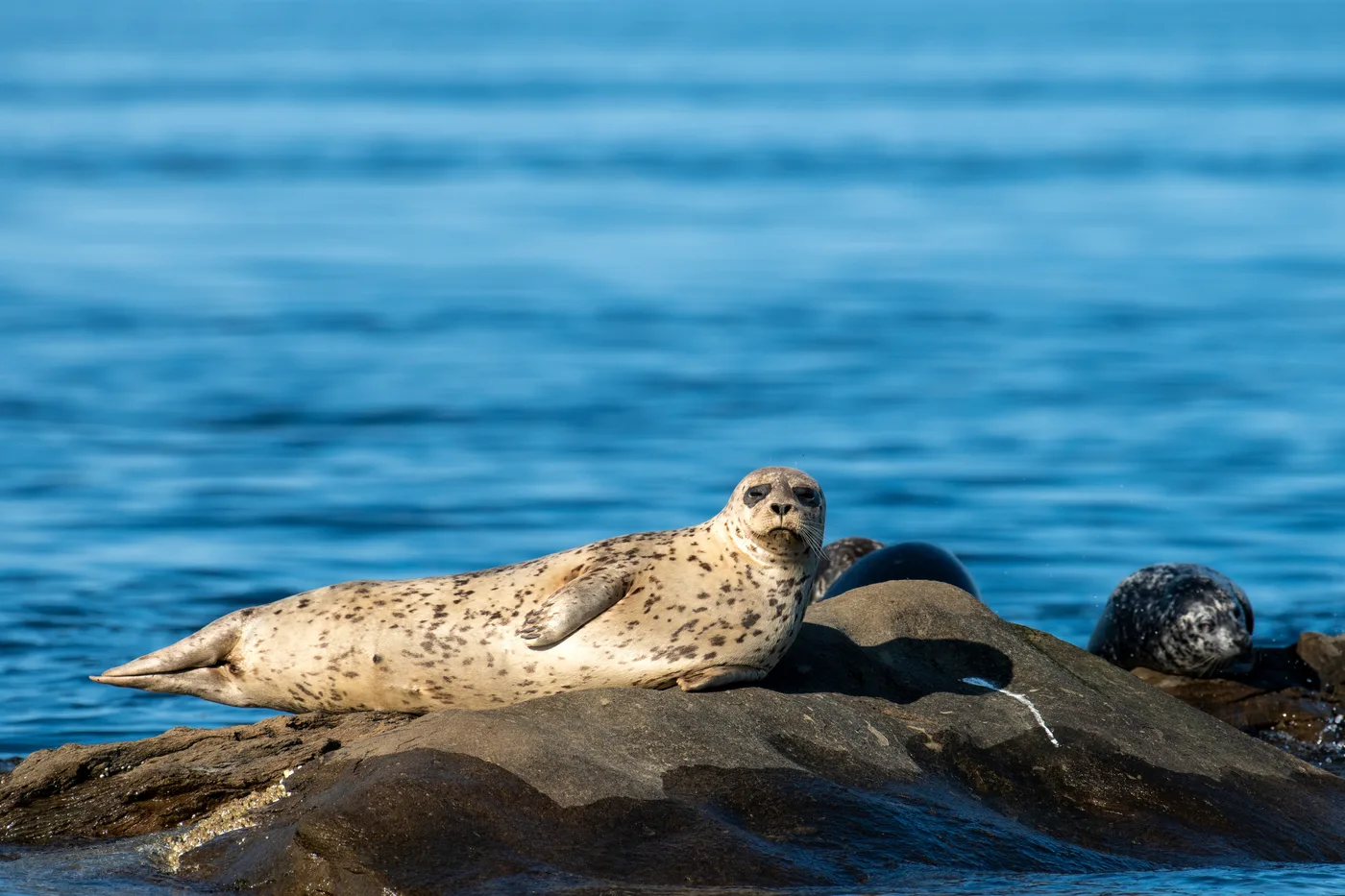
Out past the beach, on a rock that the falling tide has just uncovered, something that looked like a stone a moment ago lifts its head. Then its tail. It holds that curve, head and back flippers raised like a crescent, and settles in to rest in the cold sun. The beach parking lots are empty, the lifeguard stands have been hauled away, and the seals are back.
A winter neighbor most people never meet
Every year, as the water cools in late autumn, seals arrive in the waters around Long Island and stay through the winter, leaving again as spring warms the sound and the bays. Most of them are harbor seals, the small, round-headed, spotted seals that summer farther north along the New England and Canadian coast. Gray seals, larger and with a long, horse-like profile, turn up too, in growing numbers, and in some winters a harp or hooded seal wanders down from the far north.
For a few months, then, Long Island is a wintering ground for marine mammals, and most of the people who live here have no idea. The seals keep to quiet rocks and sandbars, they are the color of wet stone, and they arrive just after almost everyone has stopped going to the beach. You have to go looking. That is part of the pleasure.
Why they come out of the water
A seal lying on a rock is not stranded, sunbathing idly or in trouble. It is doing something essential, called hauling out. Seals feed in the water, sometimes diving deep and long, but they rest on land. Coming out lets them sleep without needing to surface for air, digest, and save the body heat that cold water steals far faster than cold air. Hauling out is part of how a warm-blooded animal makes a living in a frigid sea.
That is why they are so faithful to particular places and particular times. Seals favor rocks and sandbars that are exposed at low tide and cut off from easy approach by land, so the tide chart is the best seal forecast there is. A spot that is empty water at high tide may be crowded with resting bodies two hours after it turns. They also like quiet: places where people, dogs and boats rarely bother them.
Watch long enough and you will see the banana posture, that raised head and tail held off the rock at the same time. It is typical of resting harbor seals, and it looks uncomfortable to us, but it is ordinary for them, a way of keeping flippers off the cold stone and the body balanced. You may also see them shuffle on their bellies, since seals of this family cannot turn their back flippers forward to walk, and slip back into the water with no effort at all.
Where and when to look
The best months are roughly December through March, though the first arrivals often appear in November and some linger into April. Look on the East End and around the bays, where quiet rocks and sandbars sit offshore: the waters off Montauk Point, the inlets and bay islands of the South Fork, the rocky shores of the North Fork and the islands beyond Orient Point. Local conservation groups run guided seal walks and seal cruises through the winter, including on the South Shore barrier beaches and out of the western bays, and going with a guide the first time is the easiest way to learn what you are looking at.
On your own, a few things improve your odds a great deal:
Go on a falling or low tide. Check the tide chart and plan to arrive as the water drops, when the haul-out rocks are uncovered.
Bring binoculars. You will be watching from a long way off, which is as it should be. A pair of binoculars turns gray lumps on a far rock into faces with whiskers and dark eyes.
Look for the lumps that move. Scan the rocks slowly. Most of what you see will be stone. Then one of the stones will lift its head.
Dress for wind, not temperature. The shore in February is colder than any thermometer suggests. Stand with the wind at your back if you can, and give yourself time. Seal watching rewards patience more than any other kind of luck.
Telling them apart
Once you have found seals, the next pleasure is learning who is who. A harbor seal is compact, rarely much longer than a person is tall, with a short, rounded head and a face that reads almost like a dog's: a small snout, big dark eyes, and nostrils that sit close together in a V. Its coat is mottled with spots, and it ranges from pale silver to near-black, often looking quite different wet and dry.
A gray seal is bigger, sometimes much bigger, and its head gives it away. The profile is long and straight, with no real dip between the forehead and the nose, which is why it is sometimes called the horsehead. The nostrils sit farther apart and look more like two parallel slits. When the two species share a haul-out, as they increasingly do, the size difference alone is striking, and a few minutes of comparison through binoculars will make you confident for the rest of the winter.
How to be a good neighbor
The seals are protected by federal law, and the rule of thumb from marine mammal experts is to stay at least fifty yards, about half a football field, away. The more useful rule is to watch the seals themselves. If they lift their heads and stare at you, shuffle toward the water or flush in a group, you are too close and have cost them the rest they came out of the sea to get. Back away slowly and watch from farther off.
Keep dogs leashed and well away. Never try to feed a seal, pour water on one or encourage it back into the sea. A lone seal on a beach, especially a young one, is usually just resting, and its mother may be nearby. If one looks injured or entangled, or stays in one place on a busy beach, keep people back and call the regional marine mammal stranding hotline rather than approaching it.
What winter is for
There is a habit, on Long Island, of treating the shore as a summer place, packed away with the beach chairs on Labor Day and not thought of again until Memorial Day. The seals are a quiet argument against it. For them, the cold months here are the good months: the season of rich water, safe rocks and very few people.
Seeing them changes how winter feels. The shore turns from an empty place into a populated one, with a life of its own that runs on tides and temperatures rather than on our calendar. Pick a gray morning this winter, check the tide, bring binoculars and something warm, and go and stand at the edge for an hour. Somewhere out on the rocks, a stone will lift its head and look back at you, and you will understand that you were never the only one who lives here.



Loading comments…