
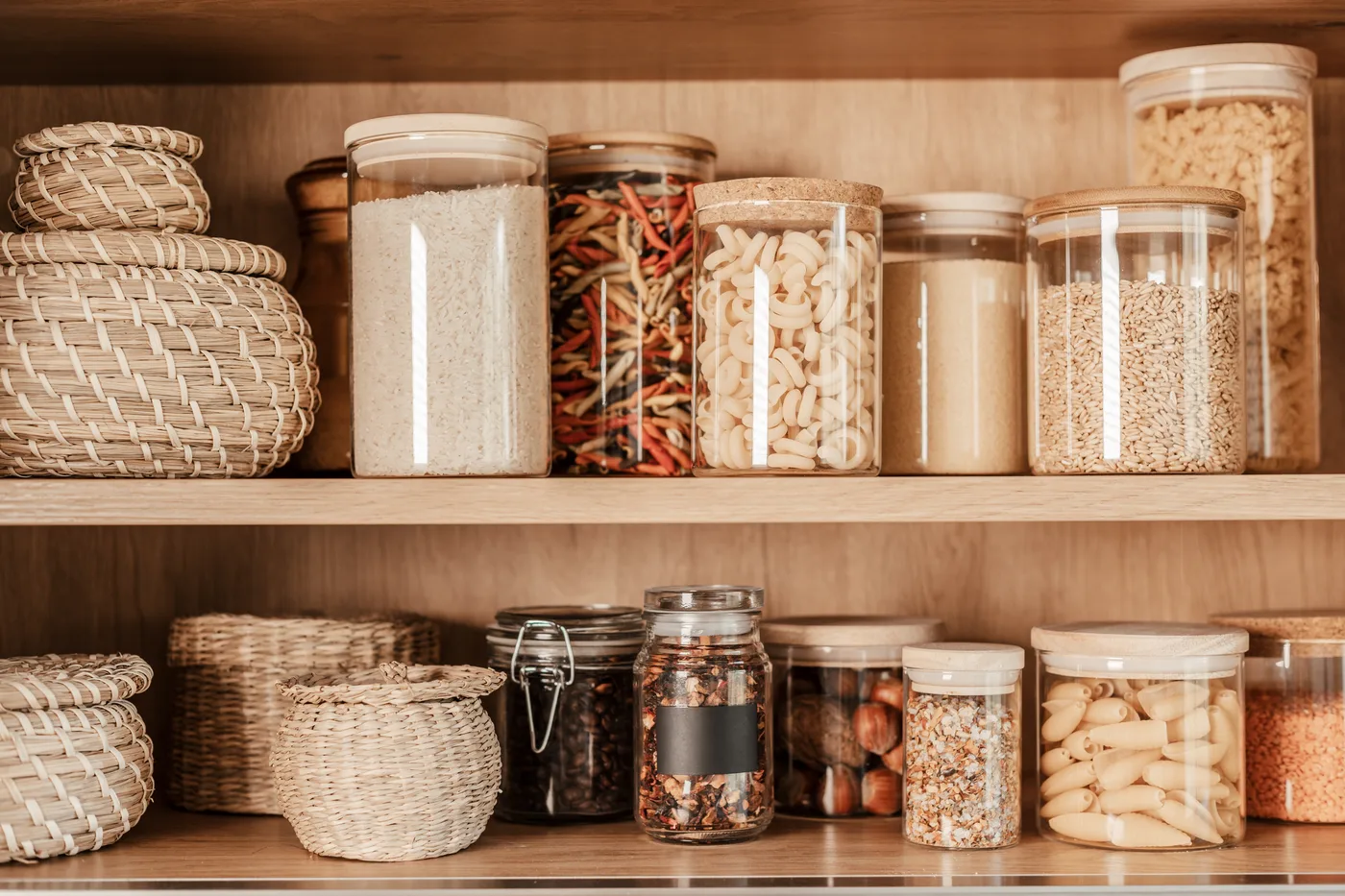
Somewhere in your kitchen there is a shelf you have stopped seeing. The cans at the back of it were bought on purpose: a dinner you meant to make, a cuisine you meant to try, a sale that felt like prudence. Then the week moved on, the shopping list started over from zero, and the food stayed where it was. Most kitchens hold weeks of meals this way, stocked and invisible at the same time. The pantry week is a simple practice for seeing them again: seven days of cooking from what the house already holds.
The shelf you stopped seeing
Cooking, as most of us practice it, runs in one direction. You decide what to make, you write the list, you buy the ingredients, you cook the meal. The pantry never enters the loop. It is where the remainders of old intentions live: the second bag of rice, bought because you could not remember whether there was a first, the beans left over from a soup you made once, the specialty flour from a recipe you saved and never opened again.
None of this is a character flaw. A supermarket is built to be legible, and a cupboard is not. The store shows you everything at eye level, faced forward, under good light. Your own supply sits in a dim cabinet behind the oatmeal, in whatever order the last unpacking left it. So the store comes to feel like the place food lives, and the pantry becomes storage rather than supply. Food kept this way does not simply wait. Eventually it goes past its best, quietly, a jar at a time, and the loss never appears anywhere you would notice it.
What the week actually is
The practice is exactly what it sounds like. For seven days, meals come from what is already in the house: the pantry, the refrigerator, and the freezer, which counts fully. You are allowed a short connector list, the fresh things that unlock what you already own. Milk, eggs, an onion, something green. The test for the connector list is strict and honest: does this purchase let me cook food I already have, or is it the beginning of a new meal that happens to pass through my kitchen on the way in? Butter for the rice is a connector. Chicken thighs and a jar of curry paste are a grocery run with extra steps.
That is the whole structure. There is no app, no tally, nothing to win, and no rule about eating out; if Friday was always pizza night, it still is. The point is not austerity, and it is certainly not a test of endurance. The point is to reverse the direction of the question for one week. Not what do I want to eat, but what does the house already hold, and what could it become?
Why a limit cooks better than a list
A small set of ingredients does the opposite of what you might expect. With the whole store available, dinner is a decision you must make from nothing, every day, at the worst possible hour for making decisions. The open question is the tiring part, more than the cooking. With one shelf available, dinner stops being a decision and becomes a puzzle with a manageable number of pieces, and a puzzle is lighter to carry than a decision.
The search flips, too. Instead of choosing a recipe and then acquiring its parts, you start from a can of chickpeas and ask what it wants to become. That direction, ingredient first, is how most home cooking in most places has always worked. The recipe-first kitchen, where the dish is chosen from a page and the ingredients summoned to match, is the newer invention. A week of cooking the older way teaches a kind of confidence that recipes alone never quite deliver: the ability to look at what is present and see a meal in it.
Expect the middle of the week to sag. Around the fourth day the obvious meals are gone and what remains looks like a shelf of mismatched parts. That dip is the productive part, not the failure of the experiment. It is the moment the easy answers run out and the actual cooking begins. The meals you invent on the far side of it are the ones you will remember, and one or two of them will quietly enter the rotation.
What the shelf will tell you about you
Before the week starts, you will take an inventory, and the inventory reads like a diary. There are the aspirational purchases: the vinegar from the good shop, the grain you read about on a Sunday and have not touched since. There are the duplicates, and every duplicate marks a moment when buying replaced checking, when it was easier to add rice to the cart than to remember the cabinet. There is, running under all of it, the gap between the cook you shop as and the cook you actually are.
Hold all of this lightly. The aspirational purchases are not failures; they are a record of who you meant to be in the kitchen, and some of them deserve the chance they were bought for. This is their week. Others have simply expired as intentions, whatever their date stamp says, and the honest move is to let them go to the food drive or the compost rather than let them keep occupying the shelf as a small standing reproach.
How to run it well
Give the inventory twenty unhurried minutes. Take things out where you can see them, because the whole problem being solved is that you cannot. Group them loosely: grains, cans, sauces and pastes, the freezer's actual contents rather than your theory of its contents. Check dates as you go and be sensible about anything genuinely past its life. Then write the list on paper and leave the paper on the counter, because a pantry you can read from across the kitchen is the tool that makes the rest of the week easy.
Plan three anchor dinners, no more. Three meals you can see clearly in the inventory, spaced across the week. Leave the other nights open, and let them be answered by what the anchors leave behind. Cook the fresh and fragile things early in the week and save the sturdy shelf food for the far end, which is the order the food itself would ask for. And keep the connector list written down rather than remembered, because the store will test your definition of a connector the moment you walk in.
When the week ends, notice how you write the next shopping list. Almost everyone writes it differently: standing in front of the open cupboard, subtracting before adding. That habit, planning backward from the house instead of forward from appetite, is the practice's real product, and it tends to outlast the week that built it.
The shelf will fade again eventually. Attention always does, and there is no need to make a religion of a cupboard. But you will know the way back, and it costs nothing: a full pantry is a plan you already paid for. The week is just the decision to keep the plan.


Loading comments…