
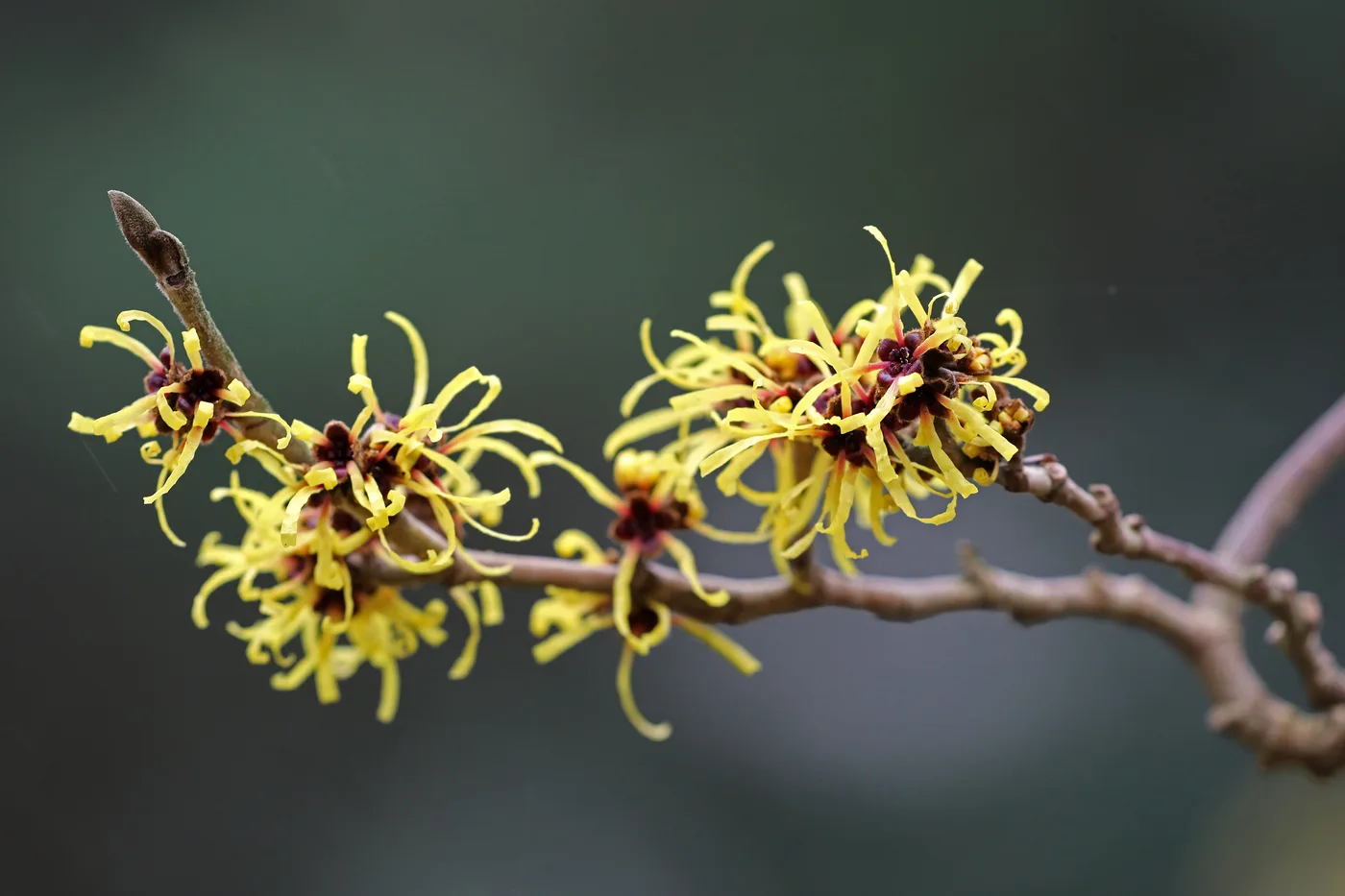
Walk into an oak wood on Long Island in early November and almost everything is closing up. The understory has gone brown and gold, the leaves are coming down in drifts, and the light leaves early. Then, at about eye level, you see it: a scatter of small yellow flowers on a bare-looking shrub, each one a little tuft of crinkled ribbons. It looks like a mistake. It is not. It is witch hazel, and it has been waiting all year for exactly now.
A shrub that keeps its own calendar
Common witch hazel is a native shrub, sometimes a small tree, that grows through the woods of eastern North America, including the woodland edges and stream banks of Long Island. For most of the year it is easy to overlook. Its leaves are plain and oval, with wavy, scalloped edges and a lopsided base where they meet the stem. In fall they turn a clear butter yellow.
And then, as those leaves turn or fall, it flowers. Each flower has four narrow petals, long and twisted like strips of yellow paper, and they cluster along the twigs in little bursts. Up close there is a faint, clean scent. The bloom can run from October into December, long after nearly every other plant in the wood has finished for the year.
On a hard frost the petals roll themselves up, and on a milder afternoon they unfurl again. A single shrub can open and close like that for weeks.
Who pollinates a flower in November?
Flowering this late seems like a poor strategy. Most bees have gone quiet. Butterflies are gone. Who is left to carry pollen?
Part of the answer is moths. Several kinds of owlet moths are active through the cold months, flying on mild nights when almost nothing else is about. They can warm their flight muscles by shivering before they take off, which lets them work when the air is far too cold for most insects. Flies and the occasional bee visit on warm days too. Witch hazel has very little competition for their attention, which is perhaps the whole point. Blooming when no one else is blooming means every visitor that is out comes to you.
Flowers and seeds on the same branch
Look closely at a flowering branch and you will often find something else beside the new blooms: small, woody, two-part capsules, a little like tiny acorns with a split at the top. Those are from last year.
Witch hazel takes its time. A flower pollinated this fall does not finish making seed until the following autumn, nearly a year later. So the plant carries this year's flowers and last year's fruit at once, the beginning and the end of the same story on one twig.
When the capsules finally dry out, they split and squeeze their two shiny black seeds until they shoot out, flinging them away from the parent shrub. On a quiet day in the woods in fall you can sometimes hear a small click as one goes. Most plants wait for wind or birds to move their seeds. This one throws its own.
The name, and the pliant branch
Witch hazel has nothing to do with witches. The first part of the name most likely comes from an old English word for a pliant, bendable branch, the same root as the wych elm. The second part came from settlers who saw a resemblance to the hazel shrubs they knew.
Those pliant forked branches had a well-known use: dowsing, the practice of walking a field with a forked stick to find water underground, which is why it is still sometimes called water witching. Long before that, Indigenous peoples of the region used the bark and leaves of the plant in their own medicine. The clear astringent sold in drugstores today, distilled from the twigs and bark, comes from the same shrub.
How to find one
You do not need to go anywhere special. Witch hazel is common in mixed oak woods, along shaded stream edges and on the slopes of wooded parks, and it is planted in plenty of yards and gardens. A walk through almost any patch of native woodland on Long Island has a fair chance of passing one.
Go in the next few weeks. The bloom is easiest to spot after most of the leaves have dropped, when the yellow stands out against bare brown branches.
Look at eye level. Witch hazel lives in the understory, beneath the oaks and maples, usually ten to twenty feet tall, with several crooked stems rising from the ground.
Check the leaves on the ground. Wavy edges and that uneven base are good clues, even when the shrub has dropped most of them.
Look for both stages. Once you find the flowers, look along the same twigs for last year's split seed capsules. Seeing both together is one of the small pleasures of a November walk.
If you garden, you may also know the witch hazels sold at nurseries that bloom in late winter, often in orange or copper as well as yellow. Those are mostly hybrids of Asian species, and they are lovely in February. The native one is the November flower, and it is a good choice for a part-shade corner of a yard, where it asks for very little and gives you color when nothing else will.
What it has to say
There is an easy lesson in witch hazel, and it is the right one. Not everything flowers on the common schedule. Some things wait until the crowd has gone home, when the light is low and the air is cold, and bloom then because that is when they can.
This week, on a gray afternoon when the woods look finished, go and look anyway. Somewhere at eye level, on a branch that seems bare, there is likely a little yellow flower, open and in no hurry, keeping its own time.

Loading comments…