
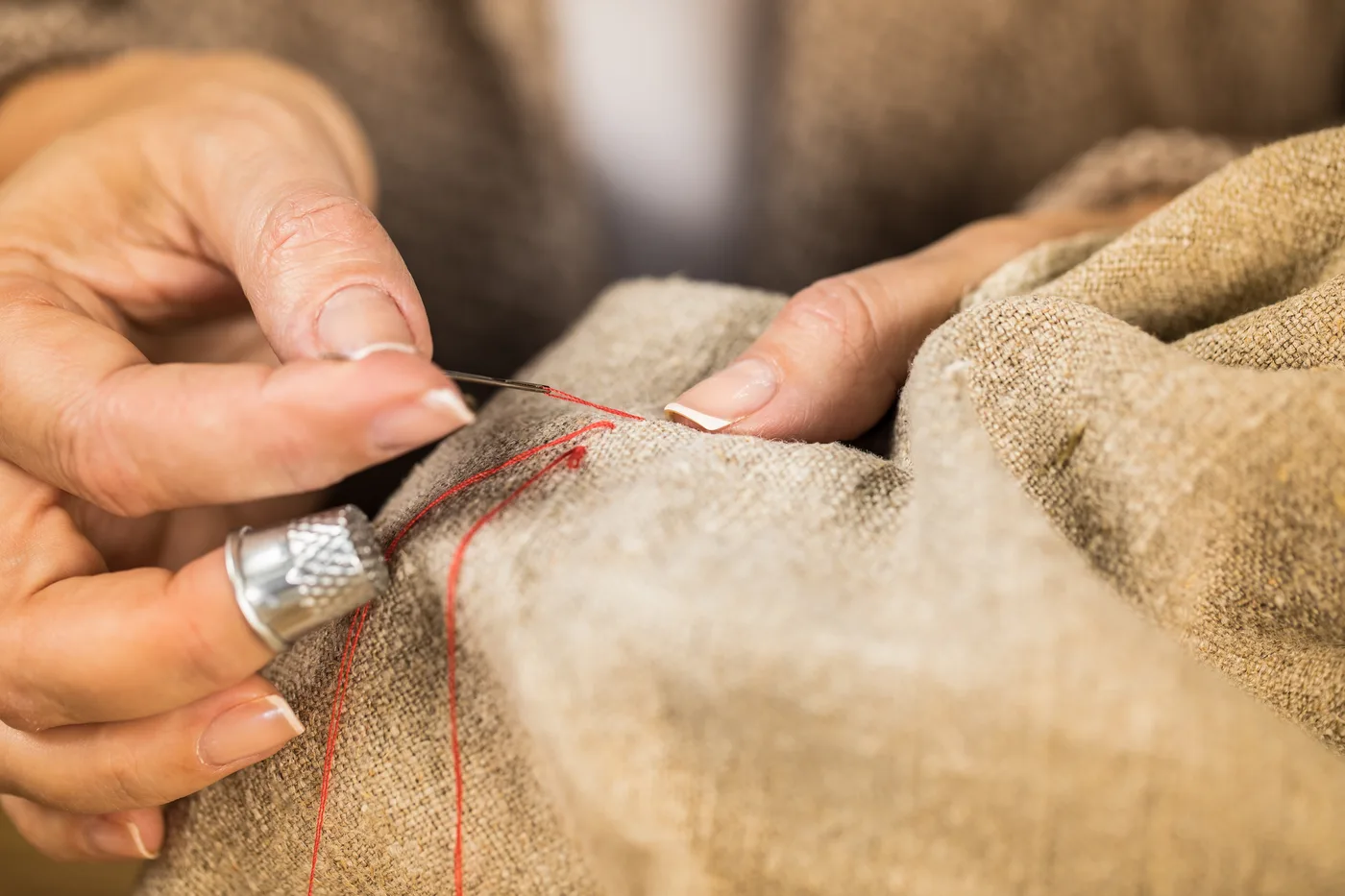
Somewhere in your home there is a small pile of clothing in suspended animation. The shirt missing its second button. The sweater with the thumb-sized hole at the elbow. The jeans whose hem came down months ago and got fixed, temporarily you said, with tape. None of it is ruined. All of it is waiting for a version of you with time, and that version never quite arrives, so the pile sits there radiating low-grade guilt every time you reach past it. This piece is about that pile, and about the fifteen minutes that dissolves it.
Mending is one of those skills that slipped out of ordinary life so quietly that nobody remembers deciding to drop it. Two generations ago it was as unremarkable as cooking. A household had a tin or a basket, needles, spare buttons, a few shades of thread, and garments simply got repaired as part of the week, the way dishes got washed. Then clothing became cheap enough that repair started to feel irrational. Why spend an evening on a seam when the whole garment costs less than lunch?
The arithmetic seemed obvious, and it rearranged more than our closets. When nothing is worth fixing, everything becomes provisional. You start relating to your own possessions the way you relate to packaging: temporarily useful, fundamentally disposable, already halfway to the bin on the day it arrives. That relationship has a texture, and the texture is thin.
What repair actually asks
Start with the honest, unglamorous truth: basic mending is easy. Not easy the way people say guitar is easy, meaning easy after two years. Actually easy. Sewing a button takes a needle, thread, and ten minutes the first time, five thereafter. Closing a split seam is a line of simple stitches along a fold that the garment itself shows you how to follow. Darning a small hole in a knit is the fanciest of the beginner repairs, and it is weaving on a doll's scale: threads laid one way, threads woven the other, done. A patient twelve-year-old can learn all three in an afternoon.
These three repairs, button, seam, small hole, cover the large majority of what actually goes wrong with clothes. The pile in your closet is almost certainly made of exactly these. It persists not because the work is hard but because the work is unscheduled, and unscheduled work loses to everything.
So schedule it once and see what happens. One evening, the pile, something on the radio. Most people who try this report the same slightly embarrassed discovery: the entire backlog took under an hour, the sewing itself was absorbing in the way small handwork reliably is, and the guilt that had been humming in the closet for half a year went silent for the cost of one sitcom's worth of time.
The visible seam
There is an old idea, with deep roots in Japanese textile tradition, that a repair need not hide. Rural households there spent generations extending the life of indigo workwear with running stitches that reinforced worn cloth, patch over patch, and the accumulated repairs became fabrics of real beauty, some now kept in museums. The stitching was thrift, and over time it became something closer to testimony: a record, held in cloth, of years of use and years of care.
The modern descendant of that spirit is visible mending, and you have likely seen it: a contrasting patch worn like a badge, a constellation of deliberate stitches over a repaired tear, a darn in bright wool that turns an elbow into a small flag. The choice to mend visibly is a quiet piece of speech. It says this object has history and I decided the history should show. In a wardrobe economy built on looking perpetually new, a proudly repaired sweater is about as countercultural as knitwear gets.
You do not have to go that far. An invisible repair is still a repair. But it is worth knowing that the ceiling on this humble skill is art, because it changes how the first clumsy button feels. You are not patching. You are starting.
What changes between you and your things
Here is the part that has nothing to do with thread. Repairing an object changes your relationship to it, reliably and in one direction. The sweater you darned is no longer interchangeable with every other sweater; you have put twenty minutes of your attention into its elbow, and attention is the raw material of attachment. People report reaching for their mended clothes more often, not less, as if the repair promoted the garment from inventory to companion.
This runs exactly opposite to the replacement reflex, which quietly teaches that the answer to any flaw is a new object. The mending reflex teaches that the answer to a flaw might be you. Practiced on clothing, the instinct starts leaking, usefully, into the rest of life: the wobbly chair gets tightened, the strap gets restitched, the thing gets looked at before it gets discarded. A household where things get fixed feels different to live in. It feels tended.
There is an ecological argument here too, and it is real: clothing that stays in use is clothing not yet in a landfill, and the most sustainable garment is reliably the one already hanging in your closet. But the ecological argument, on its own, rarely gets a needle threaded. The tended feeling does.
Building the basket
The practice begins with a container, because the container is what makes mending a standing part of the household instead of an emergency. Any box or basket will do. Into it: a pack of assorted hand needles, thread in black, white, navy and one color you actually wear, small scissors, a few spare buttons, and a thimble if your fingertips complain. The whole kit costs less than a takeout order.
Then three commitments, all small. First, when a garment fails, it goes in the basket the same day, not the closet floor: the basket is a queue, not a graveyard. Second, once a month or so, the basket gets an evening, with company or a kettle or a podcast, treated as the calm handwork it is rather than a chore to race through. Third, you learn the repairs as they arrive. The button teaches itself. For the seam and the darn, any of a thousand patient video tutorials will walk you through in minutes, and your second attempt will be twice as good as your first.
Expect your early stitches to look like early stitches. This is handwork, and hands learn at hand speed. The mended thing does not need to be flawless. It needs to be back on your body, carrying its small, invisible cargo: proof that when something you owned came apart, you were the kind of person who put it back together.



Loading comments…