
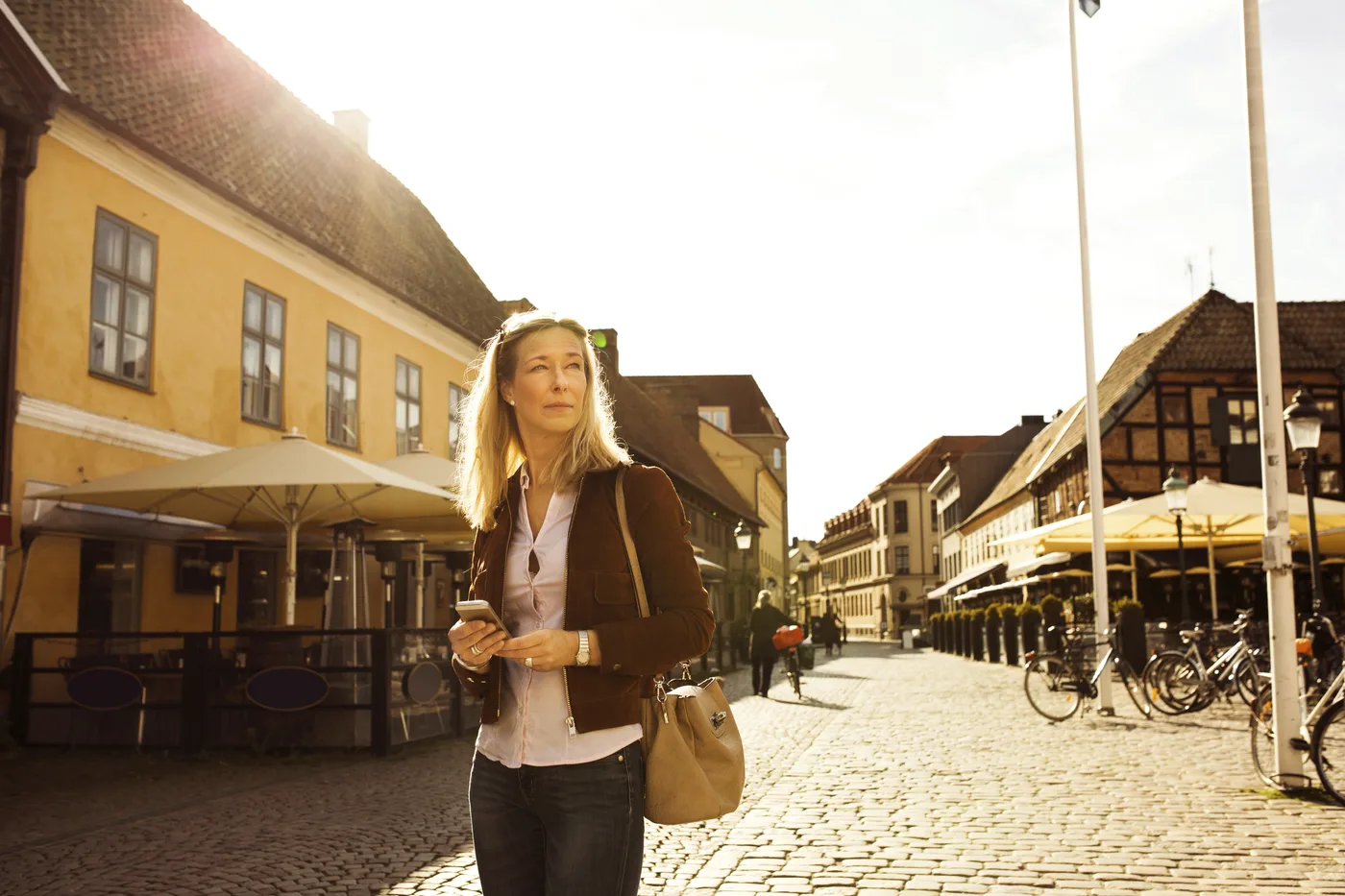
You need stamps, or bread, or the one screw the project stopped for, and before the thought is even finished your hand has found the car keys. The errand is four minutes away by car, which is why it has been four minutes away for years, and why you could not say what stands between here and there. Somewhere in that automatic reach is a whole way of living that nobody exactly chose: a life where the space between places is something to get through, not something you are in.
What the car edits out
A car is a wonderful machine for skipping the middle. That is its whole job. You are at the house, and then you are at the hardware store, and the mile between them arrives as a smear of windshield. The car edits out the neighbor repainting a porch railing, the maple that has started turning a week ahead of the others, the smell of somebody's late tomatoes, the new crack in the sidewalk that the roots finally won. None of this is information you need. All of it is information you live in.
The edit runs deeper than scenery. When every distance is a drive, distance itself goes abstract. You know your town the way you know a map: as a set of destinations connected by travel time. Ask someone what is a mile from their front door and most of us have to think, because a mile is not a thing we have felt lately. It is twenty minutes of walking, roughly, at an unhurried pace. Twenty minutes is the length of the errand you have been doing in four, and the difference between those two numbers is not wasted time. It is the part of the errand that was doing you some good.
The case for the slowest way
Walk an errand and three things happen that the car version cannot offer.
The first is the space around the task. A walk to the post office has a beginning, a middle and an end, and the middle belongs to you. Nothing is asked of you there except to keep going. People who walk regularly tend to describe the same discovery: the loose thoughts of the day, the ones that never get a turn, come forward when the body is occupied and the eyes have somewhere to rest. The errand becomes a container for the kind of unforced thinking that never survives sitting down to do it on purpose.
The second is the neighborhood itself. On foot you are available in a way a driver is not. You get the nod from the man walking his retriever, the half wave from the woman whose name you do not know but whose garden you have watched for three summers. These are small ties, and small is not the same as trivial. A town you walk through greets you back, a little more each season, and the accumulating familiarity is one of the quiet differences between living somewhere and merely sleeping there.
The third is the body, which was built for exactly this and not much else. Walking is movement at the scale the frame expects: low, long, rhythmic, load bearing without strain. It asks so little that it does not register as exercise, which is precisely why it gets done. An errand on foot smuggles half an hour of movement into a day that would have refused a workout outright.
Walking in a place built for driving
Long Island is honest ground for this practice because so much of it was laid out on the car's assumptions. Parkways, parking fields, the shopping plaza set back behind its asphalt apron: whole stretches of the Island treat a pedestrian as a rounding error. It is fair to say that plenty of errands here simply are not walkable, and pretending otherwise is the kind of advice this magazine tries not to give.
But the older grain is still there underneath. The Island is stitched with village downtowns that predate the car: main streets where a post office, a bakery, a library and a barber sit within a few hundred yards of houses, because they had to. If you live near one, you are richer than the county assessor knows. And even where you do not, the geometry is often better than habit assumes. Measure the distance from your door to the nearest errand you actually run, not the mall, just the deli or the pharmacy or the bank, and it is frequently under a mile. The trip feels unwalkable because it has never once been walked.
The practice
Keep it almost embarrassingly small. One errand a week goes on foot. Not the grocery run for a family of five, not anything with a deadline attached. The stamps. The library book. The single lightbulb. Choose the errand where slowness costs nothing, put on shoes that mean it, and take a bag so the trip home has a purpose in each hand.
Give it the whole time it takes. The failure mode of this practice is walking the errand while resenting the walk, checking the phone at every corner, treating your own legs as a slow taxi. Leave the earbuds home for the first few trips. The point is not to convert travel time into content time. The point is the middle of the trip, the part the car has been throwing away.
Where nothing at all is walkable, walk the last piece. Park once at the far edge of the plaza and do the whole strip on foot instead of re-parking three times. Park a street back from the main road and let the errand begin at the corner. This sounds like a parody of the practice, but the ingredients are the same: a little distance, taken slowly, with your own eyes doing the seeing.
What comes home with you
The stamps would have made it home either way. What the walked version carries extra is harder to name but easy to recognize once you have felt it. You come home already having been somewhere, in the old sense: out in the day, greeted twice, aware of the weather firsthand, one small thing accomplished at a pace your body recognizes as its own. The town is a few hundred yards more yours than it was at breakfast.
No one reorganizes a life around the post office. That is not the invitation. The invitation is to notice that between your door and the places your days depend on there is a middle, and it has been sitting there unvisited for years, and this week one errand could go the long, slow, oldest way.


Loading comments…