
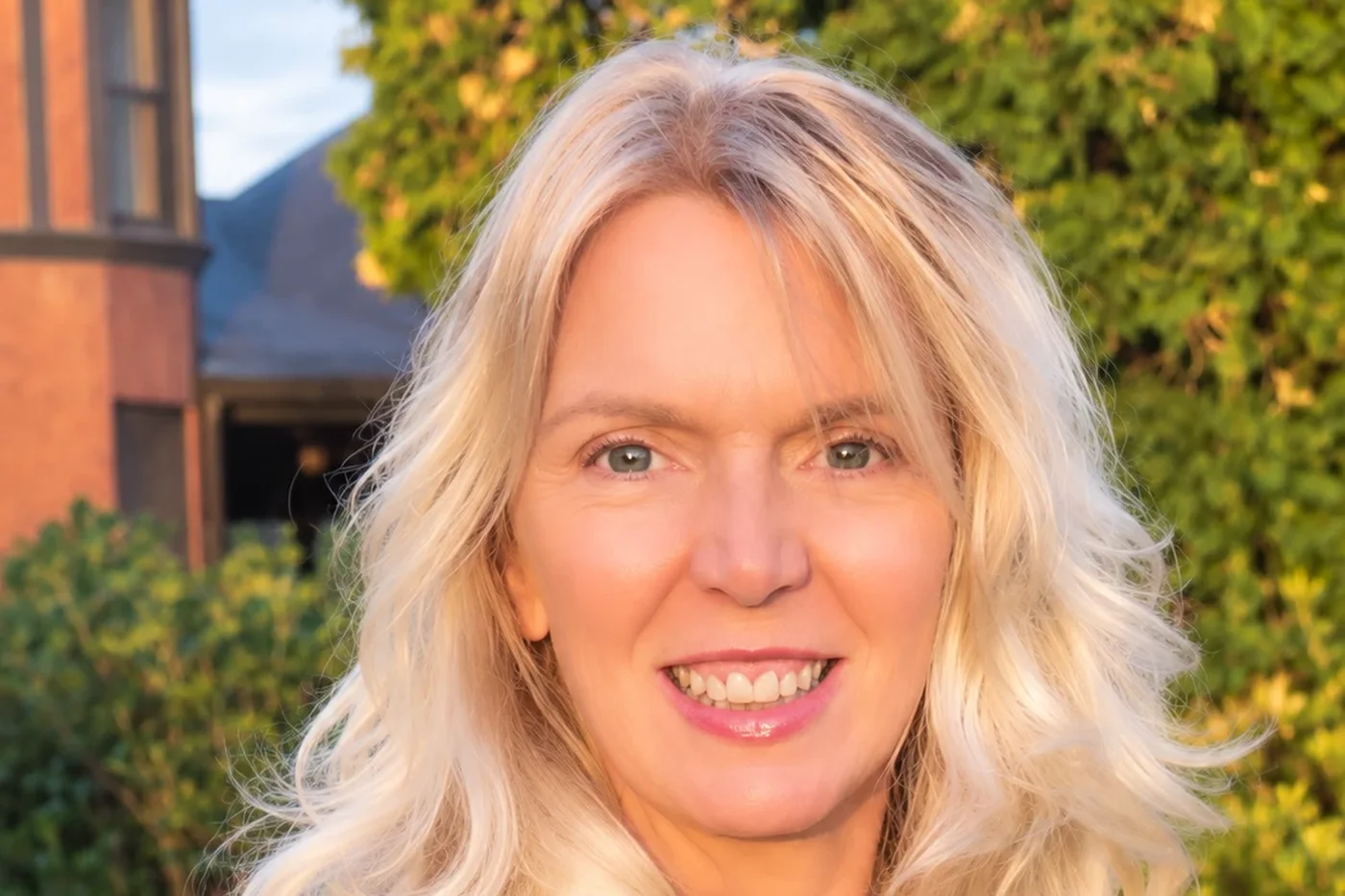
When Dr. Beth John began treating Tom, he was eighty-two and diagnosed with both Parkinson's and Alzheimer's. He could barely get through a conversation. He would drop his head into his hands mid-sentence, and at night he wandered the halls of his assisted living home. Five weeks into the nutrition program she built for him, his brother sent her a video: Tom, up out of his wheelchair at a party, dancing on the beat, alert and smiling. For the Farmingdale chiropractor, it was thirty years of practice in a single clip: the body usually knows what it needs, if someone takes the time to find out.
Dr. John's practice brings together three disciplines that are usually kept in separate offices: chiropractic care, functional nutrition and custom orthotics. What ties them together is one question she asks of every patient, whatever brought them in: what is actually causing this? We sat down with her to talk about how she got here, why she so often starts at the feet, and what happened next with Tom.
Most people choose a career. It sounds like yours chose you.
In a way. I was raised by a single mother, and she had terrible back pain. The first chiropractor she saw made it worse. The second one used a different technique, and it worked. I went with her to every appointment, and I asked about everything. He showed me her x-rays, he showed me videos, he explained what he was doing and why. Nobody had ever explained the body to me like that.
I had planned to be a veterinarian. By the time my mother was better, I knew I wanted to do what that doctor did: find the actual problem, explain it, and fix it.
Nobody had ever explained the body to me like that. By the time my mother was better, I knew what I wanted to do.
There is a line attributed to Thomas Edison that you come back to.
I found it as a student, and it has stayed with me for thirty years: the doctor of the future will give no medicine, but will interest patients in the care of the human frame, in diet, and in the cause and prevention of disease. When I read it, it felt like a job description. The human frame, diet, the cause of the problem. That is exactly what I do. It just took me a few years to build all three into one practice.
Start with the frame. What does chiropractic care look like in your office?
I have developed my own approach. Over the years I learned additional techniques that are gentle and non-force, designed to release tension in the body's deeper tissues and in the spine. I combine those with traditional chiropractic adjustments, and the results can be profound. When the tension is addressed first, the adjustment is often easier and more comfortable, and it goes deeper. It lets me give a more thorough and individualized adjustment.
The gentle techniques can also stand on their own. With some patients I use only those; with others, both. Plenty of people do not like to be "cracked" but still want relief from their back or neck pain, and for them it is a perfect option. It is also wonderful for seniors, for children, and for people who have had disc injuries or surgery. I do not believe chiropractic care should be one size fits all.
The technique should fit the patient, not the other way around.
I also adjust the hands, the wrists, the ankles and the feet, which most people do not realize a chiropractor can do. That matters a great deal for musicians, for athletes, for anyone whose work lives in their hands. A violinist and a linebacker need very different things from me, and so does an eighty-year-old with a stiff neck.
Then nutrition came in. Why?
Experience. Chiropractic care is powerful, but in practice I kept meeting problems it could not reach on its own. Sinus trouble. Memory issues. Fatigue that had nothing to do with alignment. These were clearly things happening inside the body, and I wanted a way to reach them. So I trained in functional nutrition, which looks for the root cause underneath a symptom rather than just quieting it.
What I see all the time is people who take a cabinet full of vitamins and feel no different. They read about something online, they buy it, they take it, and nothing changes. That is not because supplements do not work. It is because nobody figured out what that particular person actually needed.
Why guess when you can know?
So how do you figure that out?
I put several pictures together. Your history, your lifestyle, how you are presenting in front of me, your blood work and lab tests, and muscle testing. Then thirty years of clinical experience. From all of that I build a program aimed at specific pathways in the body, with specific products.
And it is important to understand that supplementation and nutrition are not the same thing. Supplementation means vitamins and targeted products. Nutrition is bigger. It includes what you eat every day. In most cases I work on both together.
And the third piece, the feet.
The feet are the foundation. If the foundation is off, everything built on top of it is off too. A foot that rolls in or rolls out changes the way you walk, and those abnormal forces travel straight up through the knees, the hips and the spine. You can adjust a spine beautifully, but if the feet underneath it keep pushing it back out of line, the adjustment will not hold.
So I adjust feet, I work on restoring a normal gait, and when it is needed I take a professional cast of the feet and work closely with the lab on orthotics made for that person. The chiropractic work lasts longer, and the knees and hips are spared years of wear. I had a bartender tell me his feet used to be killing him by the end of every shift. Now he goes home without pain. That is a whole life that changes.
It works in the other direction too. A misaligned spine changes the way you stand, and that can affect the feet. The two are in constant conversation. The spine is special, of course, because it houses the central nervous system. But the feet are where the structure begins.
You can adjust a spine beautifully, but if the feet underneath it keep pushing it back out of line, the adjustment will not hold.
Tell us about Tom.
I call him Tom. He was eighty-two, diagnosed with both Parkinson's and Alzheimer's. After his wife passed away, his brother David helped him move into assisted living. In conversation, Tom would put his head in his hands and simply stop talking. His speech was hesitant. He said things that did not make sense, and he told stories about things that had not happened. He could not manage his own finances. At night, he was found wandering the halls and walking into the wrong rooms, and there was real talk of moving him into a locked memory unit.
David came to me and asked whether there was anything nutritionally that could help his brother. I reviewed Tom's records and his labs, and I put together a program of three products to support his nervous system, which his aide gave him every day. I could not change his diet at all, because his meals came from the assisted living kitchen. Whatever happened next came from targeted supplementation alone.
About five weeks in, one of Tom's aides filmed him at an event at the facility and sent it to David, and David sent it to me. Tom got up out of his wheelchair, quickly and easily, and danced, coordinated and flexible and clearly enjoying himself. The faraway look was gone.
At two months, David came in for a follow-up, and the first word out of his mouth was "Wow." He had just visited Tom to pick up his tax papers for the accountant. Tom had a notebook ready with everything organized inside it, explained it all to David clearly, and even remarked that they were getting to it a little late. He knew what day it was. Their sister came by, and the three of them sat and remembered their childhood together. The hesitation in his speech was gone, and he never once put his head in his hands. His aide told David something was working. He had stopped wandering at night.
A couple of weeks after that, I got a text with a photo of Tom at a table, brush in hand. It just said, "He's painting!" Painting had been his passion in retirement, and when the illness set in he had lost the focus, the dexterity and the desire to do it. Now he was starting new paintings and finishing them. His medical doctor said he was seeing improvement where he had expected decline. Tom never went into the memory unit.
A couple of weeks later I got a text with a photo of Tom at a table, brush in hand. It just said, "He's painting!"
That is a remarkable story. How should readers hold it?
Carefully, and I want to be clear about that. It is one man, and his program was built for him. He still searches for a word now and then. Another patient with the same diagnosis would get a completely different program from me. What Tom's story shows is not that a particular supplement fixes a particular disease. It shows how much can change when you take the time to find out what one specific body actually needs.
Why has brain health become such a passion for you?
I have thought about that, and I think it comes down to something very personal. A person with significant physical limitations can still communicate, enjoy their relationships, read, sing, paint, laugh with the people they love and take part in family life. When cognitive function declines, those connections become harder and harder to hold on to.
To me, brain health is not simply about remembering where you put your keys. It is your connection to life. It is your relationships, your independence, your ability to express yourself, and your enjoyment of the things that make life meaningful. Without a certain amount of brain health, none of that is possible.
Brain health is not simply about remembering where you put your keys. It is your connection to life.
Too often, cognitive changes are dismissed as an inevitable part of aging. Nutrition cannot reverse every condition, but I believe it is important to ask whether nutritional or metabolic factors may be contributing to someone's difficulties.
I find it tremendously rewarding to help a patient improve their cholesterol or their blood sugar. But a cholesterol problem does not disconnect you from life the way losing your brain health can. There is something especially moving about watching someone who struggled to follow a conversation begin talking with their family again, or go back to something they loved, like painting or dancing. And on a less dramatic level, it is nice to remember where you put your keys.
Not every memory case looks like Tom's.
Most do not, and that is the point. Another patient of mine was a seventy-one-year-old musician whose complaint was much milder, and much more common: he could not remember the lyrics to his songs the way he used to, and he had started relying on cheat sheets at his gigs. Just as with Tom, I worked up his labs and how he was presenting and built a program for him. Within two weeks he told me he had stopped using the cheat sheets.
Why would two people with the same diagnosis get different programs?
Because a diagnosis is a name, not a cause. Two people with hair loss, or two people with Alzheimer's, can arrive at the same place by completely different routes, and their symptoms point to different priorities.
Order matters, too. If someone has digestive trouble and their liver is also struggling, I support the liver first. Otherwise you are asking the body to clear out more than it can process, and you create a bottleneck. Getting the sequence right is as important as choosing the right products.
And the gut matters more than people think, including for the brain. There is a strong connection between gut health and how clearly you think. Someone with a history of reflux, ulcers or an irritable bowel who also struggles with brain fog and focus may be looking at one problem, not two. A balanced digestive system is the basis of a balanced brain.
A diagnosis is a name, not a cause.
And beyond the brain?
The same approach applies everywhere. One of my patients was a fifty-nine-year-old woman who had been on a statin for eight years. She was worried about the side effects and wanted to see whether proper nutrition and supplements could do the job instead, and she wanted to be healthier in general.
The first thing I told her was to talk to her cardiologist: tell him she was working with a nutritional consultant, and ask whether he would take her off the statin for three months to see what we could do. He agreed. About a week after she stopped the medication he drew blood to get a baseline, and her cholesterol was through the roof, with very elevated liver enzymes.
I reviewed all of her lab work and her clinical picture and built a program. Three months later her cardiologist repeated the blood work:
- Total cholesterol down 35 points
- LDL down 32 points
- Non-HDL cholesterol down 41 points
- Triglycerides down 43 points, now within the normal range
- AST down 25 points, now within the normal range
- ALT down 51 points, to two points above the reference range
A month after that, a repeat liver panel showed both enzymes down another eight points and fully within the normal range. Her cardiologist told her she could stay off the statin, and he continues to monitor her. I would never suggest anyone stop a medication on their own. That case worked because her doctor was part of it from the first day.
I would never suggest anyone stop a medication on their own. That case worked because her doctor was part of it from the first day.
What can a reader do this week, without seeing anyone?
Two things, especially if you hit a wall in the afternoon, feel foggy, or find yourself in the kitchen at ten at night.
First, never eat a fast carbohydrate alone. If you have a rice cake or a piece of fruit, a kiwi say, anchor it with a healthy fat and some protein: an egg, some avocado. The fat and protein slow everything down, so your blood sugar rises gently instead of spiking and crashing. That crash is what you feel at three o'clock.
Second, flip the way most of us eat. Have a big, protein-rich breakfast, a boxer's breakfast, and make dinner the lighter meal. Your energy stays steady through the day, which helps your focus, and it helps with weight too. I had an eighty-year-old patient try it, and within a week she had her energy back.
And if you want a third: add one piece of fresh fruit and one vegetable to every day. It sounds too simple to matter. Start there anyway.
Do patients have to come in?
For adjustments and orthotics, yes. For nutrition, not always. I do a lot of consultations by phone and video now, and I can have the products shipped straight to someone's door. People tend to be surprised by how much we can do that way.
And people can come to me for any one of the three. Some want chiropractic care. Some want the nutrition work. Some only come for orthotics. They choose what they are ready for, and I meet them there.
If you could leave readers with one idea?
Never underestimate the role nutrition can play in your health. Whether you are dealing with fatigue, cholesterol, memory concerns, or you simply want to age as well as possible, there may be nutritional factors worth exploring.
And look for the cause. A symptom is your body telling you something. Covering it up is not the same as listening to it. The best care I know is the kind that finds out why, and then treats the person in front of you, not the label on their chart.
Covering a symptom up is not the same as listening to it.
This conversation is shared for education and is not medical advice. Individual results vary; talk with your own health care provider before starting any supplement or changing a treatment.



Loading comments…