
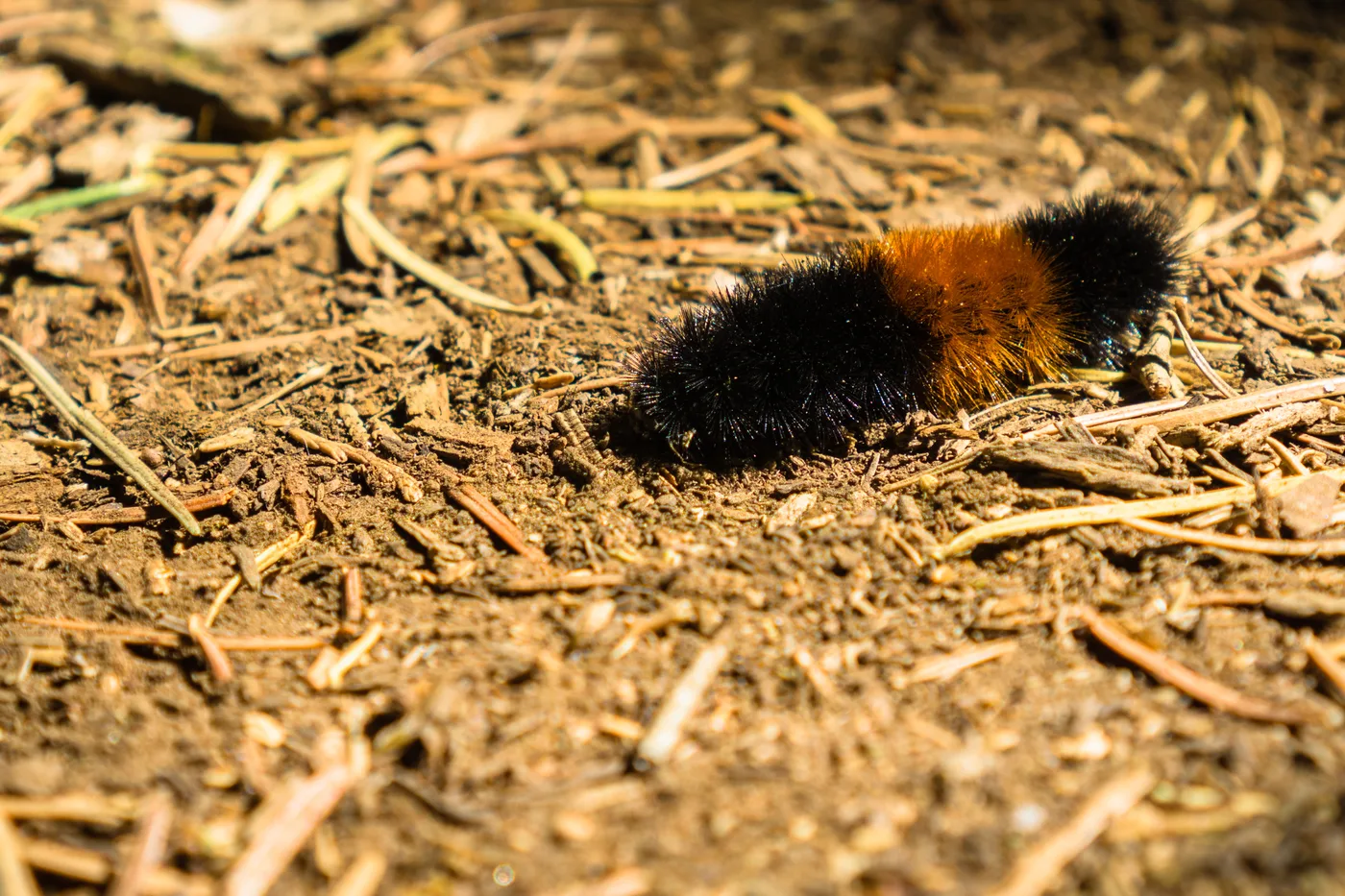
It happens every October on Long Island, usually in the warm hours after lunch: a small banded caterpillar, black at both ends and rust in the middle, crossing a road with somewhere to be. Drivers swerve. Children squat down to watch. Somebody picks it up and it curls into a bristled comma in the palm of a hand. The woolly bear is probably the only caterpillar most Americans can name on sight, and nearly everything we say about it is folklore. The real story, the one the folklore has been covering up for generations, is stranger and much better.
The forecast in the fur
The legend first, since it is the reason anyone looks twice. The woolly bear wears thirteen segments, black at the head end, black at the tail, rust-brown between, and the old farm wisdom holds that the bands foretell the winter: a wide rust band promises a mild one, heavy black at the ends warns of a hard one. The belief is old, and in the late 1940s it picked up a scientific varnish it never quite earned. An entomologist at the American Museum of Natural History began driving out of the city each fall to collect woolly bears at Bear Mountain, measuring their bands and issuing a winter forecast through a New York newspaper, at least half as a lark. The outings became an annual tradition, the forecasts became news, and the caterpillar became the groundhog of autumn.
What the bands actually record is not the winter ahead but the summer behind. A woolly bear grows in stages, shedding its skin several times on the way to full size, and with the later molts the rust band tends to widen. A caterpillar with a broad middle is, by and large, an older caterpillar: one that hatched earlier or fed through a longer, kinder growing season. Caterpillars from the same clutch can wear noticeably different bands in the same autumn, which no honest forecast could survive. The woolly bear is not a prediction. It is a record, a little furred ledger of the season that produced it.
Where it is going in such a hurry
The crossing itself has a purpose, and it is not escape and not migration. By late October the woolly bear has finished eating for the year, and its last project is real estate. It is searching for what naturalists call a hibernaculum: a sheltered pocket where it will spend the winter. Under loose bark, under a flat rock, beneath a woodpile or a forgotten board, deep in the leaf litter against a fence line. The road is simply in the way of the search, and the afternoon warmth that gets the caterpillar moving is the same warmth that brings it out where we can see it. The hurry is real. It is racing the light and the falling temperature, and it knows, in whatever way a caterpillar knows anything, that the search has a deadline.
It has not come from anywhere exotic, either. The woolly bear spends its whole summer in the margins we barely look at: the roadside strip, the unmowed edge, the weedy seam between a lawn and a fence. It is a generalist eater, raised on plantain and dandelion and grass, which is to say on the plants we spend our weekends pulling. By the time you meet it on the asphalt it has already lived an entire unnoticed life within a few dozen yards of where you are standing.
The marvel nobody mentions
Here is what the folklore leaves out. Nearly all our moths and butterflies pass the winter in some protected form: as an egg, as a pupa sealed in a case, as an adult tucked into bark. The woolly bear does something far bolder. It spends the winter as a caterpillar, in the open shelter of its chosen pocket, and it does not merely endure the cold. It freezes.
As the temperature falls, the woolly bear's body fills with glycerol, a natural antifreeze, and its chemistry begins managing the one thing that kills most frozen creatures: where the ice forms. Ice is permitted in the spaces between its cells while the glycerol protects the cells themselves, and so the caterpillar freezes the way a well-built pond freezes, solid at the surface, alive underneath. By midwinter it is stiff as a twig, frozen through, showing no more sign of life than the litter around it. In March it thaws, flexes, and walks away. In the high Arctic, a related caterpillar lives this way across many seasons, freezing each winter and growing a little each brief summer before it finally earns its wings. The woolly bear in your driveway carries the same equipment. It is not fleeing winter at all. It is provisioned for it, more thoroughly than you are.
The moth nobody connects
There is a small comedy waiting at the end of the story. In spring the woolly bear wakes, eats briefly, and spins a cocoon woven through with its own bristles. What emerges in early summer is the Isabella tiger moth: a dusty orange-yellow moth of no particular drama, the kind that circles a porch light in June without earning a second glance. The most famous caterpillar in America grows up to be one of its least noticed moths. We fall for beginnings, it turns out, and rarely stay for what they become.
If you meet one
The etiquette is simple. If you move a woolly bear off the pavement, carry it to the side it was heading for, not the side it came from; it has its reasons, and turning it around only re-runs the crossing. If you tend a yard, you are already a landlord: an unraked corner, a brush pile, leaf litter left against the fence is exactly the housing it is out here looking for.
And resist the kind impulse to bring one indoors. A woolly bear wintering beside a radiator is in far more danger than one frozen under a rock, because warmth keeps its metabolism awake through months when there is nothing to eat, spending reserves it cannot replace. The caterpillar is built for the cold the way a ship is built for water. The kindness is to leave it to the winter it came equipped for.
Reading it rightly
So the bands will not tell you whether to buy a better snow shovel. Read them anyway, just read them for what they are: the summer's minutes, kept in fur. And watch the crossing with the respect it deserves, because the small hurrying creature on the asphalt is doing something we spend whole philosophies trying to learn. It is not predicting the season ahead, and it is not afraid of it. It has put away what the summer gave, found its ground, and settled in to go through winter rather than around it. Thirteen segments, no forecast, every provision made.

Loading comments…