
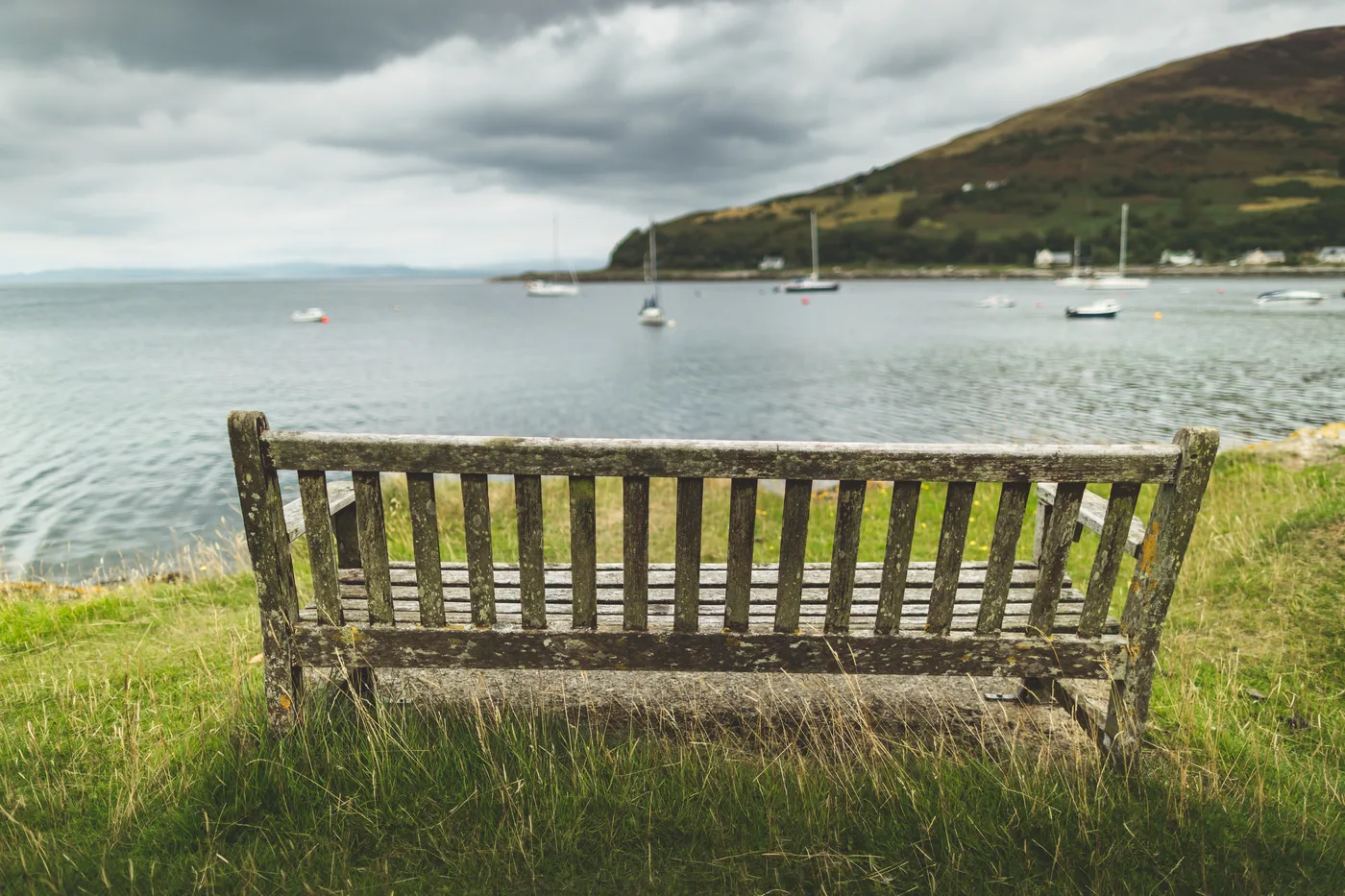
You sit down because your legs are tired, or because the view is good, or because the coffee is still too hot to walk with. Only after a minute do you notice the small metal plate screwed into the backrest behind you. A name. Two dates, or none. A line underneath it: She loved this harbor. Or: For Dad, who never missed a sunrise. Or simply: Sit a while. You turn around to read it properly, and the bench is suddenly not just a bench.
Memorial benches are everywhere once you start to see them: along boardwalks, at the edges of village greens, by ponds, beside ball fields, at the top of the hill where the trail opens out. They are among the most modest public monuments there are. No statue, no inscription carved in stone, no speeches. Just a place to sit, given by someone who loved someone, to whoever happens to be passing.
They are worth paying attention to, because almost every one of them is a small, complete lesson in what a life comes down to.
A life in one line
Read enough bench plaques and a pattern begins to emerge. Very few of them mention careers. Hardly any list achievements, titles or degrees. Nobody's bench says she was promoted twice, or that he ran a successful business for thirty years, even when those things were true.
What the plaques mention instead are habits of attention and habits of love. He walked here every morning. She fed the ducks. He loved this view. She never met a stranger. They danced in the kitchen. Sometimes there is a phrase the person used to say, the kind of line that would mean nothing to anyone outside the family and everything inside it.
The families who write these lines have a few dozen characters to sum up a whole person, and almost all of them reach for the same kind of thing: what the person loved, where they went to feel at home, how they made others feel. When everything else is stripped away, that is what remains worth saying.
It is a quiet corrective to how most of us spend our days. We put enormous energy into the things that will never appear on a bench, and very little deliberate thought into the ones that will.
A gift for strangers
There is something else unusual about a memorial bench. Most memorials ask you to stop and look. A bench asks you to stop and rest. It is a memorial that is also a kindness, offered to people the giver will never meet.
The person who sits there might be a jogger catching their breath, a parent watching a child on the swings, an older man who cannot walk the whole loop anymore and needs a place halfway, a teenager who needed somewhere to go after a bad day. None of them knew the person on the plaque. All of them benefit from someone else's love for that person.
That is a fine way to be remembered: not as a name on a wall that people walk past, but as a place where strangers can sit down and feel, for a few minutes, a little better than they did before.
Reading the benches
One way to begin is simply to read them. Next time you are walking somewhere with benches, slow down and look at the plaques. Read the names out loud, quietly, if you are alone. Notice the dates. Notice the ones that are newer and shinier, and the ones that have been weathered nearly smooth.
Some people make a habit of adopting one bench on a regular walk. They sit on it often, and over time come to feel a kind of acquaintance with the person named there. It sounds sentimental, and perhaps it is, but it is also a practice of remembering that every place we move through is layered with other people's lives and other people's grief, most of which we will never see.
You might also find yourself grateful in an unexpected way. The bench you sit on to watch the boats came from a family who lost someone. Their loss is, in a small and real way, your comfort. That is worth a moment of thanks to people you cannot thank directly.
What would yours say?
The more useful question, though, is not about the benches you find. It is about the one that might someday have your name on it.
Try this. Sit down somewhere quiet with a notebook and imagine the people who love you choosing a single line to put under your name. Not the line you would want them to choose. The line they would honestly reach for, based on how you are living now.
Write down a few possibilities. Be honest. If the truest line right now would be something like always busy, or never quite there, notice that without judging it harshly. It is information, not a verdict.
Then write the line you would want. Keep it short, the way the real ones are. She made everyone feel welcome. He always had time to talk. She knew the name of every bird on this shore. He fixed things for the neighbors. Look at what you have written. It is almost certainly about love and attention, not about achievement.
Now the practical part: what is one thing you could do this week that would make that line a little more true? If you want to be remembered for making time, it might be one unhurried phone call. If you want to be remembered for loving a place, it might be one morning walk without your phone. The bench is far off, if it ever comes at all. The line is being written every day.
The ones who are still here
There is a gentler version of the same exercise, and it may matter even more. Think of someone you love who is still alive. What would their bench say? What is the habit, the phrase, the way of moving through the world that would be impossible to leave off the plaque?
Then consider telling them. Not in those terms, which would be morbid, but in plain ones. I love the way you always notice the light at this time of year. You are the reason anyone in this family knows how to make a decent pie. Whenever I walk past the water, I think of you. Most people only hear these things in a eulogy, after they can no longer hear them at all.
Benches are, in the end, a kind of message from the living to the living. They tell us what to pay attention to while there is still time. You can take that message without waiting for a bench of your own. Sit somewhere this week, read a stranger's name, and then go and say the true line out loud to someone who can still hear it.



Loading comments…