
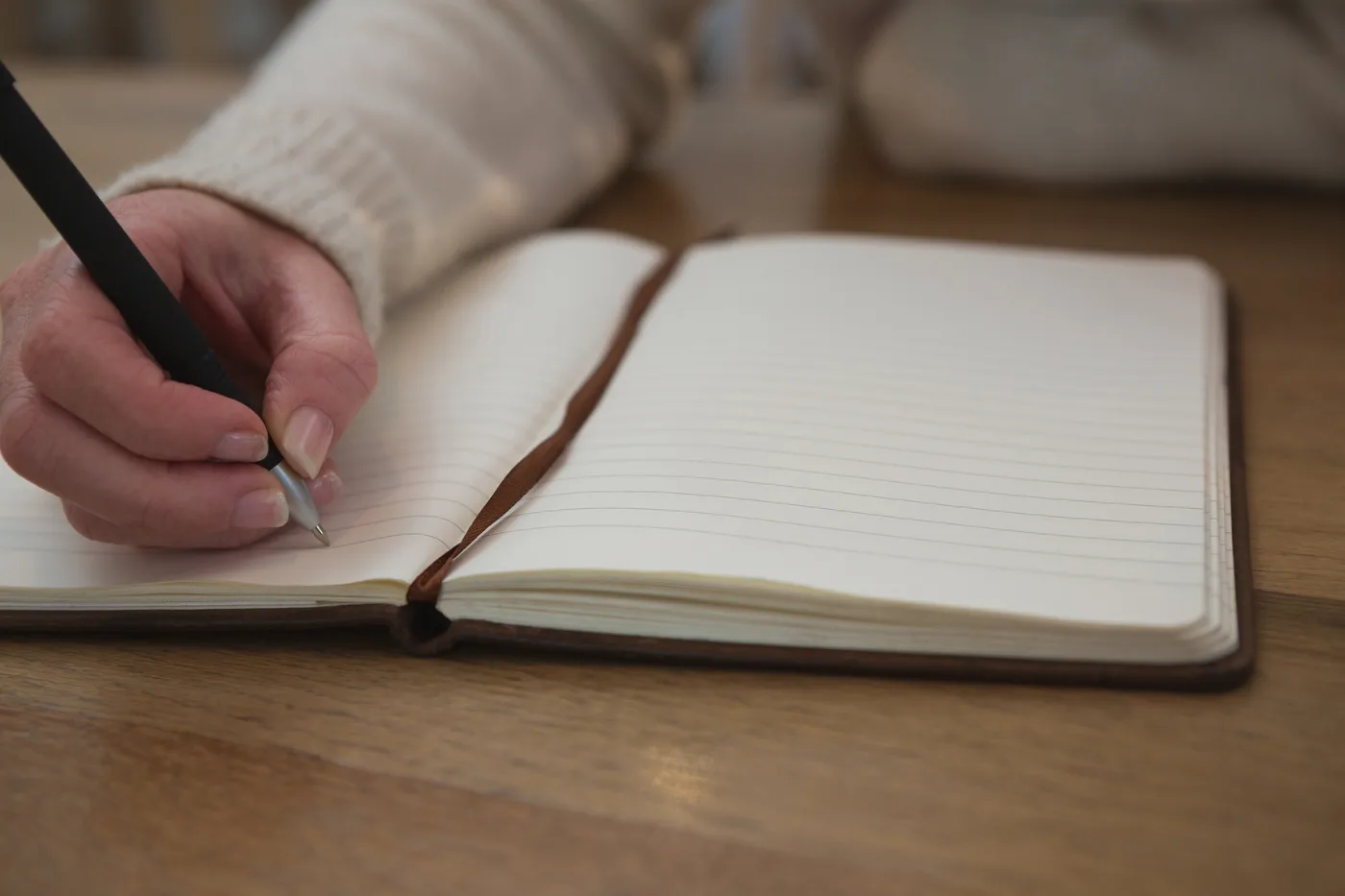
Somewhere in a drawer or a shoebox, most of us have met one by accident: a note in our own handwriting from years ago, a diary page, a card we drafted and never sent. The shock of it is always the same. Here is a person who is unmistakably you, worrying about things you have entirely forgotten, hoping for things you now live inside of without noticing. For a minute the two of you stand in the same room. There is a way to arrange that meeting on purpose. Write a letter to yourself, seal it, date the envelope one year from today, and put it where you will find it.
An old practice, not a gimmick
People have been leaving messages for their future selves for as long as there has been paper: sealed letters tucked into family Bibles, notes to be opened at twenty-one, time capsules under cornerstones. Teachers have long assigned the letter-to-yourself on the first day of school, to be returned in June, and anyone who received one remembers the strange authority it carried. It is a simple technology, and it does something no journal quite does. A journal talks to today. A letter crosses time on purpose, and both ends of the crossing are changed by it.
What writing it does now
The unexpected part is that most of the benefit arrives before the envelope is ever opened. Writing to the person you will be in a year forces a shift in vantage that everyday thinking almost never takes. From inside a life, everything looks permanent and urgent at once. Addressing someone twelve months downstream, you find yourself sorting automatically: this worry will have resolved, this situation is temporary, this hope is the one that actually matters. Psychologists who study self-distancing have found that stepping outside the immediate first-person view tends to cool strong feeling and clarify judgment, and the letter builds that step into its very grammar. You cannot write to next year without, for an hour, seeing this year as a chapter rather than the whole book.
The letter also quietly audits your direction. To tell your future self what you hope will be true, you have to decide what you hope will be true, in words, which most of us have not actually done lately. Vague intentions do not survive the sentence. Written to a real reader, even a reader who is you, I want things to be better has to become something concrete: I hope you kept the Tuesday walks. I hope you called him. I hope the garden happened. It is goal-setting with the bureaucracy stripped out and the tenderness left in.
What to put in it
The temptation is to write only aspirations, and the aspirational letter is the least interesting kind to receive. What the future reader is starving for, though they do not know it yet, is the ordinary present. Memory keeps the milestones and throws away the texture, so the texture is what the letter should smuggle across.
Describe an ordinary day: where the light comes in, what the kitchen smells like in the morning, who you talked to this week and what about. Name what is worrying you, specifically and without dressing it up, because watching last year's worries from the far side is one of the most quietly reassuring experiences available to a person. Name what you are grateful for while it is still unremarkable. Say who matters to you right now and what state those ties are in. Ask your reader some questions: did the move happen, are you still angry about that, do you still listen to that song. Make one or two hopes explicit, small enough to be real. And somewhere, leave a kindness, the sentence you would want on a hard day, because you cannot know what week the letter will land in.
Length does not matter. A page is plenty. Honesty matters entirely, and here the letter has an advantage over almost every other kind of writing: the audience is the one person you cannot really impress and do not need to perform for. No one else will ever read it. You can put the true things in.
The mechanics
Paper beats the screen for this, for reasons beyond sentiment: a physical envelope survives your app choices and password resets and cannot be reread in a weak moment. Write the opening date on the front in large letters. Seal it. Then park it somewhere with a built-in alarm: the box of holiday decorations you unpack every December, the file with the tax documents, taped inside the coat closet at eye level, or given to a person you trust with instructions and a date. A calendar reminder set for next year does no harm as a backstop.
Anniversaries make natural send dates: New Year's, a birthday, the first day of school, the first frost. Not because the calendar is magic, but because a recurring date makes it easy to answer one letter and write the next in the same sitting, which is how a one-time exercise becomes a correspondence. People who have kept the practice for a decade describe the growing stack of opened envelopes the way other people describe photo albums, except that photographs show how you looked, and the letters show how you thought.
It also travels well as a shared ritual. A family that writes letters at Thanksgiving and opens last year's at the same table has built itself a small annual ceremony of noticing. Children take to it instantly, and a child's letter opened a year later is a document of change so vivid it can make the whole table go quiet.
What opening it does
Then, one day, the envelope comes due, and the second half of the gift arrives. Some of it is comic: the crisis that consumed last February, now barely recognizable. Some of it is corrective: the intention you were certain about and quietly dropped, asking politely what happened. And some of it is the thing itself, the reason the practice endures: proof of motion. A year of living rarely feels like progress from inside; days accrete, and the person changing is the last to see it. The letter is a fixed point, and against a fixed point, drift becomes visible. You read the worries you no longer have, the questions you can now answer, the hope that came true so thoroughly you forgot it was ever in doubt, and you understand, with evidence in hand, that time is doing something with you, not just to you.
There is compassion in it too. It is hard to read a page written by the person you were, trying their best with what they knew, and stay harsh with them. Regular correspondents with their own past report that the practice softens them toward themselves in a way resolutions never did. You cannot despise someone whose letters you keep.
Tonight, before it becomes a project
Like all simple practices, this one is easiest to kill by planning it. There is no right stationery. Tonight, an ordinary sheet of paper, twenty minutes, the date one year out written at the top. Say what today was like. Say what you are afraid of and what you are hoping. Ask a few questions. Sign it the way you would to someone you love, seal it, and hide it where December will find it.
A year from now, someone with your name is going to stand in a room you cannot picture, holding your handwriting, hearing your voice with a clarity no memory could give them. It is worth deciding on purpose what you want to say.

Loading comments…