
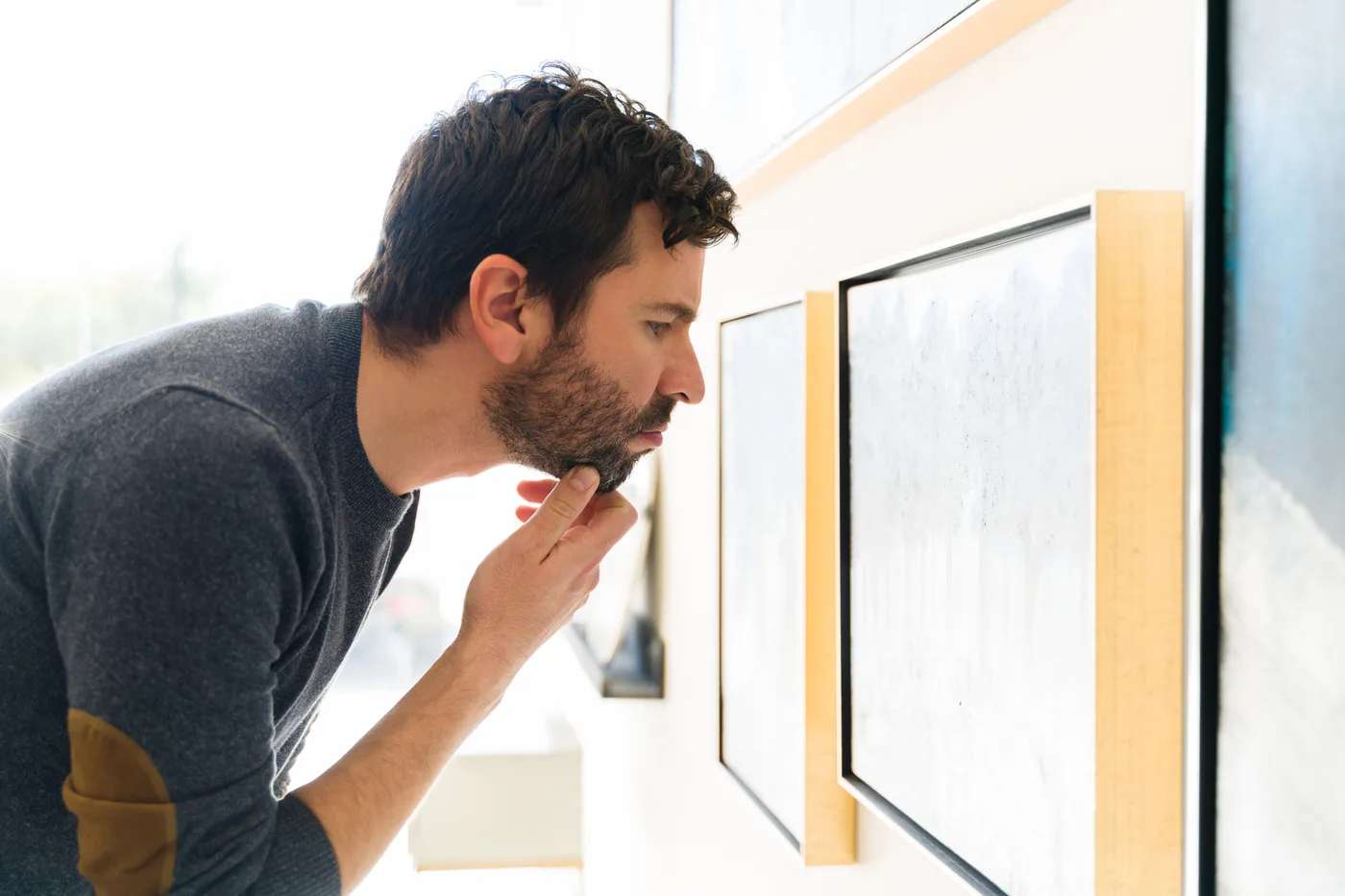
You glance at the painting, read the little card beside it, and move on. You have seen it. Or you have seen enough of it to know what it is, which is not quite the same thing. The same happens with the view from the kitchen, the face across the table, the leaf on the sidewalk. Most of what passes in front of your eyes in a day gets a glance and a label and nothing more. There is an old, quiet practice that reverses this, and it asks for almost nothing: one thing, and ten minutes of your attention.
How long we actually look
Researchers who watched visitors at the Metropolitan Museum of Art in New York, some of the most celebrated paintings in the world in front of them, found that people spent less than half a minute with each work on average, and often under twenty seconds. That figure gets quoted as an indictment, but it is really just a description of how attention works in a world with too much to see. We look long enough to recognize, and recognition feels like completion.
The trouble is that recognition is the beginning of seeing, not the end of it. The label arrives in a second or two. Everything the label leaves out, the color under the color, the odd angle of a hand, the way the light falls differently on the left side, only shows up later, and only if you are still there.
Jennifer Roberts, an art historian at Harvard, has made a point of asking her students to spend three full hours with a single work of art before writing about it. She has written about doing the same herself with a single portrait, and finding details at nine minutes, then at twenty, then at forty-five, that she would have sworn were not there at the start. The painting did not change. The looking did.
You do not need three hours, or a museum. Ten minutes and something ordinary is enough to feel the mechanism at work.
Why this is a meditation
Most meditation practices rest on a simple loop. You choose a place to put your attention, you notice when it wanders, and you bring it back. The breath is the usual anchor because it is always with you. But anything can serve, and for many people an object in front of the eyes is easier to stay with than something as faint as the breath.
Slow looking works the same muscle. The mind drifts to the shopping list, to the email you did not answer, to the question of whether this is working. You notice. You come back to the thing. Each return is one repetition, and the repetitions are the practice.
What makes it distinct is the reward. With the breath, the reward is mostly a calmer state. With an object, there is a second reward that arrives on its own: the thing gets more interesting the longer you stay. That makes it gentler than many sitting practices for people who find the breath dull or slippery.
The shape of ten minutes
If you try this, it helps to know what tends to happen, because the middle can be uncomfortable enough to quit.
The first minute feels finished. You see the thing, name it, and feel a faint sense of being done. This is the label arriving. Stay anyway.
Around minute three, boredom. There is often a wave of restlessness and a strong pull to check the time or pick up the phone. It is the same wave that ends most museum visits after half a minute. It passes if you let it, usually within a minute or two.
After that, detail. Somewhere past the boredom, the object starts to open. You notice that the pear is not one green but several, with a bruise you did not see and a freckled patch near the stem. You notice that the bark of the tree has a direction to it. You notice the shadow under the cup is not gray but faintly blue. These are not insights. They are just things that were always there, now visible because you stayed.
By the end, a different kind of quiet. Many people describe a settling that is less about relaxation than about absorption. The chatter of the mind has had somewhere to go.
How to do it
Pick something that will hold still. A piece of fruit, a houseplant, a stone, a mug, a single painting or photograph, the tree outside, your own hand resting on the table. Choose something you think you already know. Ordinary is better than beautiful, because the point is to find out what the ordinary has been hiding.
Set a timer for ten minutes and put it out of sight. Not knowing how much time is left helps you stop negotiating with it.
Look in passes. Start with the whole outline. Then color, then texture, then light and shadow, then the edges where the thing meets its background. When you run out of one kind of noticing, move to the next. When you run out of all of them, start the list again; it will not be the same the second time.
Name things silently, then let the names go. A quiet word for what you see (dent, shine, curve) can steady the attention. But do not stop at the word. The word is the glance; what you are after is what comes after it.
When the mind wanders, come back without commentary. No scolding, no scorekeeping. Wandering is not failure. It is the moment the exercise happens.
Afterward, write one sentence. Something you saw that you had not seen before. Over a week or two, the sentences become a small record of a skill getting stronger.
What it changes
Slow looking will not make you a different person. What it tends to do is more modest and more lasting. It loosens the habit of treating the world as already known. It gives the restless mind something concrete to rest on. And it makes you a little better at staying with things, a dish, a conversation, a difficult feeling, past the point where you would normally move on.
There is a kind of respect in it, too. To look at something for ten minutes is to treat it as worth looking at. Few of the objects in a day get that from us. Few of the people do, either.
Choose one thing in the room you are in now. Not the most interesting thing, just the nearest one. Give it ten minutes before the day is out, and see what it was keeping from you.
Loading comments…