
You get home, and you are not home. Your keys are in the bowl and your body is in the kitchen, but the meeting is still running in your head, playing back the thing you said and auditioning the thing you should have said. Someone you love asks a question and you answer it from very far away. The day did this at every junction: the drive absorbed the office, the dinner absorbed the drive, the pillow absorbed all of it. Nothing was fully entered because nothing was ever fully left. The problem is not the number of things in your day. It is the absence of any seam between them.
Modern life has quietly deleted its transitions. The commute, whatever else it cost, used to be a corridor between selves; for many people it is now ten steps from the kitchen table to the desk. The walk between meetings became the click between windows. Even the small mechanical pauses, the kettle, the elevator, the checkout line, get paved over instantly with a glance at the phone. We move through the day like someone slamming from room to room, and then wonder why every room feels like the last one.
The residue you carry
Attention has momentum. When you stop one activity and start another, some portion of your mind declines to make the trip: it stays behind with the unfinished email, the unresolved conversation, the tab left open. Psychologists who study task switching describe this lingering occupation as a kind of residue, and anyone can verify it from the inside. You are reading to a child while composing a reply. You are in the shower rehearsing tomorrow. The previous thing haunts the current thing.
The residue is thickest when the previous thing is unfinished or emotionally loud, which describes most of what a workday produces. And it compounds. By evening you are not doing one thing poorly; you are doing one thing while faintly doing six, a stack of ghost activities, each holding a small lien on your attention. What gets crowded out is not productivity. It is presence, the basic capacity to be where you are, with whoever is there with you.
The mind already believes in doorways
Here is the odd, hopeful part: your mind is already built to organize experience around boundaries. There is a well-known quirk of memory in which walking through a doorway makes you forget what you came for. You stand in the bedroom, errand gone, and only when you return to the kitchen does it come back. Memory researchers understand this as a feature rather than a failure: the mind carves continuous experience into episodes, and a doorway is one of the signals it uses to close one file and open another. Crossing a threshold tells the brain, at some level below argument, that one context has ended and another has begun.
Which means a threshold practice is not imposing something foreign on the mind. It is cooperating with something the mind already does, and doing it on purpose. The doorway is right there, closing files whether you attend to it or not. The practice is simply to show up for the crossing.
An old instruction
Contemplative traditions noticed all this centuries before anyone studied it. In Benedictine monastic life there is a practice of pausing deliberately before entering a place of prayer or beginning the next appointed thing: a stillness of a breath or two, taken at the boundary, to let the previous activity end and to arrive in the one beginning. The monks did not treat transition as dead time between the real events. They treated the transition as one of the real events, worthy of its own small ceremony.
The insight underneath the custom is durable: how you enter a thing shapes what the thing becomes. A conversation entered at full speed, trailing the last conversation, never quite becomes itself. The same is true of a meal, a workout, a bedtime, a Tuesday.
The practice
The practice is two breaths at the threshold, and the whole art is in remembering, so build it on doorways you cannot miss.
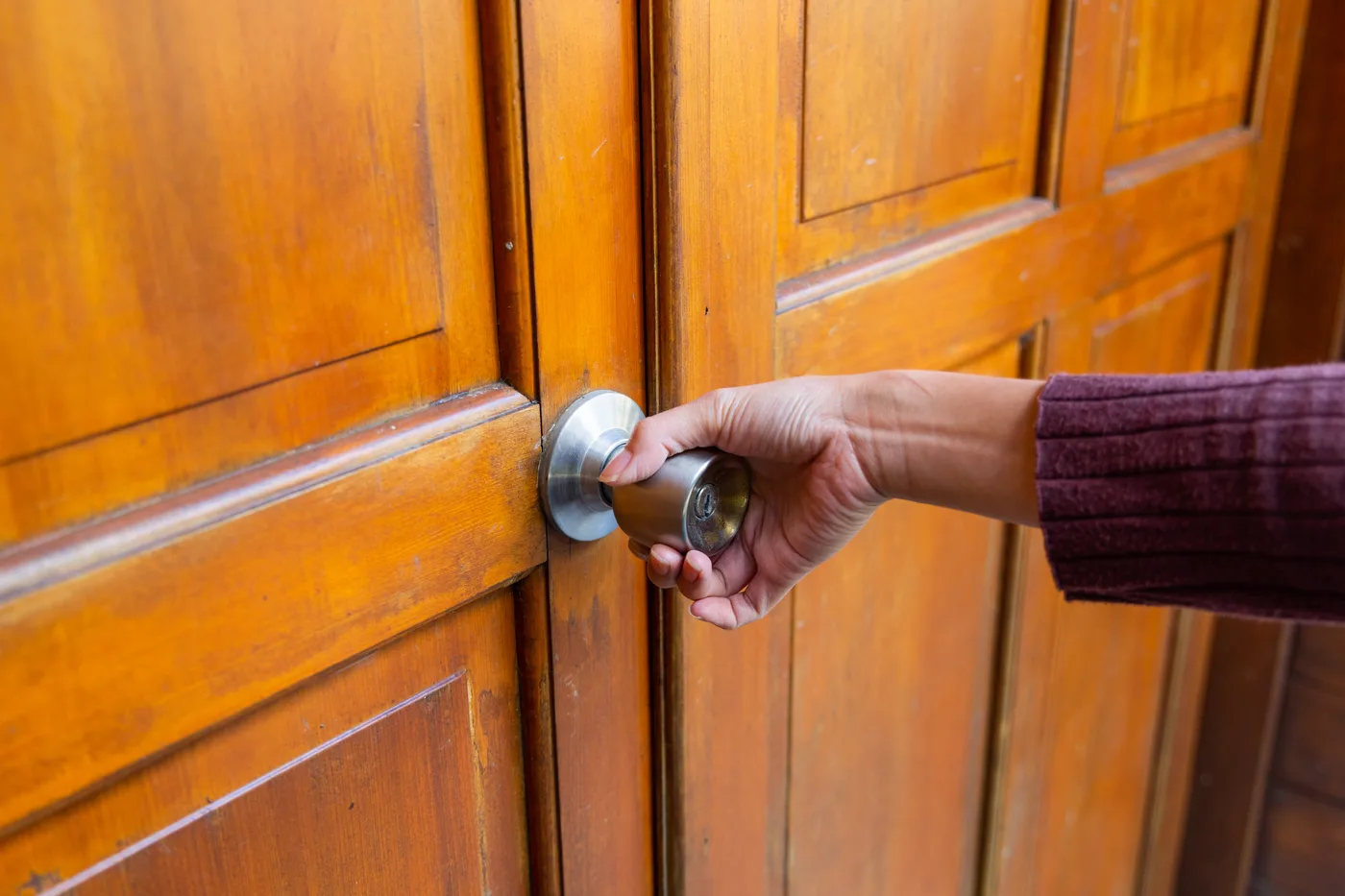
Choose two or three crossings that matter most. The strongest candidate for most people is the arrival home: the car in the driveway, or the hand on the apartment door. Before you go in, stop. Take one slow breath and let the workday be over, actually over, its unfinished business written down if it needs writing down. Take a second breath and think of what you are entering instead: these rooms, these people, this evening. Then open the door. Ten seconds, no app, no cushion, invisible to everyone but you.
Other thresholds announce themselves once you start looking. The moment before opening the laptop, so the day begins on purpose rather than by ambush. The moment after closing it, so the day's work has an actual edge. The pause outside a difficult meeting or a hospital room or your child's bedroom at story time. The first hand on the steering wheel. Each is a doorway the day was already going to make you cross; the practice just asks you to cross it awake.
Two breaths will sometimes feel absurdly small against the momentum of a hard day, and that is fine. The pause is not meant to dissolve the day's weight. It is meant to keep the weight from being delivered, unsorted, to whoever happens to be on the other side of the door. On the days it works you will feel the previous hour lose its grip a little, like a hand opening. On the days it does not, you still crossed one threshold knowing you were crossing it, which is one more than most days contain.
Days with seams
Give it two weeks and the day starts to change shape. Not the contents, the shape: the same meetings and errands and dinners, but with seams between them, each one entered slightly more on purpose. People around you notice before you do, because they are the beneficiaries. The person who gets you after the pause gets measurably more of you than the person who used to get you mid-playback.
There is an old feeling, mostly forgotten now, of a door meaning something: the schoolroom door, the church door, the front door at the end of a long trip. Doors were where one kind of time ended and another began. The doors are all still there, dozens of them, waiting in your ordinary day. The practice is small enough to start tonight, at the first one you reach: stop, breathe, arrive, and then go in.

Loading comments…