
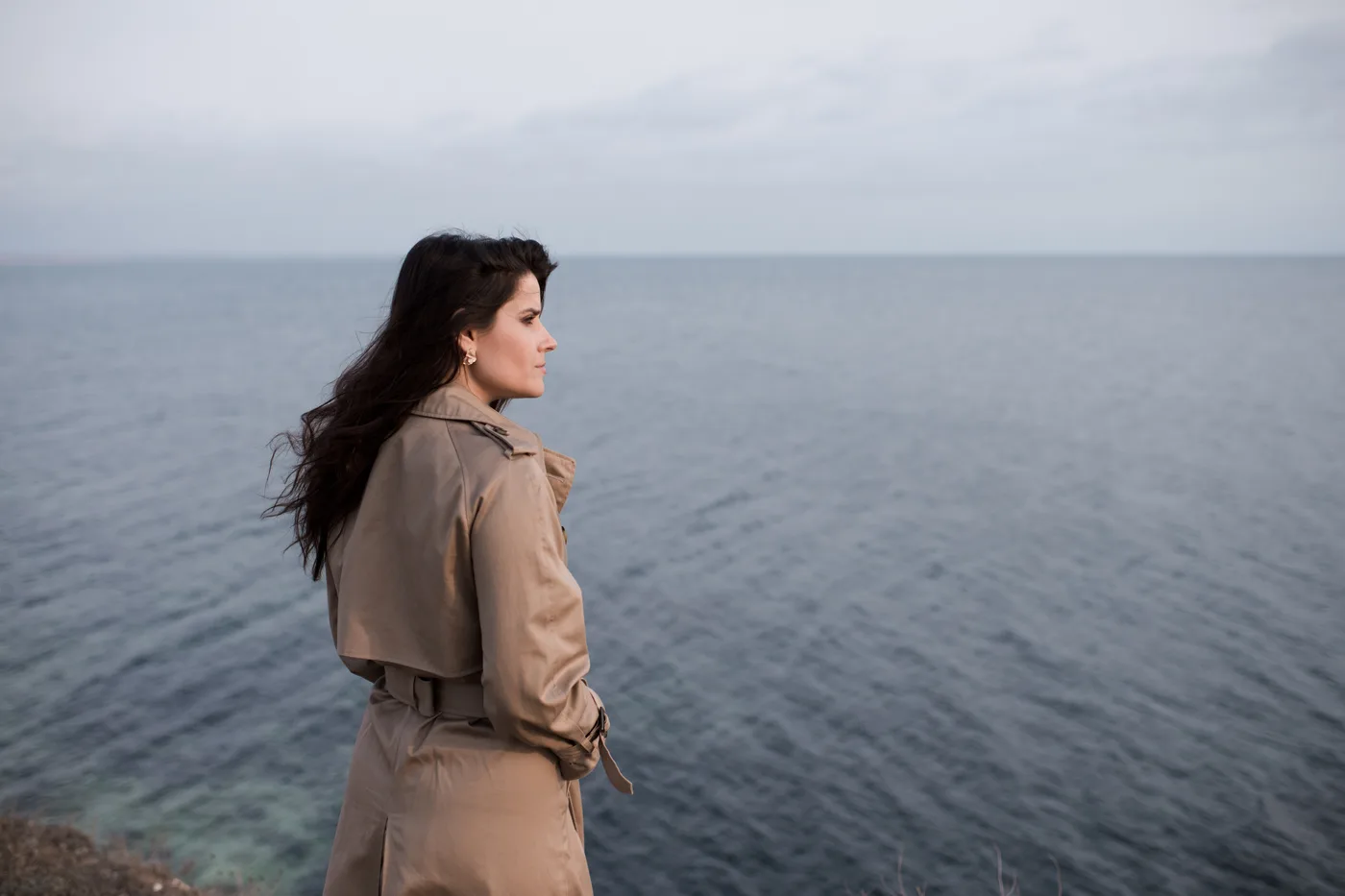
Notice, right now, what your eyes are doing. If you are reading this on a phone, they are aimed at a rectangle roughly the size of your palm, held about a foot from your face, and they have been doing some version of this for hours. The muscles around them are set. Your blinking has slowed without your permission. The rest of the world, the room, the window, the sky doing something interesting above your street, has been demoted to a blur you have not consulted in a long time. Now lift your eyes and look at the farthest thing you can see. Let the edges of the scene in. Somewhere in your shoulders, something just moved. That small shift has a long history, and it is worth understanding.
The Eyes Go First
Vision and vigilance grew up together. For most of the deep history of creatures like us, the thing that mattered most in the visual field was the thing that might end you or feed you, and the body's whole emergency system is built to serve the eyes accordingly. Under real stress, attention narrows like a beam. People who live through frightening events routinely describe it afterward: they can recall the one central detail with terrible clarity and almost nothing around it. The pupils widen. The blink rate changes. The periphery, biologically speaking, gets switched off as a luxury the moment cannot afford.
That narrowing is a brilliant piece of equipment for the moment it evolved to serve, which lasted seconds. The trouble is that modern life has discovered how to hold the trigger down. A screen is a small bright object that rewards hard focus and punishes wandering. A deadline is a threat with no body to run from. An argument replaying in your head keeps the beam tight on a point that does not even exist in the room. The equipment cannot tell the difference. So the narrow gaze, the braced forehead, the unblinking stare, the state built for a few seconds of emergency, becomes a posture some of us hold for most of the waking day.
Here is the useful part: the wiring appears to run in both directions. The state narrows the gaze, and the gaze helps hold the state. Which means the eyes are not just a symptom of a wound-up mind. They are a handle on it.
An Old Discovery, Made Repeatedly
People keep finding this handle, in traditions with no way of knowing about each other.
In Zen halls, meditators are taught to sit with eyes half open and lowered, focused on nothing, taking in the whole visual field at once, and generations of teachers have treated that instruction as load-bearing rather than incidental. Riding instructors teach the same thing under the same name this essay borrows: soft eyes, a wide receiving gaze that takes in the whole arena, because a rider who locks a hard stare onto one obstacle stiffens in the saddle, and the horse, a prey animal fluent in the vocabulary of vigilance, reads the stare and stiffens too. Hunters and trackers train a version of it, a deliberate wide-angle vision that catches motion at the edges that a pointed stare would miss. Old Hawaiian practice has a name for it as well, an expanded, relaxed awareness of the periphery held while the mind stays quiet.
Different centuries, different continents, different purposes. The same discovery underneath: something about deliberately widening the visual field is incompatible with a certain kind of clench. The traditions did not have the physiology, but they had the result, and they kept it.
What Softening Actually Involves
Soft eyes is not staring into space, and it is not defocusing until the world smears. It is a shift of attention rather than optics: you keep looking wherever you are looking, and you widen what you are willing to receive, until the edges of the scene, the floor, the ceiling line, the movement in the corner, are all faintly present at once. The gaze stops being a spear and becomes a net.
Two ordinary things tend to happen. The first is muscular. Near focus is work: a ring of muscle inside the eye holds the lens curved for close range, and hours of screens keep it held, which is part of why the end of a desk day aches behind the eyes. Distance and width let it stand down; eye-care guidance has recommended regular far-off gazing breaks for exactly this reason for years. The second is the one the traditions kept. With the visual field wide, the beam-state loosens its grip. People report the breath dropping lower, the jaw unclenching, thoughts losing a little of their velocity. Try to hold a truly panoramic gaze and a frantic inner monologue at the same time, and notice that each one softens the other.
None of this is a treatment for anything, and a widened gaze will not resolve what a hard week is actually made of. It is smaller than that, and more available: one lever, attached to a very old system, that happens to be within reach every waking hour.
The Practice
Once an hour, look at the farthest thing available. Out the window, down the block, at the horizon if you are lucky enough to have one. Long Island keeps a generous supply: the flat blue line off any south shore beach is a masterclass in distance. Thirty seconds is enough to count.
While you are there, go wide. Keep your eyes on that far point and let the periphery in: both edges of the window, the whole sweep of the street, the ceiling and the floor of the scene at once. Hold it for five slow breaths. Notice, without forcing anything, what the shoulders and jaw do on their own.
Use it where vigilance finds you. Waiting rooms, hard conversations, the minutes before something you are dreading. Nobody around you will know you are doing anything at all, which makes it one of the few settling practices available in the middle of a meeting.
Walk with it. Take ten minutes of an ordinary walk and carry the wide gaze the whole way, catching motion at the edges, birds, leaves, a neighbor's flag, instead of aiming your eyes at the sidewalk three steps ahead. It turns a familiar street strange and new, which is its own kind of rest.
Notice the stare when it happens. The practice matures into a kind of early warning. You catch yourself locked onto the screen, the road, the point in space where the argument lives, and the catch itself is the cue: widen, breathe, resume. The stare will return. So will the catch.
The Width of the World
There is a plain metaphor sitting inside all this, and it earns its place. The narrow gaze is honest about what worry is: a mind aimed at one point, holding it, unable to afford the periphery. And the widening is honest about what ease is: not the absence of the hard thing, but the return of everything around it, the room, the sky, the rest of the day, the parts of your life that are not the problem. The world has been out there at full width the entire time, patient at the edges of the frame, waiting for the eyes to let it back in. Yours will still be there in an hour. Look up.
Loading comments…