
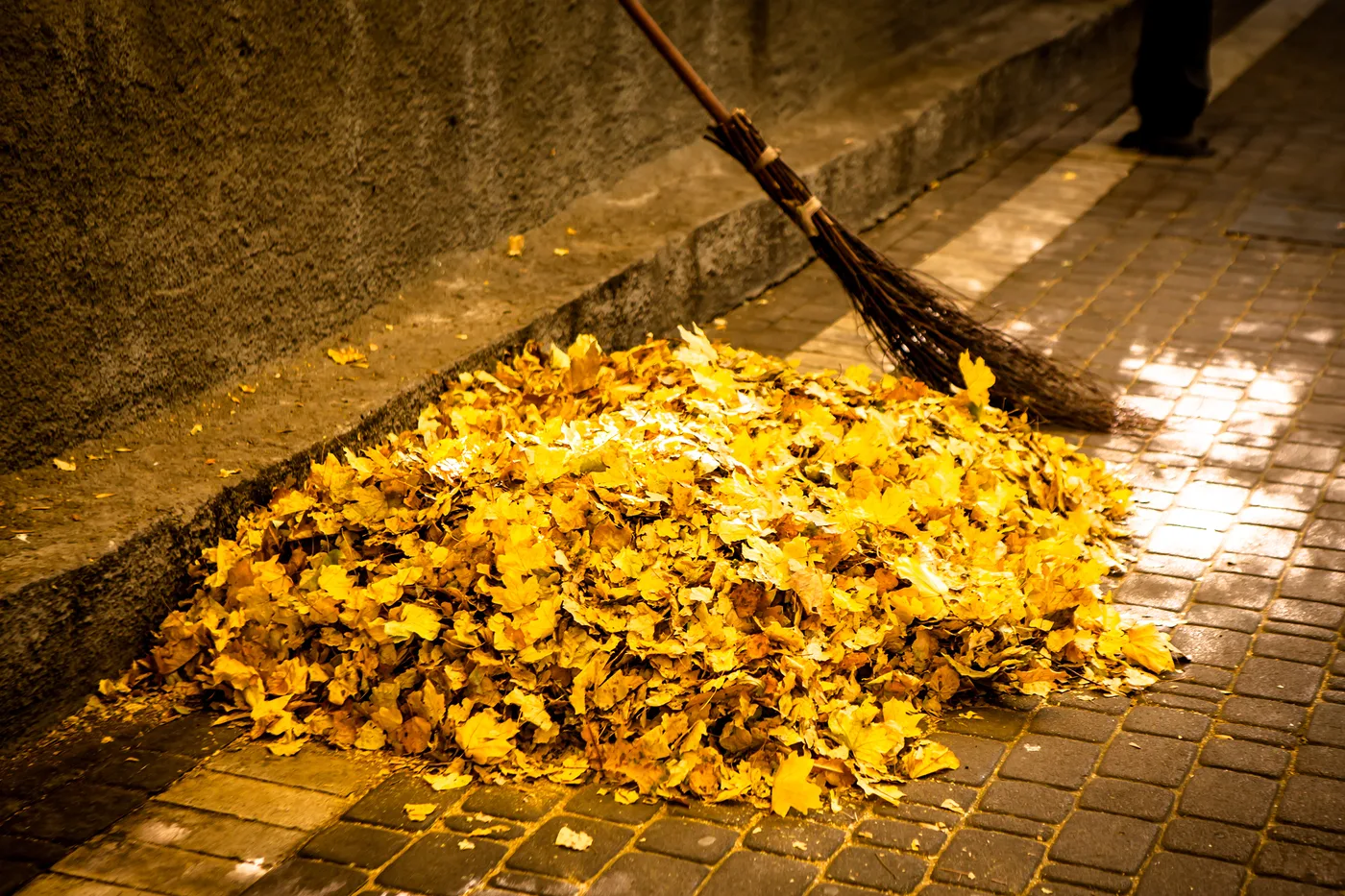
There is a kind of neighbor every street seems to have had at some point. Early in the morning, before most of the houses were awake, they were out with a broom, sweeping the leaves off their front walk and the sidewalk in front of it. And when they reached the edge of their own property, they did not stop. They kept going a few strokes past the line, into the next yard's stretch of pavement, and then turned back. Nobody asked them to. Most people never noticed. The sidewalk was simply a little cleaner than it had any reason to be.
The line and the broom's width beyond it
The habit of sweeping the stoop and the sidewalk out front is an old one, and in many places it was once a daily household chore, as ordinary as making the bed. What matters here is not the sweeping itself but those few extra strokes. They are the smallest possible act of care for something that is not yours. They cost nothing, take seconds, earn no credit and change almost nothing. And yet anyone who has lived next door to a person like that knows the feeling they leave behind: a sense that somebody on this street is paying attention.
We all live on lines like that. There is the edge of our desk and the shared table beside it. The part of the kitchen we used and the part we did not. Our spot on the train platform, our stretch of the beach path, our own cart in the parking lot. Most of the time we take care of our side, more or less, and leave the rest to whoever is responsible for it. Which is reasonable. It is also, quietly, how shared places slide into neglect: not through anyone's bad behavior, but because the space between everyone's lines belongs to no one in particular.
Why the small thing matters
It is easy to dismiss this as trivial. A few leaves, a stray cup, a cart left in the wrong place. But anyone who has thought about how neighborhoods and workplaces feel knows that small signs of care and small signs of neglect both have a way of multiplying. A clean corner tends to stay clean. A corner with one piece of litter collects a second. People read the condition of a place, mostly without thinking about it, and adjust their own behavior to match.
The person who sweeps past their own step is, in a small way, setting the tone for the whole block. They are making a public statement without saying a word: this place is cared for. And because most people want to match the standard around them, the statement tends to spread.
There is a practical side as well, especially at this time of year. Fallen leaves that wash into the storm drains along the curb can clog them, and a clogged drain means a flooded corner the next time it pours. Many towns ask residents to clear the drain nearest their house during leaf season, and the neighbor who does it for the drain two doors down, too, is doing a genuine public service that will never show up on any list.
What it does for you
The less obvious effect is on the person holding the broom. Caring for something that is not strictly yours changes your relationship to it. A sidewalk you sweep becomes, in a modest way, your sidewalk. A shared kitchen you wipe down becomes a little more your kitchen. You begin to feel that you belong to the place, rather than simply using it, and that feeling of belonging is one of the quieter supports of a good life. It is hard to feel like a stranger on a street you have swept.
It also trains your attention outward, a few feet past your own concerns. Most of us spend the day inside a fairly small circle of our own tasks and worries. The habit of going a broom's width past the line is a gentle, daily reminder that the world continues on the other side of it, full of people you share it with, most of whom you will never meet.
And it is one of the few forms of generosity that asks almost nothing of you. You do not need money, time, a cause or a sign-up sheet. You only need to notice the line and keep going a little.
Choosing your step
Try this for the next week. Pick one shared place you pass through every day. It could be the sidewalk in front of your house, the break room at work, the laundry room in your building, the path from the parking lot to the beach, the pew or the folding chairs after a meeting. The only requirement is that it belongs to more than one person, and that nobody will notice what you do there.
Each time you pass through, leave it slightly better than your share. Sweep a few strokes past your own walk. Rinse the mug that is not yours along with yours. Pick up the one piece of trash on the beach path, not the whole beach. Return the stray cart along with your own. Push the chairs in on your row and the one behind it. Keep it small enough that it takes less than a minute, because the point is not to become the unpaid custodian of the world. The point is to cross the line, every day, by a little.
Pay attention, too, to how it feels. Some days it will feel good, a small private satisfaction. Some days you may feel a flicker of resentment, a question about why you are doing someone else's part. That flicker is worth noticing. It usually means you have started keeping score, and the habit only works if you do not. If the resentment grows, do less, not more. A broom's width is plenty.
The people who already do it
Once you start, you will begin to see the others. The person at the coffee shop who wipes down the cream station on their way out. The commuter who picks up the newspaper someone left on the seat. The neighbor who brings in your garbage cans along with theirs after pickup. They were always there. You simply did not have the eyes for them, because you were not yet one of them.
There is no club and no badge, and that is part of what makes it good. It is a kind of quiet citizenship, practiced in the space between everyone's lines, and it holds a great deal more of the world together than anyone gives it credit for.
A broom's width
Tomorrow morning, or whenever you next step outside, look at where your part ends. The edge of the walk. The corner of the counter. The end of your row. Then go a little further, just a few strokes, and turn back.
Nobody will thank you. The leaves will fall again by afternoon. Do it anyway, and see what it does to the way that place feels, and to the way you feel walking through it.



Loading comments…