
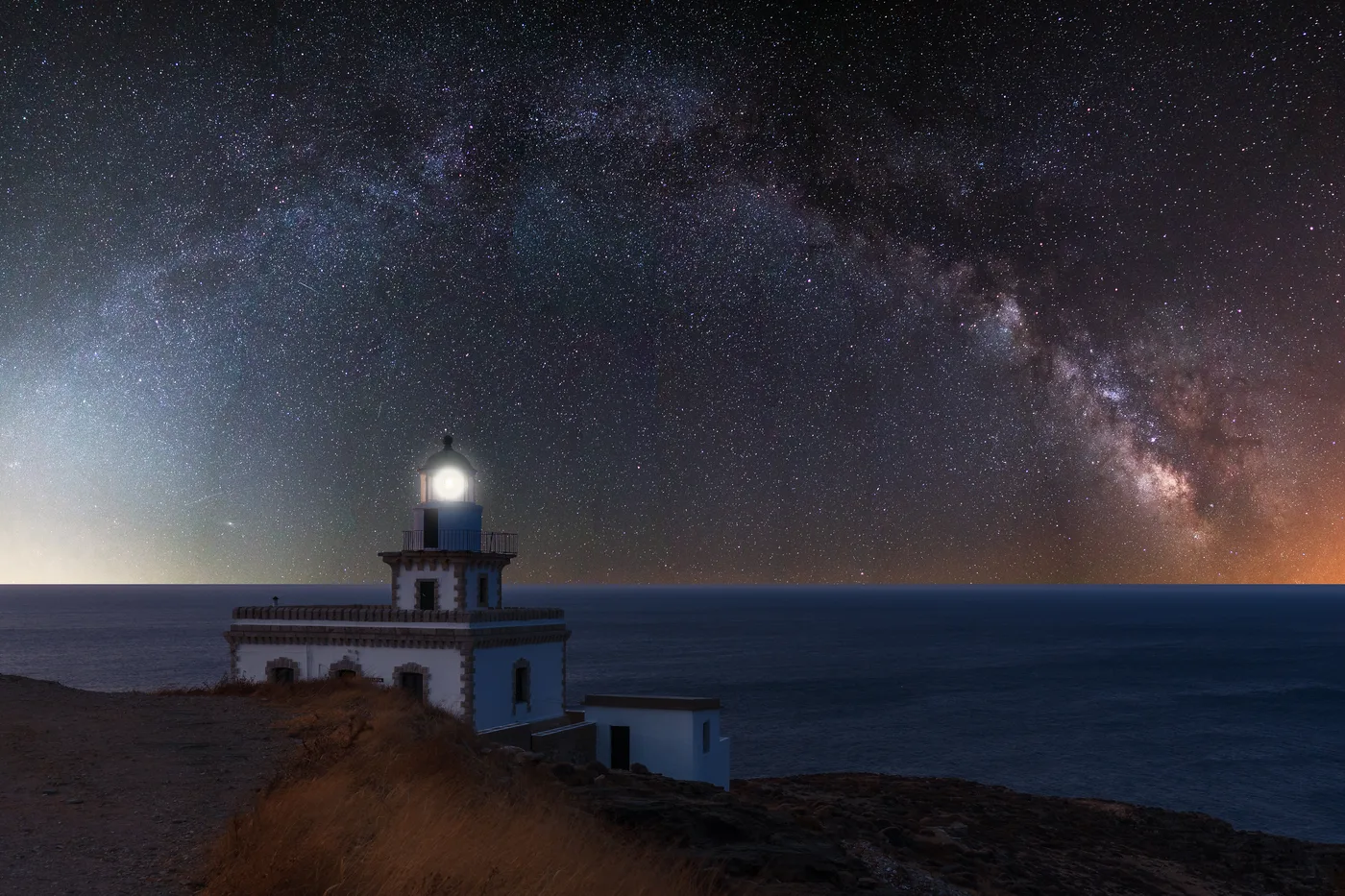
You have had the feeling. The night you walked out of a beach parking lot and the sky had more stars in it than it was supposed to, and you stood by the car with the keys in your hand, not getting in. The thunderhead stacked over the ocean like a white mountain range that had not been there an hour before. The first time you held a newborn and the room went quiet in a way that had nothing to do with sound. The feeling has a name, awe, and for most of history it belonged to religion, mountaintops and cathedral doors. In the last two decades, researchers started treating it as something that could be studied, and what they found is worth knowing: awe is not a luxury emotion for vacations. It is a regular maintenance the self can be given, it changes people in measurable ways, and it is available within a short drive of wherever you are reading this.
The Emotion of Too Big
The researchers' definition is simple and holds up. Awe is what you feel in the presence of something vast, vast in size, number, age, complexity or goodness, that your current picture of the world cannot quite contain. The mind meets something too big for its categories and, for a moment, stops filing and just stands there. The night sky does it with size and number. A murmuration of starlings does it with complexity. A great kindness can do it with moral size. The common ingredient is not beauty, which the mind can file comfortably. It is the moment the filing fails.
The body knows the moment before you name it. Goosebumps, the slight parting of the lips, the long exhale, the word wow escaping without consultation. People in awe go quiet and still, eyes wide, like every porch crowd that has ever watched a storm come in. Something in the organism recognizes that the correct response to vastness is to stop broadcasting and receive.
The Small Self
Here is the finding at the center of the research, and it sounds like a loss until you feel it. Awe makes the self smaller.
People fresh from an awe experience, standing under giant trees, looking from an overlook, watching immensity on a screen, consistently describe themselves as smaller, and draw and photograph themselves smaller, than people fresh from ordinary pleasure. The inner narrator, the one that runs commentary on your standing, your worries, your unanswered messages, drops its volume. And rather than feeling diminished, people report feeling relieved, the way a small boat is relieved to be in a large harbor. The self was never built to be the biggest thing in view, and it rests when it is not.
The downstream effects follow from that shrinking, and they have been measured. People who have just felt awe give more generously in experiments and describe their time as more plentiful, where hurry is, at bottom, the feeling of being the largest and most urgent object in the frame. In one study that has aged well, older adults were asked to take one fifteen-minute walk a week and simply tune it toward wonder, noticing what was vast, old or new. Over eight weeks, compared with ordinary walkers, their daily emotional weather measurably brightened, and in the selfies the study collected, they literally made themselves smaller in the frame, giving more of the picture to the world. Nothing about their lives had changed. The aperture had.
Why This Belongs to the Spirit
Every contemplative tradition has known this by other names. Reverence, wonder, the fear of the Lord in the old sense of the word, the pilgrim's arrival, the instruction to consider the heavens. The traditions disagree about what the vastness is. They agree with remarkable unanimity about what standing before it does to a person: it rights the scale, putting the self back among things instead of above them, and what flows from that resizing is, reliably, gratitude and humility and a loosened grip.
This is why awe is the most portable of spiritual practices. It asks no belief. The atheist under the Perseids and the believer under the same sky are having recognizably the same experience, whatever they call it afterward. If you have a tradition, awe is likely near its center. If you have none, awe may be the part of religion that was describing something real all along, the part you can keep. To be moved by something incomparably larger than yourself, and to come back kinder and less hurried, does not require a theology. It only requires showing up where the vastness is.
The Awe Walk
The practice, then, borrowed straight from that eight-week study: one walk a week, aimed at wonder.
The method is mostly a matter of attention. Go somewhere with some bigness in it, water, sky, old trees, and walk without the phone, or with it silenced and pocketed. Then tune outward. Awe favors three things: the vast, the old and the new. Look for what is larger than you, the horizon, the weather, the ocean doing its permanent work. Look for what is older than you, a two-hundred-year-old oak, the glacial boulder in the woods, the moon. Look for what you have never actually seen before, which is everywhere once you look slowly. Novelty is awe's doorway, which is why travel produces so much of it, and why the practice is really the art of traveling in place.
Expect self-consciousness at first, and expect the narrator to keep interrupting. Fine. The skill, as in any meditation, is the return: back to the sky, back to the water, back to the thing too big to file. Fifteen minutes. Once a week. It is a small tithe for what it buys.
Where the Vastness Lives Here
Long Island keeps more awe in stock than its reputation suggests, and late summer is a strong season for it.
The ocean horizon is the nearest supply: that line off Jones Beach or Fire Island is miles away and looks it, the largest single thing most of us ever stand in front of, open all year, free after Labor Day. The night sky survives out east; a moonless night at Montauk Point, with the Milky Way over the water and the lighthouse beam sweeping under it, is a cathedral with the roof off. August itself cooperates, sending the Perseids every year around the middle of the month. Storms count, watched with respect from a safe porch as a thunderhead builds its ranges over the South Shore. So do the starling murmurations of fall, turning like one animal over the parkways, and the old glacial erratics in the North Shore woods, boulders that outwait every family that names them, and the horseshoe crabs of a June high tide, older than the trees, older than the ridge the trees stand on.
None of it is far. That was the point of studying ordinary awe in the first place: the vastness was never rationed, only unvisited. One walk this week, aimed at something too big to file. Stand in front of it until the narrator quiets and the frame widens and you are, briefly and correctly, a small thing in a large and interesting place. Then notice the size of what you carry home.
Loading comments…