
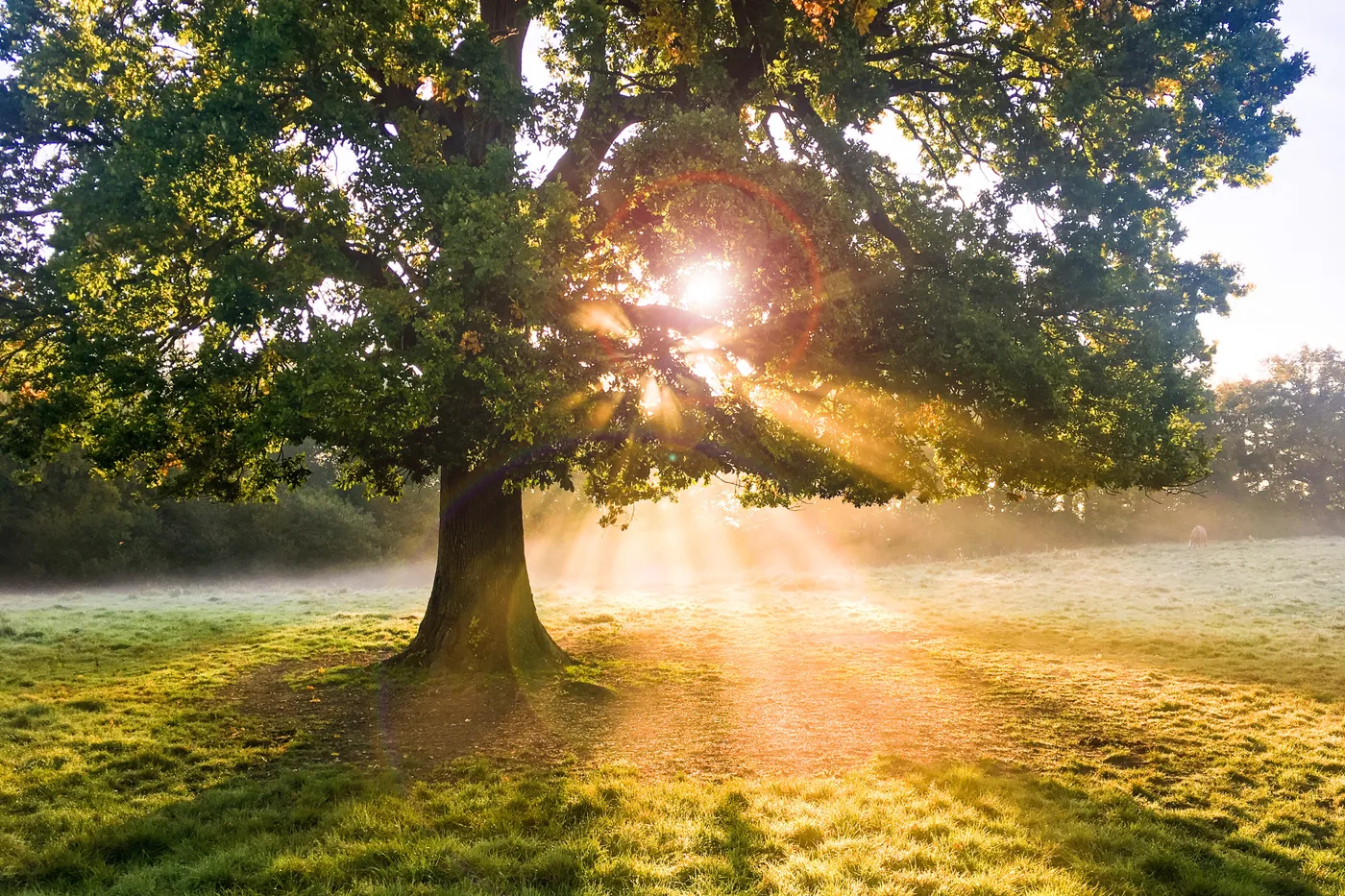
There is a tree in front of your house, or near the corner where you wait to cross, that you have seen more often than you have seen most of the people you love. You could draw its silhouette from memory. You know which branch drops first in a storm and where the shade lands in July. And there is a fair chance you do not know its name. Not the private name a child might give it, but the plain one: what kind of tree it is, what it is called by everyone who ever learned to call it anything.
Scenery, and what it hides
Most of the living world reaches us as backdrop. Botany educators in the 1990s gave a name to one piece of this: the tendency to see plants not as individual living things but as a green wash behind the parts of the scene that move. The same flattening happens with birdsong, with the weeds in the sidewalk cracks, with the stars, and, if we are honest, with people. The man at the deli counter who has made your sandwich two hundred times is, in your mind, quite possibly still the sandwich guy.
None of this is a moral failure. Attention is expensive, and the mind economizes by filing the familiar under scenery. But the filing has a cost. A world made of backdrop is a lonely place to live, and it is lonelier than it needs to be, because the remedy is nearly free. The remedy is a name.
What a name actually does
Learn one name and you can watch the machinery work. Suppose you learn today that the tree with the deeply ridged bark and the round-lobed leaves is a white oak. For years it was simply there. Within a week you will start seeing white oaks everywhere: in the parking lot at the grocery store, along the parkway, in the neighbor's yard. They were always there. What changed is that you now have a handle for them, and the mind retrieves what it has handles for. Psychologists call the sudden everywhere-ness of a newly learned word the frequency illusion, and it is one of the few illusions that leaves you better off.
A name does something subtler, too. It converts a category into individuals. Before you learn the word, there are trees. After, there is the white oak on your street, which is not the same as the pin oak two doors down with its pointed lobes, which is not the same as the sassafras at the edge of the school field wearing three different leaf shapes on one branch, one of them shaped like a mitten. Difference becomes visible only when you have words to hang it on. And what is visible can be loved. It is very hard to love a green wash. It is easy to love the sassafras with the mittens.
An old instinct
The traditions noticed this long before the psychologists did. In the Genesis story, the first task given to the first human is not building or tilling but naming: the animals are brought forward one by one to see what he will call them. Whatever else that story is doing, it is saying something true about us, that naming is the first act of relationship, the moment a creature stops being furniture and starts being a neighbor.
Folklore carries the same intuition from the other direction. In stories the world over, knowing a being's true name gives you a claim on it: Rumpelstiltskin loses his power the moment the queen says who he is. The old tales treat names as a form of intimacy so potent it borders on magic. They are not wrong. Think of what it does to you, in a waiting room or on a phone call, when a stranger uses your name and gets it right.
Even the scientists who built the modern catalog of life were driven by something that looks, up close, a great deal like devotion. Linnaeus spent his career giving every plant and animal a two-part Latin name, and the system survives because it did what names do: it let people all over the world talk about the same creature and know they meant it. A taxonomy is a love letter written in a very dry hand.
The people, too
It would be a strange practice that extended more courtesy to trees than to human beings, so let the practice include the people. The crossing guard, the mail carrier, the woman who is always at the desk when you return your library books. Most of them are wearing a name tag or would be glad to tell you. Ask once, use it after, and notice what happens to the transaction. It stops being a transaction. You have not become friends; you have become particular to each other, which is the soil friendship grows in and is worth something even when nothing grows.
This costs more than learning the oak, because it risks a moment of awkwardness, and the modern nervous system treats awkwardness as a hazard on the order of weather. It is not. It is three seconds of warmth in exchange for being, from then on, a person where you used to be a function.
A practice for one week
Here is the whole practice: learn ten names this week. Not as trivia, but as introductions. A workable list looks like this.
Three trees you pass daily. On Long Island the odds favor oaks, maples, black cherry, pitch pine near the barrens, sassafras at the wood edges, and the tulip tree standing head and shoulders over everything else. A field guide works, and so does any of the free plant identification apps: point, photograph, and the name is yours to keep.
Two birds you hear or see. The Cornell Lab of Ornithology gives away an app called Merlin that can identify a bird from its song through your phone's microphone, which feels like being handed a working enchantment. October on Long Island brings the white-throated sparrows down from the north woods; birders learn their thin, whistled song as a phrase about a man named Sam Peabody. Once you can name that song, your street corner in autumn is never anonymous again.
Two plants you have been calling weeds. The blue roadside flower that closes by afternoon is chicory. The tall one foaming gold along the roads right now is goldenrod. Both have been keeping you company for years.
And three people whose faces you know and whose names you do not. One a week is plenty if ten feels like a crowd. The number is not the point. The direction is the point.
What to expect
Do not expect transcendence by Friday. Expect something smaller and more durable: the walk to the train gets thicker with acquaintances. The season stops being weather and starts being a story with characters in it, arriving and leaving on schedule. You will catch yourself greeting things, silently, the way you nod at a neighbor, and the greeting will be returned in the only way the world returns a greeting, by being more fully there.
Attention, the old teachers keep telling us, is the beginning of reverence. That can sound abstract until you hold it by the specific end: you cannot revere a green wash, but you can revere a white oak you know by name, in its particular corner, dropping its particular acorns. The world is not asking to be admired in general. It is waiting, patiently, the way anything waits at the edge of a party, to be introduced.


Loading comments…