
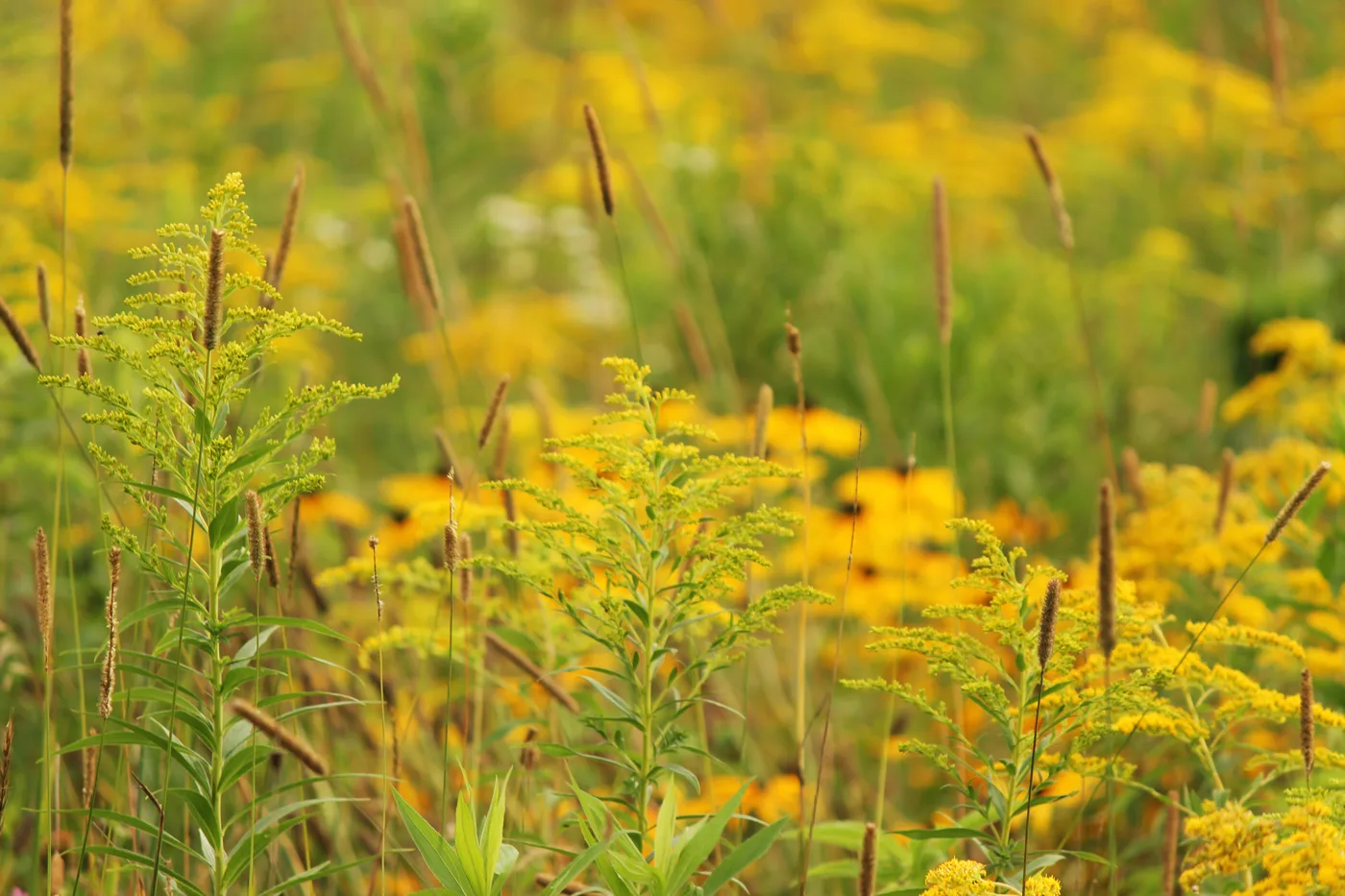
Right about now, along every Long Island roadside and railroad cut, at the edges of parking lots and the backs of dunes, the goldenrod comes into bloom: tall, unruly plumes of saturated yellow, the last big color of the growing year. And right about now, as if on cue, the sneezing starts. The two events arrive together every August, and for more than a century the flower has been convicted on timing alone. It is one of the most durable wrong ideas in American backyards, and the truth behind it is better than the myth: a small lesson in how pollen actually travels, and a reason to look at the showiest plant of late summer with something like gratitude.
The Case of Mistaken Identity
The sneezing is real. Late August through the first frost is the height of fall allergy season in the Northeast, and it is miserable for millions of people. But the culprit is not the yellow flower you can see. It is a plain green plant you have probably never consciously looked at: common ragweed, which blooms on exactly the same calendar, often in exactly the same waste ground, a few feet from the goldenrod that takes the blame.
Ragweed is easy to overlook because it has nothing to show you. Its flowers are small, greenish, and arranged in nondescript spikes, and that drabness is the whole story. Ragweed is wind pollinated. It does not need to attract a single insect, so it spends nothing on petals, color, or scent. It puts its entire budget into pollen, staggering quantities of it, grains so small and light they ride the wind for miles. That cloud is invisible, and it is what lands in your nose. A plant you cannot pick out of a lineup is the one responsible, while the flower blazing yellow beside it gets the sneeze and the reputation.
Why Goldenrod Cannot Be the Problem
Goldenrod runs the opposite strategy. All that color is advertising, and advertising only makes sense if customers are coming in person. Goldenrod is insect pollinated: its pollen is comparatively heavy, waxy, and sticky, built to cling to the leg of a bee rather than to drift on the air. Very little of it goes anywhere the wind takes it, which is why goldenrod pollen barely registers in air sampling even when the plant is blooming by the acre. You would essentially have to put your face in the flowers to dose yourself.
Here is the rule of thumb worth keeping, because it sorts nearly every allergy accusation you will ever hear: if a flower is showy, it is almost certainly not your problem. Showiness and airborne pollen are opposite strategies, and a plant does not pay for both. The plants that cause hay fever, the ragweeds, the grasses, the wind-pollinated trees of spring, are all drab, because they never needed to be beautiful. The flowers we blame are the ones we can see, and the ones we can see are precisely the ones that are not in the air.
What Goldenrod Is Actually Doing
Once the charge is dropped, you can see the plant for what it is: the most important restaurant of the late season. By September, most of the summer's blooms are finished, but the customers are not. Honeybees are provisioning hives for winter. Bumblebee queens are feeding before their long dormancy. Migrating monarchs are working their way along the coast toward the south, burning fuel the whole way. For all of them, goldenrod is the great last table, open from August until frost, often the most reliable nectar and pollen source left standing.
Stand next to a big stand of it on a warm afternoon and simply listen. The whole plant hums. Dozens of species of bees, wasps, flies, beetles, and butterflies work the plumes at once, and none of them are there by accident. Ecologists consistently rank the goldenrods among the most valuable native plants in the Northeast for supporting insect life, which means, one link up the chain, for supporting the birds that eat those insects and feed them to their young.
Long Island has its own specialist in the family: seaside goldenrod, the thick-leaved, salt-tough species that blooms on the dunes and back barrier flats into October. If you walk the ocean beaches in early fall and see monarchs drifting south along the dune line, watch where they stop. Those bright plumes above the sand are gas stations on a flyway that ends in Mexico, and there is not much else out there serving.
Living With the Season
None of this shortens allergy season, so it is fair to ask what to do with the real culprit. You can learn ragweed by sight: knee to shoulder high, ferny, deeply lobed leaves, green flower spikes with no petals to speak of, thriving in disturbed soil, road edges, and the unweeded corner of the yard. Pulling it before it flowers in your own yard is worthwhile, less for your air than for your neighborhood's seed bank, since each plant seeds the years to come. Beyond that, the practical moves are the familiar ones: pollen counts run highest from morning into midday on warm, dry, breezy days, so time long outdoor efforts accordingly, and a rinse and change of clothes after yard work keeps the day's accumulation out of the evening. For allergies that genuinely interfere with life, a clinician can sort out what you are actually reacting to; a piece like this is context, not care.
What you need not do is take it out on the goldenrod. Cutting it down does nothing for anyone's nose and takes the last table away from everything still flying.
An Amends Worth Making
There is even a case for planting it. Native goldenrods, and there are well-behaved garden species alongside the roadside giants, ask for almost nothing: poor soil, no watering once established, no spraying, and they return every year with the season's most defiant color at exactly the moment the garden goes tired. Pair them with the asters that bloom on the same schedule and you have the classic late New England palette, gold against violet, plus a yard that hums into October.
Mostly, though, this is an invitation to look again this week, because the show is on right now and it is free. Somewhere within a short walk of wherever you are reading this, a stand of goldenrod is carrying the end of the season on its back, feeding everything that still needs feeding, guilty of nothing but blooming in public while the real offender stands green and unnoticed nearby. It is a good reminder, and not only about plants: the accused and the culprit are not always the same, and the loudest evidence, arriving together, is still just timing.

Loading comments…