

There is a version of your body you carry around in your head: the one that aches a little, looks a certain way in photographs, should probably drink more water. And then there is the body you actually have, the one doing all of this quietly under your clothes right now. The body scan is a practice for visiting the second one. It is the least glamorous exercise in all of meditation, a slow tour of attention from the soles of the feet to the top of the head, and nearly everyone who tries it decides at some point that it cannot possibly be doing anything. It is doing something. It is just not doing it where you can watch.
The practice, in one paragraph
Lie down somewhere you will not be stepped on, close your eyes, and bring your attention to the toes of your left foot. Not a picture of the toes, and not an effort to relax them. Just whatever is actually there: warmth, pressure, a faint tingling, the touch of a sock, or nothing at all. Nothing is a legitimate finding. After half a minute or so, move on. The sole, the heel, the ankle, the lower leg, and so on, part by part, through the whole body, ending at the scalp. When you notice your mind has left the body entirely and gone back to its usual programming, return to the last body part you remember and continue. That is the entire practice. There is no part two.
It is also the oldest trick in the modern mindfulness book. The slow sweep of attention through the body comes out of Burmese meditation lineages that are centuries old, and when mindfulness was first adapted into a secular eight-week course for hospital patients, the body scan was the first formal practice taught, before any sitting meditation at all. That ordering was not an accident. It is the gentlest possible introduction to watching your own attention, because the body gives attention somewhere concrete to stand.
Why the feet and not the breath
Most meditation instruction starts with the breath, and for a lot of people the breath is a perfectly good anchor. But it is a loaded one. The moment some people watch their breathing, they start managing it, the way you suddenly cannot walk naturally when you know someone is filming. Others, especially anyone whose anxiety lives in the chest, find that attending to the breath feels less like resting and more like monitoring. If that is you, you did not fail at meditation. You were handed the wrong anchor.
The body is a bigger, quieter target. Sensation has one property that makes it ideal for this work: it only happens now. You can think about yesterday and worry about Thursday, but you cannot feel your left heel yesterday. The moment you actually feel it, you are, by definition, here. And the feet have another advantage, which is that they are a long way from the narrator. The voice that comments on everything lives up in the head, fluent and tireless. The feet have no opinions. Sending attention down there is like stepping out of a loud party into a stairwell.
Scientists have a word for the felt sense of the body from the inside: interoception. It covers everything from a full bladder to a racing heart to the vague heaviness that turns out, on inspection, to be tiredness you had not admitted. Like any perception, it sharpens with use. People who practice attending to the body get better at reading its early, quiet signals, and the signals are worth reading, because the body usually knows you are hungry, cold, exhausted or braced long before the narrator gets the memo.
What the tour actually trains
The scan looks like a relaxation exercise, and it often is relaxing, but relaxation is a side effect. What the practice drills, over and over, is three small moves: aim attention at a chosen place, hold it there for a while, then deliberately release it and move it somewhere new. Aim, hold, release, move. Forty times in a single pass through the body.
That sequence is worth noticing, because it is the skill your actual day runs on. Very little of life asks you to concentrate on one point forever. Almost all of it asks you to move attention on purpose: from the road to the mirror and back, from what your child is saying to the pot that is about to boil over, from the paragraph you are writing to the person in the doorway. The scan is attention taken through its full range of motion, the way a physical therapist moves a joint. Not held rigid. Moved, smoothly, under your own steam.
And then there is what you find in there. Almost no one gets through their first week of scans without discovering effort being spent that they had not authorized: a jaw held tight, shoulders riding an inch high, a stomach gripped as if bracing for a blow that is not coming. These are not symbols of anything. They are just muscles doing unpaid overtime. Sometimes simply noticing one is enough to let it stand down, and the first time your shoulders drop on their own mid-scan is quietly astonishing. Sometimes the tension stays right where it is. That is fine too. You are taking inventory, not performing repairs.
Falling asleep is information
Here is what will probably happen the first few times: you will lie down, get somewhere around the knees, and wake up forty minutes later with no memory of the thighs. Nearly everyone does this, and it deserves a kinder reading than failure.
Two things are true at once. First, you are horizontal with your eyes closed, which is a posture your nervous system has spent your whole life learning as the cue for sleep. Second, you may simply be tired, and the stillness gave your body its first uninterrupted chance all day to say so. That is not a broken meditation. That is data.
If you keep sleeping through it and would rather not, the adjustments are simple: do the scan earlier in the day, do it sitting up, or let your eyes stay slightly open. Some people keep two versions, a nighttime scan that is allowed to dissolve into sleep and a daytime one that is for staying awake inside the body. Both are useful. They are just different practices, and it helps to know which one you are doing.
How to do it this week
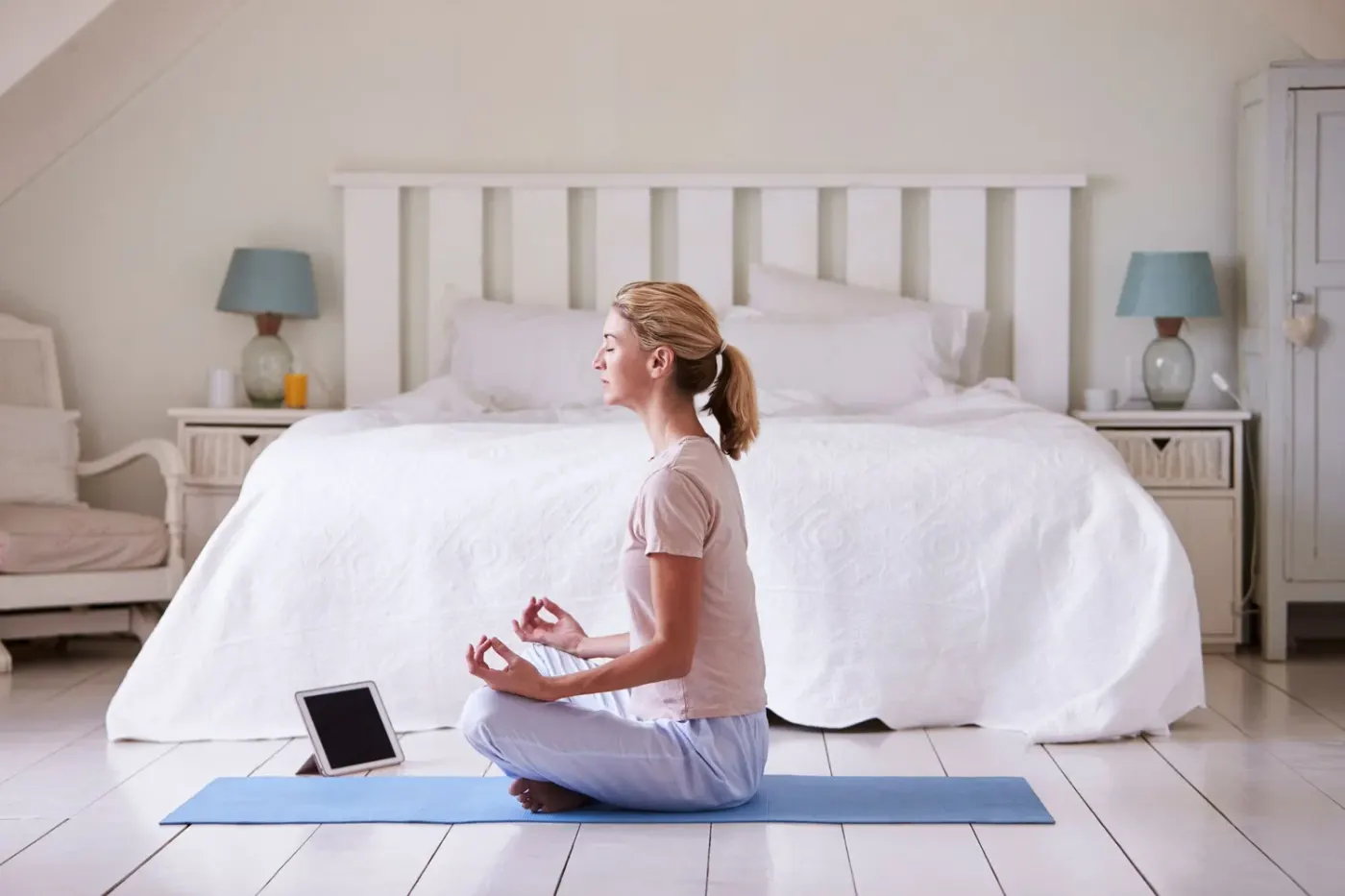
Ten minutes, once a day, for a week. Lie on a rug or a bed, or sit if lying down means sleeping. Same time each day if you can manage it, because the habit does half the work. Start at the feet and move up in stages: feet, lower legs, knees, thighs, hips, belly, chest, back, hands, arms, shoulders, neck, jaw, face, scalp. Roughly half a minute each, no stopwatch required. A slow recorded guide is fine if the silence feels like too much room, but you do not need one. The body already knows the route.
Expect the first few sessions to be boring, sleepy or both. Somewhere in the second week, for most people, the practice starts leaking off the rug: you catch the raised shoulders at your desk at two in the afternoon instead of discovering them at midnight, notice the held breath in traffic, feel the difference between tired and defeated early enough to do something about it. That leak is not a bonus. It is the point.
One honest boundary: versions of this practice are used in programs for people living with chronic pain, and some of them report that attending to the body changes how the pain is carried. If pain or any ongoing condition is part of your picture, the scan can sit alongside your care, but it is a practice, not a treatment, and it is no substitute for a clinician who knows you.
Your life is not happening in the version of your body you carry around in your head. It is happening in the one on the rug, the one with the cold feet and the tight jaw and the breath moving on its own, the one that has been holding you up all day without being thanked. You do not have to improve it to visit it. You only have to show up at the toes and start walking.

Loading comments…