
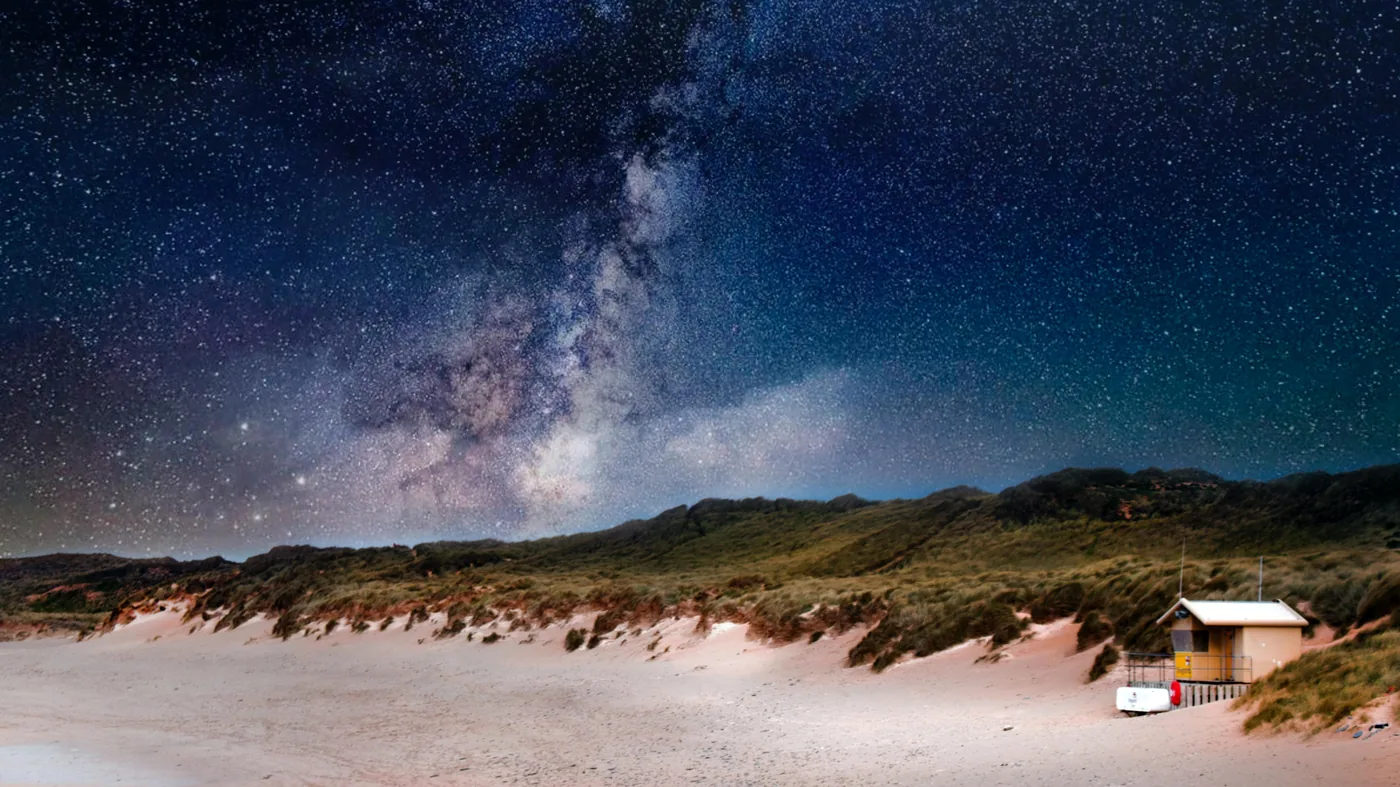
Every human being who lived before roughly 1900 knew what the night sky looked like. Not as an interest or a hobby, but as scenery, the way we know what a street looks like. The band of the Milky Way was simply overhead most clear nights of the year, bright enough to cast the faintest shadow, and it had been there for every generation that had ever drawn breath. Then, in about four decades, most of us stopped being able to see it, and almost nobody noticed it going.
What the Maps Show
The clearest accounting came in 2016, when an international team led by Fabio Falchi published an atlas of artificial night sky brightness built from satellite data and thousands of ground measurements. Its findings are stark. More than eighty percent of the world's population, and more than ninety-nine percent of people in the United States and Europe, live under a sky measurably brightened by artificial light. Around a third of humanity can no longer see the Milky Way at all from home. In North America the figure is close to eighty percent.
Astronomers grade this on the Bortle scale, which runs from one, a genuinely dark site where the galaxy casts shadows, to nine, an inner-city sky in which a few dozen stars are all that survive. Manhattan sits at the top of that range. Western Nassau is not far behind. The gradient across this island runs almost the whole width of the scale, and it runs east.
What Is Lost, Beyond the View
It would be easy to file this under aesthetics, and the aesthetic loss is real enough. But the night is a habitat, and roughly half the species on earth are adapted to it.
Migrating birds navigate partly by the stars and are drawn off course by lit structures, sometimes fatally and in large numbers on a bad night. Moths and other night-flying insects are pulled out of their normal range by fixtures and exhausted against them, a mechanism now recognized as one contributor among several to declining insect populations. Fireflies, which signal to each other in the dark, are straightforwardly outshone by a bright yard.
In people the picture is more tentative and deserves to be described as such. Light in the blue part of the spectrum, at night, suppresses melatonin, and that much is well established in the laboratory. Population studies have found associations between outdoor light at night and disrupted sleep and various health measures, though disentangling how much of that is caused by the light itself, as opposed to everything else that goes with living in a brightly lit place, is genuinely unresolved. The prudent summary is that the sleep effect is on firm ground and the rest is an open question worth taking seriously rather than a settled fact.
Where the Dark Still Is
Long Island has one great advantage in this: it is long, and it ends in the ocean. Drive far enough east and there is simply nothing left to the south or the east to make light.
Montauk Point. The eastern tip is the darkest easily reachable ground on the island, rated around Bortle four, which is not wilderness dark but is enough to show the Milky Way as a distinct band on a clear moonless night. The advantage is the ocean on three sides, so the horizon stays black in the directions that matter.
The Custer Institute, Southold. Long Island's oldest public observatory sits in one of the last genuinely dark pockets on the North Fork, and it opens to the public on Saturday evenings, from dusk until around midnight, weather permitting. Amateur astronomers set up their own instruments on the lawn and are, as a rule, delighted to let a stranger look through them. For anyone who has never seen Saturn's rings with their own eye rather than in a photograph, this is the shortest distance between here and that.
The Napeague stretch and the walking dunes. Low, open and largely undeveloped, with the ocean to the south.
Fire Island. A barrier island with no through road is dark almost by definition, and the water on both sides does the rest.
Access hours and parking rules at state and county properties change with the season, and some close at dusk, which is inconvenient for the obvious reason. It is worth checking before driving two hours.
How to Look
Most people who try this once come away disappointed, and it is almost always for the same three reasons.
Give your eyes their time. Full dark adaptation takes between twenty and forty minutes, and it is not gradual in the way you expect. The sky keeps filling in. One glance at a phone screen undoes nearly all of it in an instant, which is the single most common way an evening is wasted. If you need light, use red.
Check the moon before you check the weather. A full moon washes out more than a thin layer of cloud does. The week around the new moon is the whole ballgame.
Look slightly to the side. The center of your vision is the worst part of your eye in low light. Faint objects appear when you look a little away from them, which feels wrong and works reliably.
For the Milky Way itself, the core is above the horizon in the evening between roughly March and October, and on a July night it stands in the south once the sky is properly dark. Lie down if you can. The neck gives out long before the interest does.
What You Can Do From Your Own Yard
The unusual thing about light pollution, among environmental problems, is that it is instantly reversible. Switch off a light and the dark comes back the same second. Nothing has to be cleaned up and nothing persists.
The practical guidance from DarkSky International amounts to four ideas. Point light down, using shielded fixtures that put it on the ground rather than into the sky and your neighbor's bedroom. Use no more of it than the task needs. Put it on a motion sensor or a timer rather than leaving it burning at four in the morning for nobody. And choose warmer color temperature bulbs, under about 3000 kelvin, since the blue-heavy white ones scatter further in the atmosphere and do more of the damage.
Done across a street, this is noticeable. Done across a village, it brings stars back.
The Reason to Bother
There is research now on awe, on what happens to people confronted with something vast enough to require them to adjust their sense of scale. It tends to make people feel smaller and, oddly, better rather than worse: more patient, more generous, less occupied with themselves. The night sky is the most reliable source of that experience available to a person for free.
It is also the oldest thing you will ever look at. The light arriving at your eye from the far side of the galaxy left before there were people here to see it. That is available on a clear Saturday in Southold, about two hours from most driveways on this island, and it has been waiting the entire time.
Loading comments…