
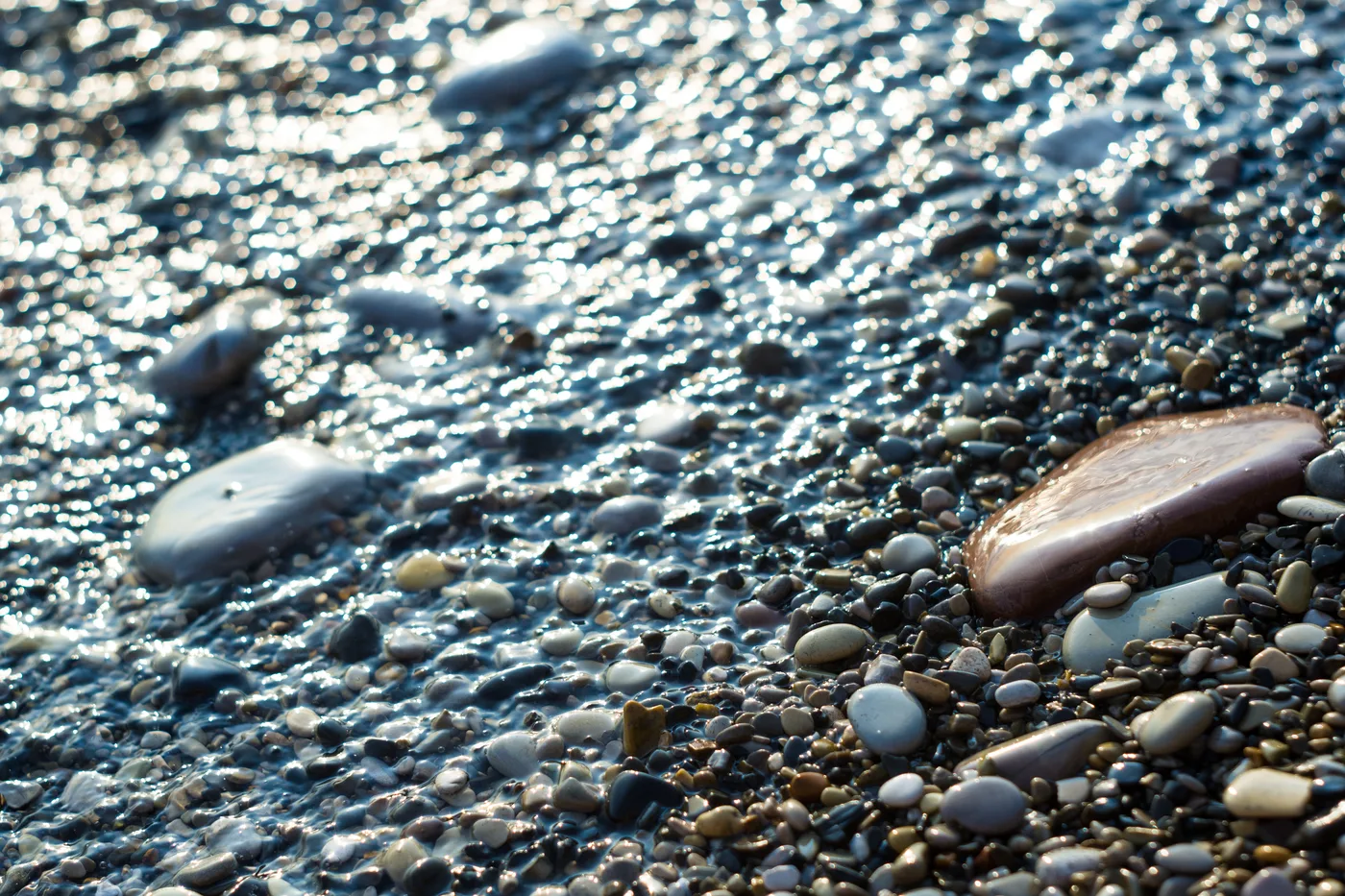
You are walking the tide line on a gray morning and one stone stops you. It is no bigger than the end of your thumb, worn smooth on every side, cool and slightly heavy for its size. You turn it over twice and, without quite deciding to, you put it in your coat pocket. Days later your fingers find it while you wait in line at the pharmacy, and for a second you are back on the beach, the wind in your face, the whole morning returned to you through one small weight. That second is the subject of this piece.
The oldest reminder there is
People have been carrying small things to touch for as long as there have been pockets, and long before. Prayer beads turn up in tradition after tradition: the rosary, the knotted wool prayer rope of the Orthodox churches, the mala used in Hindu and Buddhist practice, often strung with 108 beads, and the prayer beads of Islam, commonly in sets of 33 or 99. The forms differ and the prayers differ, but the gesture is the same. The hand moves, and the mind is called back.
Outside any tradition, the same instinct shows up in quieter ways. A grandmother's ring worn on a chain. A shell kept in the car's cup holder. A worry stone, the kind with a shallow hollow worn for a thumb, sold in gift shops and museum stores everywhere. None of these objects does anything on its own. What they do is give attention somewhere to land.
That is the whole secret, and it is worth slowing down on. Most of us already know what we want to remember. We want to remember to breathe before we answer, to be gentle with the person in front of us, to notice that we are alive on an ordinary Wednesday. The trouble is not knowing it. The trouble is that knowing lives in the head, and the day does not happen in the head. It happens in the hands, the feet, the body moving from task to task. A stone in a pocket puts the reminder where the day actually is.
Why the body remembers first
Touch is one of the quickest routes back to the present. When your fingers close around something with a distinct texture and weight, your attention follows them, even briefly, out of whatever story you were telling yourself and into the sensation itself. Cool, smooth, here. It takes less than a breath.
Repetition does the rest. The first few times you touch the stone, you have to remember what it is for. After a week or two, the meaning starts to arrive on its own. Your hand finds the stone and the pause comes with it, the way a familiar song brings back the summer you first heard it. You have not added a new task to your day. You have tied an intention to a gesture you were going to make anyway.
This is why the object matters less than the bond between you and it. A stone you chose on a morning you remember carries more than one bought in a hurry, not because it is magic but because it already has a memory folded into it. You are not starting from nothing each time you reach for it.
Choosing yours
Long Island is generous here. The beaches along the North Shore are stony, made of rock the glaciers carried down and left behind, and the surf has been polishing it ever since. Walk any of them at low tide and you will find stones of every color: granite flecked with pink, dark basalt, pale quartz that looks lit from inside when it is wet. Many parks and preserves ask visitors to leave natural objects where they are, so check before you pocket anything, or choose your stone from a beach where collecting is allowed, a garden bed or a path you walk often.
Look for one that fits easily in a closed hand and has no sharp edges, since you will be touching it often and without looking. Weight helps. A stone that is a little heavy for its size is easier to notice in a pocket and easier to find by feel.
Then take your time. Hold a few. Put back the ones that feel like nothing in particular. You will usually know the one, not because it is the most beautiful but because your hand does not want to let go of it.
Giving it one meaning
The most important step is the simplest, and the one people skip. Decide what the stone is for, and give it only one job.
It might be a single word: slow, soften, here, thanks. It might be a question you want to ask yourself more often, such as what is actually happening right now? It might be a person you are holding in your heart through a hard season, so that each time you touch the stone you send them a moment of goodwill. It might be gratitude, plain and specific: one thing, right now, that you are glad of.
Whatever you choose, say it once, quietly, while you hold the stone for the first time at home. You are not casting a spell. You are making a small agreement with yourself, and a stated agreement is easier to keep than a vague one. One meaning is enough. A stone asked to remind you of seven things reminds you of none of them.
Carrying it through a day
Keep it in the same pocket, so your hand learns where it lives. Some people move it from coat to coat with the seasons. Some keep it in the pocket of whatever they wear most, or in the corner of a bag where their fingers land when they reach for keys.
You do not need to schedule the moments. They find you. Waiting for the kettle. Standing at a red light. Sitting in the car before you walk into a difficult meeting or a hospital room or a family dinner. Your hand goes to your pocket out of habit, meets the stone, and the meaning you gave it rises up. Let it. A single breath is a complete practice.
Thresholds are especially good. Touch the stone as you leave the house and again as you come home, and you will start to cross those doorways a little more awake. Touch it before you speak when you are upset, and you may find you say less and mean more.
When it stops working
One day you will notice that the stone has gone quiet. You touch it and nothing comes; it has become just a thing in your pocket. This is not a failure. It usually means the intention has done its work and settled into you, or that your life has moved on and the old meaning no longer fits.
That is the moment to choose again. Some people give the stone a new meaning. Others return it, setting it back on the beach or in the garden with a word of thanks, and go looking for the next one. There is something good in that ending: a reminder that was never meant to be permanent, handed back to the place it came from, the way the tide hands everything back eventually.
The weight you carry on purpose
Most of what we carry through a day, we did not choose. Worry, the to-do list, the conversation we keep replaying. A stone in your pocket is a small counterweight: one thing you picked up deliberately, that weighs almost nothing, and that keeps quietly asking you to come back to what matters.
Go find one this week. Hold it until your hand warms it. Give it one word. Then let your fingers do the remembering for you.

Loading comments…