
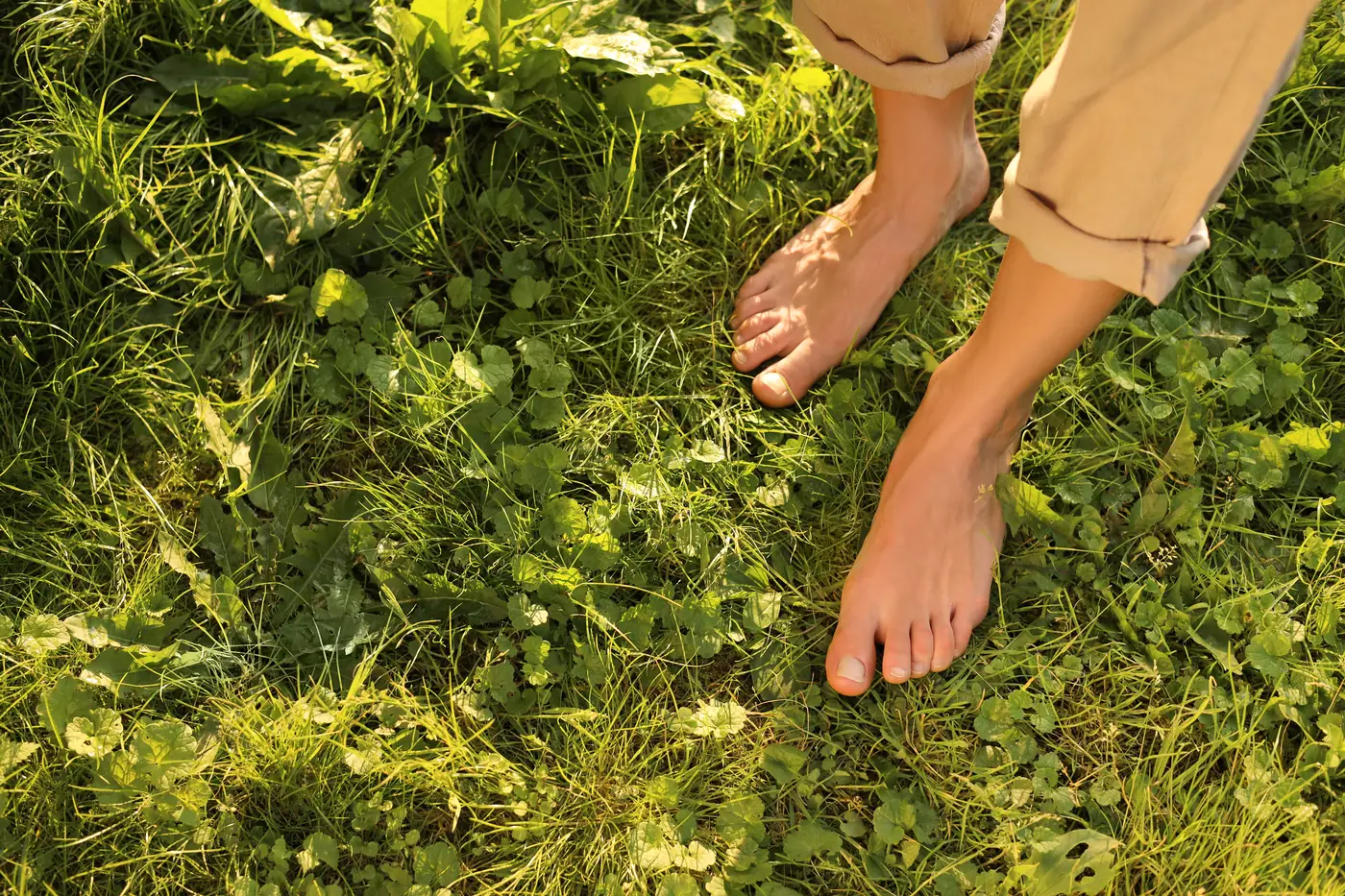
Take a moment and notice your feet. Not look at them, notice them, from the inside. Most people find there is very little there to notice: a vague warmth, the pressure of a shoe, possibly an ache that has been running so long it stopped counting as information. We spend a great deal of attention on the parts of the body we can see in a mirror and almost none on the two structures carrying all of it, and which have been sealed inside a padded box for roughly twelve hours a day since we were four years old.
An Instrument, Not a Platform
Start with the anatomy, because it is genuinely surprising.
Each foot contains twenty-six bones, more than thirty joints, and something over a hundred muscles, tendons and ligaments. Put the two together and roughly a quarter of all the bones in your body are below your ankles. That is not the design of a platform. Nothing needs thirty joints to be a platform. That is the design of something meant to grip, adapt, flex, spread and read the surface underneath it, changing shape several times a second as you cross uneven ground.
And then there is the sole, which is among the most densely nerve-supplied surfaces on the body, in the same conversation as the palms and the lips. Those receptors report pressure, texture, slope, vibration, stretch and the exact distribution of your weight, continuously, to a brain that uses the information to keep you upright without ever consulting you about it.
This is the part worth sitting with. Your foot is a sense organ. We have been treating it as furniture.
What the Shoe Did
None of this is an argument that shoes are bad. Shoes are excellent. They are the reason we can walk on gravel and hot asphalt and January sidewalks, and there is no romance in a puncture wound. But it is worth being clear-eyed about the trade, because the trade is real and almost nobody is told about it.
A thick cushioned sole muffles the signal. The receptors are still there and still firing, but they are reporting on foam rather than on ground, and the texture information simply never arrives. A narrow toe box holds the toes together in a wedge, when their working position is spread wide, particularly the big toe, which is supposed to sit straight ahead and act as the final push-off point of every step. A raised heel, even the modest one in an ordinary sneaker, tips the whole body forward slightly, and the ankles, knees, hips and low back all make small permanent adjustments to keep your eyes level.
And a firm arch support does for the arch what a sling does for an arm. It is exactly the right thing when a structure needs protecting or a condition needs managing, which is a real and common situation and worth taking seriously with a clinician. It is a different thing when it is worn continuously for forty years by a healthy foot. Muscles that are held do not have to work, and muscles that do not have to work get smaller. The arch is not a fixed architectural feature. It is an active, muscular, spring-loaded structure that is supposed to flatten under load and recoil.
The net result, for most adults, is a foot that is weaker, stiffer, narrower and far less informative than it was designed to be. Not damaged. Just underemployed for a very long time.
The Balance You Did Not Know You Were Losing
Here is a quick and slightly uncomfortable test. Stand near a wall, in bare feet, and lift one foot off the floor. Now close your eyes.
Most people who have not practiced this in years wobble immediately and touch down within a few seconds, and they are startled by that, because standing on one leg is not exactly an athletic feat. What just happened is worth understanding. With your eyes open, vision was doing most of the work. Close them and the job falls to two other systems: the balance organs of the inner ear, and the stream of information coming up from the joints and the soles of your feet, which is called proprioception, the body's sense of where it is in space.
Proprioception is a use-it-or-lose-it faculty. Feed the system less information, and give it less practice at responding, and it gets quieter and slower. This is a large part of why balance declines with age, and it is why balance is one of the most trainable things in the body at any age. The system responds quickly to practice. A few minutes a day of standing on one leg produces noticeable change within weeks, and it is genuinely one of the highest-return small habits available to a person over fifty.
You do not have to think of this as fall prevention, though it is that. Think of it as staying fluent in a language your body has been speaking since you were a toddler and has fallen out of practice with.
The Chain Runs Upward
Feet rarely have problems in isolation, and problems that begin elsewhere often show up here first.
The big toe is the clearest example. In a healthy stride, it extends as your heel lifts and you push off through it, and that push-off is what tensions the arch and loads the calf and drives you forward. When the big toe joint gets stiff, or the toe has been squeezed inward for years, that push-off fades. The body compensates by rolling off the inside of the foot or by shortening the stride, and those compensations travel: to the arch, to the calf, to the knee, to the hip, to one side of the low back. People often arrive at a therapist with a knee complaint and leave having been given exercises for a toe.
The calf and the plantar fascia are the other conversation. The fascia is a thick band running from the heel to the ball of the foot, and it works with the calf and the Achilles as a spring. Tight calves keep that spring under permanent tension, which is a common thread in heel pain that greets people on the first steps out of bed in the morning.
Feet also carry a lot of the tension people believe they are carrying in their shoulders. Anyone who has had a proper foot massage and felt their breathing change knows this already. The connection is not mystical. Densely innervated tissue, worked slowly, is one of the more direct routes into the calming branch of the nervous system.
The Ground Itself
There is a reason walking barefoot on sand or grass feels different in a way that is hard to name.
Uneven, textured, yielding ground is information. Every step lands slightly differently, every step asks a different set of small muscles to respond, and all of it is being reported upward at a resolution that a flat sidewalk in a cushioned shoe simply cannot supply. It is exercise for the foot and it is stimulation for the nervous system, and it is also, for reasons that overlap with everything above, calming.
Long Island is unusually well set up for this. There is sand within reach of nearly everyone here, and wet packed sand near the waterline is close to the ideal surface: firm enough to push off, giving enough to demand small adjustments, cool enough to wake the sole up. Twenty minutes barefoot along the tide line is a foot workout that no floor exercise quite reproduces, and it does not feel like exercise at all.
Giving Them Their Job Back
Go slowly with all of this. Feet that have been supported for decades need to be strengthened over months, not converted over a weekend, and the injuries in this area almost all come from enthusiasm rather than from the approach.
Be barefoot at home. The simplest change available and the one that does the most. Ten or fifteen minutes on the first days, building up, on whatever floors you already have.
Stand on one leg while you brush your teeth. Two minutes twice a day, alternating legs, no equipment, no extra time in the day. Eyes open at first. Eyes closed when that gets easy, and hold something.
Spread the toes. Sit down, and try to spread all five apart without curling them. Most people cannot at first and it looks ridiculous, which is a fair indication of how long it has been. Lift the big toe alone while the others stay down, then the reverse. Two minutes while the kettle boils.
Scrunch a towel. Flat towel on the floor, and drag it toward you using only your toes. Thirty seconds a foot. It works the small muscles inside the arch that nothing else in a modern day asks for.
Do calf raises off a step. Heels lowered below the step, then up slowly, then down slower still. Two sets of fifteen, a few times a week. Good for the Achilles, good for the arch, good for the ankle.
Roll the sole. A tennis ball or a chilled water bottle underfoot for a minute or two while you sit. Slow, moderate pressure. Notice what happens to your breathing.
Walk on varied ground on purpose. Grass, sand, a dirt path, a trail with roots in it. Choose the uneven route rather than the smooth one when both are available.
Look at the shape of your shoes. Set one next to your bare foot. If the shoe is narrower than the foot it is meant to hold, that is worth knowing. Wider toe boxes and lower heel-to-toe drop are worth exploring for everyday wear, introduced gradually and not for your longest run of the week.
One important exception. If you live with diabetes, peripheral neuropathy, poor circulation or any reduced sensation in the feet, barefoot walking is not the right practice, and foot care belongs with your clinician. Reduced sensation means an injury can go unnoticed, and that is a serious matter rather than a cautious footnote.
What Comes Back
People who do this for a few months report the same handful of things, and almost none of them are about feet.
They stand differently, and the change usually arrives before they notice they made it. They feel steadier on stairs and on ice and on a boat. Old complaints in the knee or hip sometimes quiet down for no reason they can name. And nearly everyone describes a curious sense of being more present outdoors, which makes sense: you have just reopened a channel of information about the world that had been muffled since childhood.
Your feet have carried you every day of your life without ever being consulted about it. Take your shoes off this evening, stand on the grass for a few minutes, and let them tell you where you are.

Loading comments…