
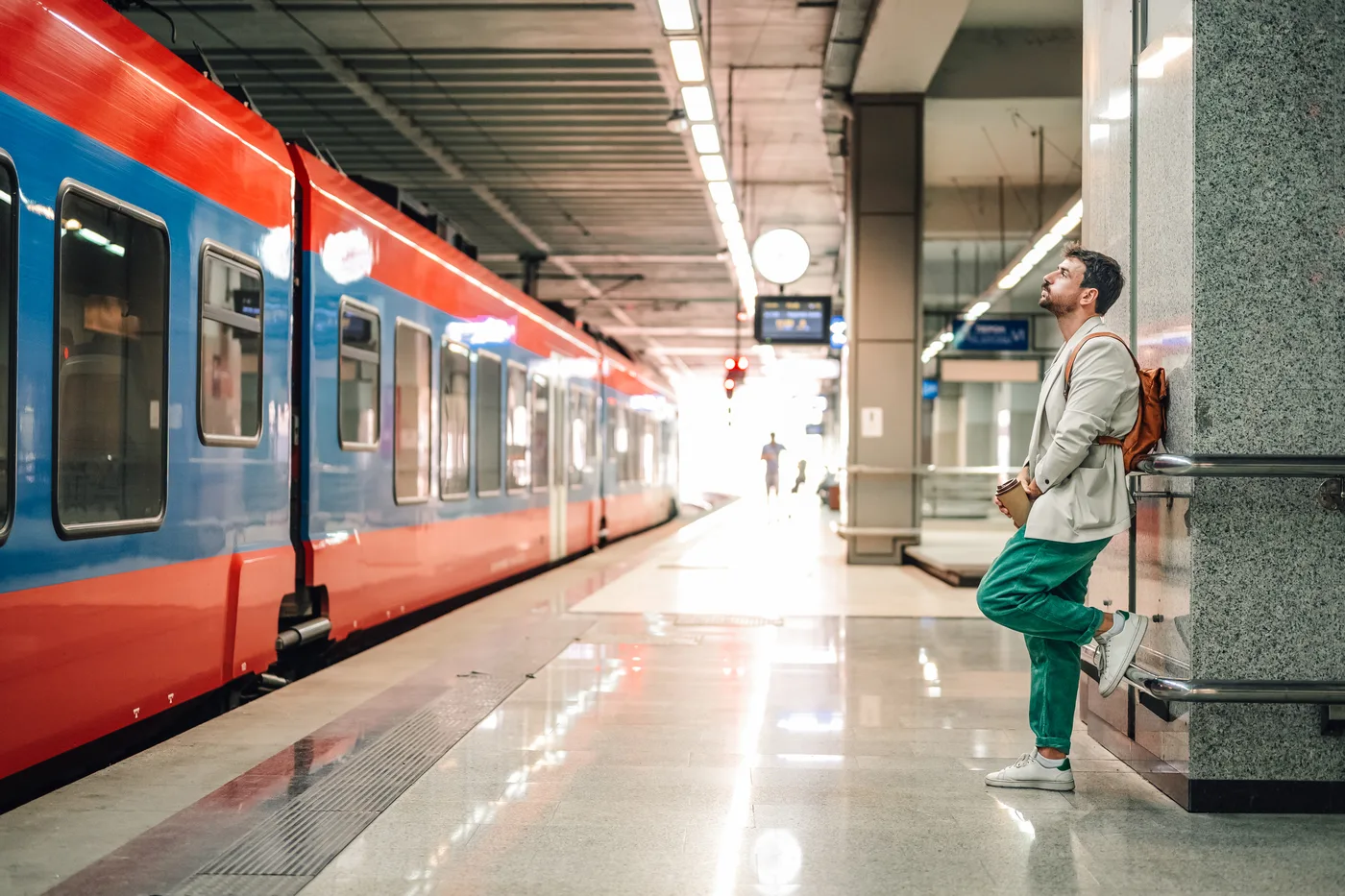
You are third in line at the pharmacy, and the person at the counter has a question about their insurance. Somewhere between their second sentence and their third, your hand has already found your phone. You did not decide to reach for it. The wait opened, and the hand moved, the way a door swings when the latch is worn. Most of us now pass through dozens of these small waits a day without ever actually being in one.
This is a piece about those waits: the line, the red light, the kettle, the elevator, the ten minutes before the appointment. Not about giving up your phone, and not about squeezing more usefulness out of dead time. About what a wait actually is, and what happens when you let one stay empty.
What a wait actually is
Strip away the irritation and a wait is a strange, rare thing: a stretch of time with no assignment. You cannot leave, you cannot speed it up, and nothing is being asked of you. For most of human history these pauses were simply part of the texture of a day. People stood in them, looked around, drifted. The mind did what minds do when nothing is required of them: it wandered, settled, digested.
What changed is not the waiting. Lines are as long as they ever were. What changed is that the pause now has a competitor in your pocket, one engineered to be more interesting than a parking lot. So the wait stopped being a pause and became a trigger: unassigned time appears, and something rushes in to claim it.
Notice the sequence the next time it happens. There is a beat, half a second maybe, between the wait beginning and the phone appearing. In that beat there is a feeling. It is small, but it is real: a faint restlessness, a low hum of not-quite-comfort. The reach for the phone is not really about the phone. It is about ending that feeling before it can develop.
The cost of never waiting
Here is the mechanism worth understanding. Every time the little discomfort of an empty moment gets instantly relieved, the relief gets easier to want and the discomfort gets harder to sit with. Nothing dramatic happens on any single occasion. But run the exchange thirty times a day for years and you have trained something: an intolerance for unfilled time, rehearsed more often than almost anything else you do.
That intolerance does not stay in the checkout line. It follows you into conversations, where a friend's pause starts to feel like a gap to be filled. It follows you into work, where the difficult middle of a task, the part where nothing is happening yet, becomes the moment you check something. It follows you to bed. The capacity being worn down is not patience exactly. It is the ability to be somewhere without requiring the somewhere to entertain you.
And something else quietly goes with it. The wandering mind, the one that shows up only when nothing is scheduled, is where an unhurried kind of thinking happens: the loose ends of the week get found, the thing you actually feel about a decision surfaces, the sentence you could not write in front of the screen arrives from nowhere. A day with no empty minutes in it is a day that thinking never gets.
The oldest trick in the practice
Contemplative traditions figured out something clever a long time ago: a practice attached to an interruption is a practice you cannot forget to do. Some monasteries let the ringing of a bell stand as an instruction, wherever you were and whatever you were doing, to stop and return to yourself. The bell was not an annoyance to be endured. It was the practice, arriving on its own schedule.
A wait is a bell that modern life rings for you all day long. You do not need a cushion, an app, or twenty spare minutes at dawn. You need only to reclassify something that already happens: the line is no longer an obstacle between you and your day. For one or two minutes, it is the day.
The practice, plainly
Do not try to transform every wait. That is a resolution, and resolutions about attention tend to last four days. Instead, choose one recurring wait you can name in advance: the school pickup line, the coffee machine at work, the platform before the 7:42, the kettle. One. That specificity is the whole trick, because it turns a vague intention into a location.
When you arrive in your chosen wait, the practice is almost embarrassingly simple. The phone stays wherever it is. You stand there, or sit there, and you let the wait be what it is. Feel your feet holding you up. Notice the temperature of the air and the sounds arriving from the left and the right. When the restlessness comes, and it will come quickly, you do not fight it or scold it. You just notice it the way you would notice weather: there it is, the little storm that wants the phone. It rises, it peaks, it passes. It always passes. Almost nobody knows that, because almost nobody stays past the peak.
That is the entire practice. No breath counting, no technique, nothing to do well or badly. One wait a day, most days.
What to expect
The first few days are mostly irritation, and it is worth knowing that in advance so you do not read the irritation as failure. The restless feeling will be louder than you expect for something so small, which tells you something about how reliably it has been obeyed.
Then, somewhere in the second week, the texture changes. The wait starts to feel less like a held breath and more like a sat-down rest. You begin to notice things: the pharmacy has a skylight, the man ahead of you says thank you twice, the light before yours turns green a beat early. None of it is important. All of it is the world, arriving unfiltered, which is a thing you may not have experienced in a while.
And the beat between trigger and reach gets longer. That half second where the restlessness lives becomes a full second, then three. This is the quiet payoff, and it is bigger than it sounds, because that gap is not specific to phones. It is the same gap in which you decide whether to interrupt someone, whether to send the sharp reply, whether to abandon the hard task at its hardest point. Widen it anywhere and you have widened it everywhere.
The wait you are in now
There is a larger version of this, and it deserves a sentence. Much of a life is spent waiting for something: the diagnosis, the offer, the reply, the spring. Those long waits cannot be filled or skipped either, and how you stand in the two-minute ones turns out to be how you stand in the two-month ones. The line at the pharmacy is a small rehearsal space, open all day, no fee.
So this week, pick your one wait. Not the noblest one, just the most reliable one. And the next time you are standing in it, empty-handed, doing absolutely nothing, notice that nothing is going wrong. The line moves when it moves. You were never in charge of that part. You were only ever in charge of where you were while it happened.

Loading comments…