
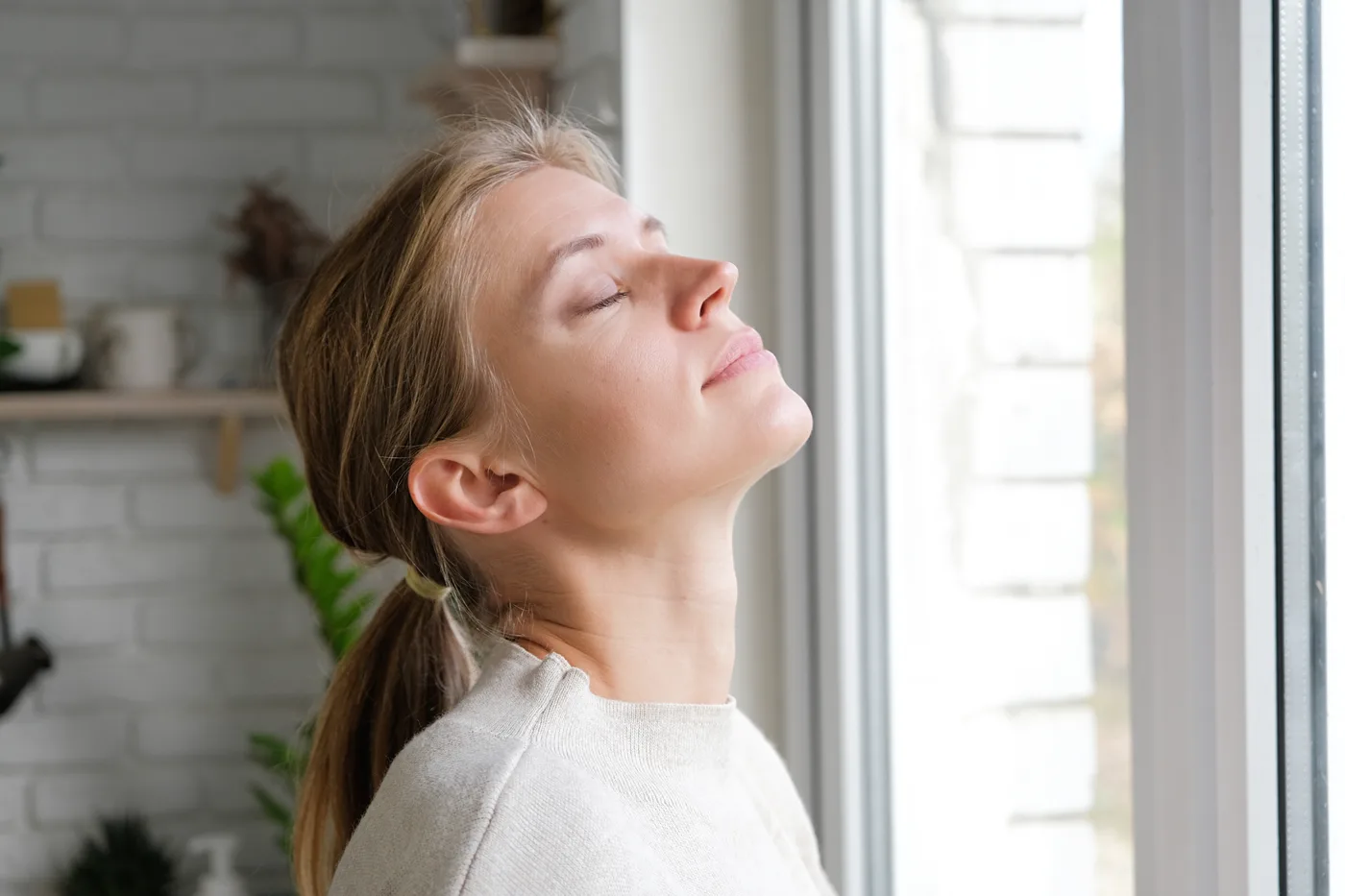
You did it a few minutes ago without noticing. Somewhere between one thought and the next, your body took a breath deeper than the ones around it, held it a beat, and let it go long. Maybe someone nearby heard it and asked if you were all right. The sigh has a reputation as a mood, a small performance of weariness or relief, but before it is any of that it is machinery: one of the oldest pieces of self-repair the body owns, running quietly in the background of every hour of your life.
The Housekeeping Breath
Start with what the sigh is for when nobody is feeling anything. Your lungs are not two simple balloons. They are a foam of hundreds of millions of tiny air sacs, each one a wisp of wet tissue, and wet surfaces like to stick to themselves. Left alone, under the shallow tidal breathing that carries you through a normal seated hour, some of those little sacs gradually collapse and fold shut, the way a plastic bag clings closed once the air is out of it.
The sigh is the fix. Several times an hour, without consulting you, the body takes a breath roughly twice the usual size. That larger breath stretches the lung, pops the folded sacs back open, and restores the full surface across which oxygen enters the blood. This is not optional maintenance. Hospital ventilators are programmed to deliver periodic sigh breaths for exactly this reason, because lungs that are never stretched slowly lose their working area. A creature that could not sigh would be in trouble within hours.
Deep in the brainstem, in the region that keeps breathing running whether or not you attend to it, researchers have traced sighing to a surprisingly small cluster of neurons with this one job. The sigh, in other words, is not a habit you picked up. It is wired in, older than language, older than feeling sorry for yourself on a Tuesday.
Why Feelings Come Out as Breath
So why does the housekeeping breath show up precisely when you are stressed, relieved, frustrated, or letting go of something? Watch for it and you will notice the pattern: the sigh arrives at transitions. The difficult phone call ends, and you sigh. The search for the lost keys succeeds, and you sigh. You read the same paragraph for the third time, and you sigh before you begin it a fourth.
Part of the answer is that stress changes breathing. Under tension, breaths go shallow, quick, and high in the chest, which is exactly the pattern that lets those air sacs start folding and lets carbon dioxide drift out of its comfortable range. The body notices the drift and files its correction, and so the sigh lands more often in a tense hour than a calm one. The feeling did not invent the sigh. The feeling created the conditions that called for one.
But the traffic runs the other way too, and this is the part worth keeping. A sigh does not just service the lungs. The long exhale leans on the heart. Your heart rate is not steady; it rises slightly on every inhale and falls on every exhale, a see-saw run by the calming branch of the nervous system. A breath with a long, unhurried exhale tips that see-saw toward slow. One sigh will not turn a hard day into a soft one, but it reliably takes the top off the body's arousal, which is why the sigh of relief feels the way it does. The relief is not only in the news you got. It is in the breath itself.
Borrowing the Reflex
Here is the practical heart of it: the sigh works just as well when you do it on purpose.
The deliberate version is sometimes called a physiological sigh, and it has a specific shape. Inhale through the nose, and when you feel full, sip in a second, smaller inhale on top of the first. Then let the whole thing go through the mouth, slowly, taking longer on the exhale than both inhales took together. The second sip matters: it is the stretch that reopens the folded air sacs, the same trick the involuntary sigh performs. The long exhale matters more: it is the lever on the heart.
Try one now, reading this. Two breaths in through the nose, one long breath out. Most people feel the difference on the first repetition, a small but unmistakable downshift, like a hand easing off an accelerator.
Researchers have begun testing what happens when people practice this deliberately. In one small month-long study, a few minutes of intentional sighing each day left participants in measurably better daily moods and with slower resting breathing than comparable groups assigned other calm-down practices. Small studies deserve small conclusions, and this one does not prove a cure for anything. But it points where the physiology already points: the exhale is a handle, and it is always within reach.
A Practice the Size of a Minute
Because the sigh is so brief, it fits in the places a longer practice will not. You do not need a cushion, an app, or ten free minutes. You need the gap between pulling into the driveway and walking into the house. The moment after you hang up. The pause before you answer the message that annoyed you, which is perhaps the single highest-value minute in modern life.
A shape that works: when you notice the clench, wherever you are, take three deliberate sighs in a row, and on each exhale let the shoulders and the jaw go with the air. Three is enough to feel. If you have two minutes, in the car, at the kitchen counter, on the edge of the bed, simply repeat the cycle unhurried until the timer runs out. There is nothing to get right beyond the shape of the breath, and nothing to achieve. You are not transcending anything. You are doing lung maintenance, and letting the heart come along.
Two honest cautions belong here. Deliberate breathing practice can feel odd at first, and a few slow sighs are plenty; this is not a contest, and forcing breath after breath can leave you lightheaded. And a breathing pattern is a tool for an ordinary tense hour, not treatment. If anxiety is a room you live in rather than a weather that passes, that deserves a clinician's care, and nothing on this page substitutes for it.
The Body Was Already Doing It
There is something quietly reassuring in the whole arrangement. Long before you learned a single technique, before anyone sold you an approach to calm, your body was already interrupting its own tension several times an hour with a built-in reset it never once asked you to supervise. The involuntary sigh is proof that regulation is not a skill you lack. It is a rhythm you are already inside.
The practice, then, is less an achievement than a borrowing. The body sighs on its own schedule; you are allowed to add a few on yours. This week, let the sigh become something you notice, in yourself and in the people around you, the audible sound of a nervous system tidying up after effort. And when the clench comes, remember that the oldest reset you own is one breath wide: in, a little more in, and a long way out.


Loading comments…