
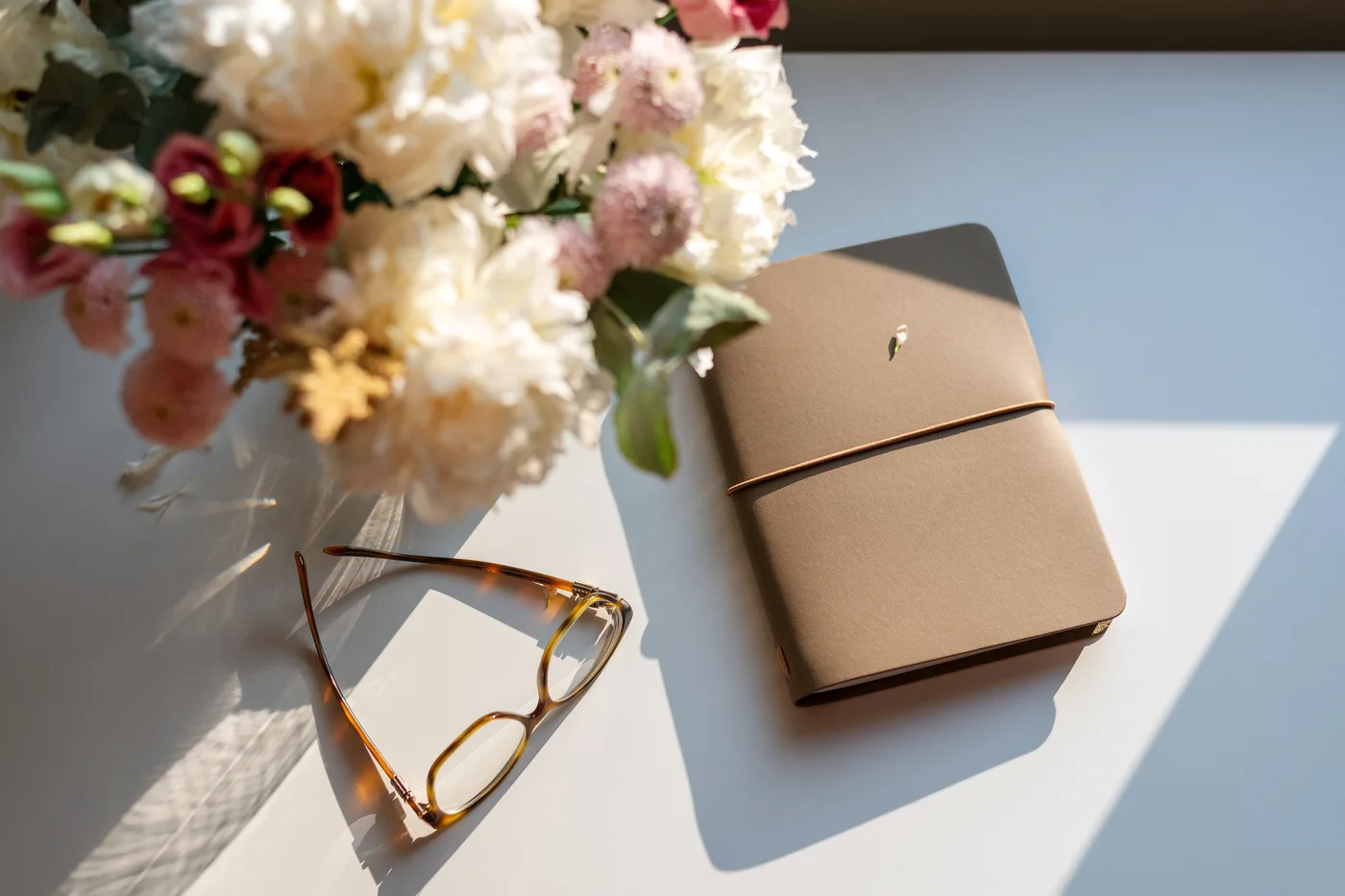
The notebook sits on the shelf where you can see it. Maybe someone gave it to you, or maybe you bought it yourself, drawn in by the cloth cover and the thick cream paper and the ribbon sewn into the spine. That was months ago. You have picked it up more than once, opened it, run a thumb across the first page, and put it back. It is still empty. Not because you have nothing to say, but because nothing you have to say has felt good enough for it.
What the blank page is protecting
An unused thing holds every possible version of itself at once. The empty notebook could become a journal kept faithfully for a year, a sketchbook full of confident drawings, the place where the novel finally starts. The moment you make the first mark, all of those futures collapse into one actual page, and the actual page can be judged. Blank, the notebook is perfect. Used, it is only as good as what you put in it.
That is the whole trap, and it is worth seeing clearly because it does not feel like a trap from the inside. From the inside it feels like respect. You are not avoiding the notebook, you tell yourself, you are saving it: for the right project, the better idea, the version of you with neater handwriting and clearer thoughts. The saving feels virtuous. But notice what is actually being protected. It is not the notebook. Paper does not care what is written on it. What is being protected is the fantasy of a flawless start, and the person being protected from judgment is you.
Psychologists who study how people treat their possessions have a name for part of this: once we designate something as special, using it starts to register as spending it, and we hoard it the way we hoard anything we are afraid to lose. The designation is the problem. The notebook did not arrive special. You made it special, usually in the very moment you decided it deserved better than your ordinary life.
It is never only the notebook
Look around the house and you will find the notebook's relatives. The good watercolors, still in their tray while you practice with the cheap ones. The yarn too beautiful to knit into anything, because any actual sweater would be a comedown from the skein. The candle never lit, the china kept for company that comes twice a year, the dress waiting for an occasion that keeps not arriving, the stationery too lovely to send to anyone you actually know.
Each one is a small deferral, and each one carries the same quiet message: not yet, not this, not you as you currently are. One deferred object is nothing. A house full of them adds up to a strange verdict on your own daily life, a standing declaration that the real occasion is always somewhere ahead, and that today, the only day you demonstrably have, does not qualify.
For people who make things, the cost is more specific. If the good paper is reserved for the work you will do someday, then the work you do today is, by your own arrangement, done on scrap. You have built a hierarchy of materials and placed your actual practice at the bottom of it. Do that for long enough and the hierarchy stops describing the paper. It starts describing you: a person whose real work has not started yet. No one improves inside that verdict. The painters and writers you admire did not save their best materials for their best work. They used what was in front of them, daily, and the daily use is what the best work grew out of.
Spoil the first page on purpose
Here is the practice, and it is deliberately small. This week, take one saved thing and ruin its perfection on purpose.
If it is the notebook, open it to the first page and write today's date and something entirely mundane. The grocery list. What the weather is doing. One sentence about how it feels to be writing on paper this good, which will be some mixture of guilt and relief. Do not write anything worthy of the notebook. Worthiness is the disease; the grocery list is the cure. The point of the first page is not to be good. The point of the first page is to end the notebook's career as an object of reverence and begin its career as a notebook.
If it is the paints, paint a bad and cheerful something with them today, on whatever paper is nearest. If it is the candle, light it on an ordinary Tuesday while you pay the bills. If it is the china, eat a weeknight dinner off it, the kind with no guests and no tablecloth. The pattern is the same in every case: put the saved thing into contact with an unremarkable day, so that the association between this object and some future, better occasion is broken by hand.
Expect the first minute to feel genuinely uncomfortable, a little like spending money you meant to keep. That discomfort is not a sign you are doing it wrong. It is the sound of the designation coming off. Expect the second page, the second pour, the second lit evening to be dramatically easier, because the perfection you were guarding is already gone and there is nothing left to protect. This is why the spoiling has to be deliberate. If you wait to need the notebook, the reverence comes with you. If you break the seal on purpose, with something trivial, you have made a decision instead of an exception.
What use gives back
Something else happens once a beautiful thing enters ordinary service, and it is worth naming because it is the reverse of what the saving instinct predicts. The instinct says use will diminish the object. Mostly, use improves it. The notebook with a cracked spine and a warped cover, dated in the corner of every filled page, is a richer object than the pristine one could ever be, because it has become a record instead of a promise. Leather wears in. Copper pans darken exactly where the heat has been. A quilt that has covered twenty winters of sleep is worth more, by any measure that matters, than one preserved in a cedar chest.
Meanwhile the saved object was never actually safe. Paper yellows in the drawer. Paint dries in the tube. Elastic gives out, candles fade, and the occasion the china was waiting for turns out, on the honest accounting, to have been happening all along, every evening, unattended. Preservation was never neutral. It was just decay with the lights off.
There is a reason this piece sits under Creativity and not under housekeeping. The person who cannot mark the first page and the person who cannot start the project are the same person, running the same protection racket on themselves: keep it potential, and it cannot be judged. Every maker knows the version of the empty notebook that is an empty file, an untouched instrument, a course bought and never begun. The first page is where you practice the only move that ever gets anything made, which is trading a perfect possibility for an imperfect actual thing.
So spoil the page. Light the candle. Get the good dishes down where you can reach them. The most respectful thing you can do to a beautiful tool is not to keep it safe. It is to wear it out.



Loading comments…