
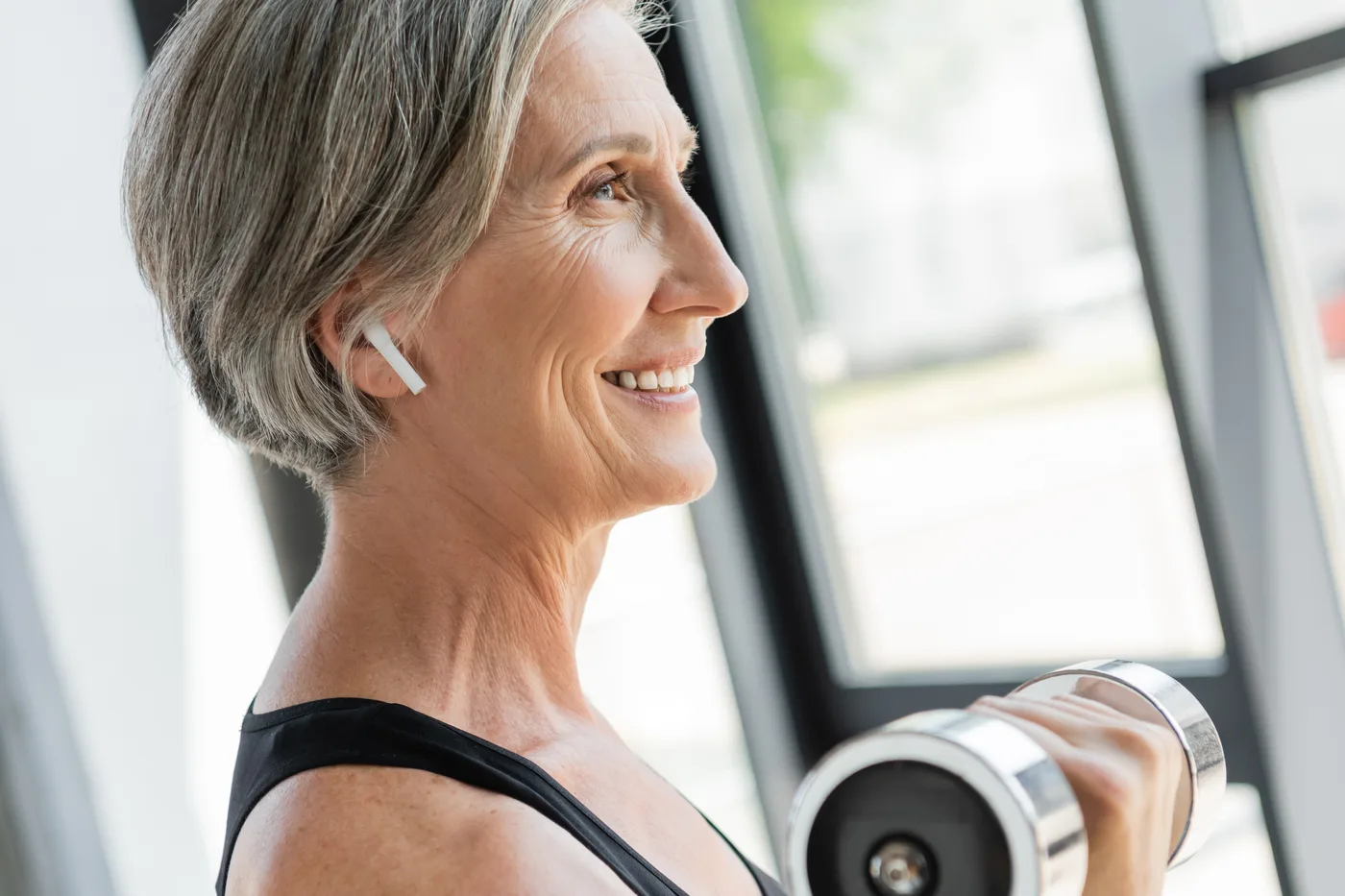
It announces itself in small ways first. The grocery bags come in over two trips instead of one. The suitcase into the overhead bin becomes a thing you time, and then a thing you quietly let someone else do. Nothing hurts, exactly. The body has just started declining tasks it used to accept without comment, and because it happens a teaspoon at a time, it is easy to file under getting older and move on. It deserves a closer look than that.
What is actually happening is specific, well understood, and, unusually for things in this category, substantially answerable. This piece is about strength, why women in particular were talked out of building it, and what a modest, sane version of reclaiming it looks like.
The quiet withdrawal
Muscle is not a fixed asset. It is a tissue in constant negotiation with what you ask of it, and from roughly the middle thirties onward, most adults begin losing a little of it each year. The loss is slow enough to be invisible and steady enough to compound. Left entirely alone, the strength that carries a body up stairs and off low chairs in its eighties is drawn down decades earlier, in years when nobody is paying attention because everything still works.
For women there is a second account being drawn on at the same time. Bone, like muscle, is living tissue, constantly dismantled and rebuilt. Estrogen is one of the signals that keeps that rebuilding in balance, and in the years around menopause, as it falls, the balance tips: for a while, bone is taken down faster than it is put back. This is not a malfunction. It is the standard trajectory, which is exactly why it is worth taking personally. The time to influence the account is while it is still being actively traded.
Here is the part that changes the story from gloomy to useful: both tissues remain negotiable at every age. Muscle asked to work against resistance responds by rebuilding, in the seventies as surely as in the thirties, a finding confirmed so often it is no longer controversial. Bone responds to being loaded: to impact, to pull of muscle on its anchor points, to carrying weight through the frame. Neither responds much to wishing, and neither responds much to the kind of exercise most women were actually encouraged to do.
How women were steered away
For two or three generations, the fitness offered to women was cardio for the figure and stretching for the nerves, with strength kept over in the corner, behind the men, under a set of warnings. Lifting would make you bulky. Lifting was vanity, or aggression, or simply not done. Whole decades of women were handed three-pound dumbbells, a lifetime membership to the treadmill, and the word toning, which described nothing the body actually does.
The bulk fear deserves one plain paragraph, because it has cost women more strength than any injury ever has. Building conspicuous muscle is extraordinarily hard. It requires years of deliberate, heavy, high-volume training and eating in aggressive support of it, and the hormonal deck is stacked against it in women besides. What actually happens when a woman lifts twice a week is that she gets stronger while looking almost exactly the same, except perhaps in how she stands. Nobody has ever accidentally become bulky, in the way nobody has accidentally learned the cello.
Meanwhile the thing being avoided was the thing most worth having. Walking is genuinely good, and not enough. It maintains the heart and mood admirably, but it asks so little of the muscles above the waist, and loads the skeleton so gently, that it cannot by itself hold the line on either account. The line is held by resistance.
What strength actually buys
Not a shape. A capability, and the capability is the point. Strength is groceries in one trip and a grandchild lifted without arithmetic. It is the confidence on stairs, on ice, on the ladder to the attic. Further out, it is the difference between a stumble and a fall, and between a fall and a fracture: strong legs catch a trip that weak ones cannot, and denser bone forgives the landing that thinner bone does not. Researchers who study aging keep arriving at the same unglamorous conclusion, that the strength of the legs and grip in the middle years is among the better predictors of independence in the late ones. Independence is the honest name for what is being trained.
There are quieter returns as well. Muscle is metabolically expensive tissue, which is part of why holding onto it matters through the midlife years when everything else about metabolism is renegotiating. And many women report something harder to measure: that being physically strong changes their relationship to space, to effort, to asking for help, in ways they did not anticipate and would not give back.
A sane way in
The good news is that the effective dose is small. Two sessions a week, thirty to forty minutes, is not the beginner's compromise; it is roughly what the research on maintaining muscle and bone keeps pointing at. And the movements are not exotic. The body has perhaps six things it does against resistance: it squats, it hinges at the hips, it pushes, it pulls, it carries, it gets up off the floor. A session is simply those, loaded to the point of honest effort.
Begin where you are, without apology. A squat to a kitchen chair and back up, ten times, is strength training. Wall push-ups are strength training. So is the most literal exercise in the catalog: pick up something heavy for you, a loaded tote, a full watering can, and walk the hallway with your shoulders back until you need to set it down. The carry trains grip, posture, core and nerve all at once, and it has the advantage of being indistinguishable from life.
The one principle that separates training from movement is progression. The body adapts to what is asked, then stops adapting unless the ask grows. So when ten chair squats become easy, hold something while you do them. When the wall push-up is easy, find a lower counter. Effort that stays comfortable maintains; effort that keeps edging forward builds. Free weights, bands, or a gym all work, and none is required. Gravity and patience are the actual equipment.
Two cautions, stated plainly. Soreness in muscle a day later is normal; pain in a joint during is information, and the answer is to adjust the movement, not to push through. And if you already have a diagnosis in this territory, osteoporosis, a heart condition, a joint replacement, none of this replaces your clinician; it is a conversation to bring to them, and worth bringing, because the answer is very rarely do nothing.
Carrying your own life
There is a phrase worth keeping from the strength world: training for the eighty-year-old you will be. She is real, and she is the one who cashes out whatever you deposit now. But the returns do not wait thirty years. They show up in weeks, in the bag lifted without thought, in the jar that opens, in the flight of stairs that has stopped being a calculation.
So this week, twice, ten minutes: the chair, the wall, the heavy tote down the hallway. Nothing to buy, nobody to impress. Just the oldest bargain the body offers, still open at every age: ask more of me, and I will become the kind of body that can be asked.



Loading comments…