
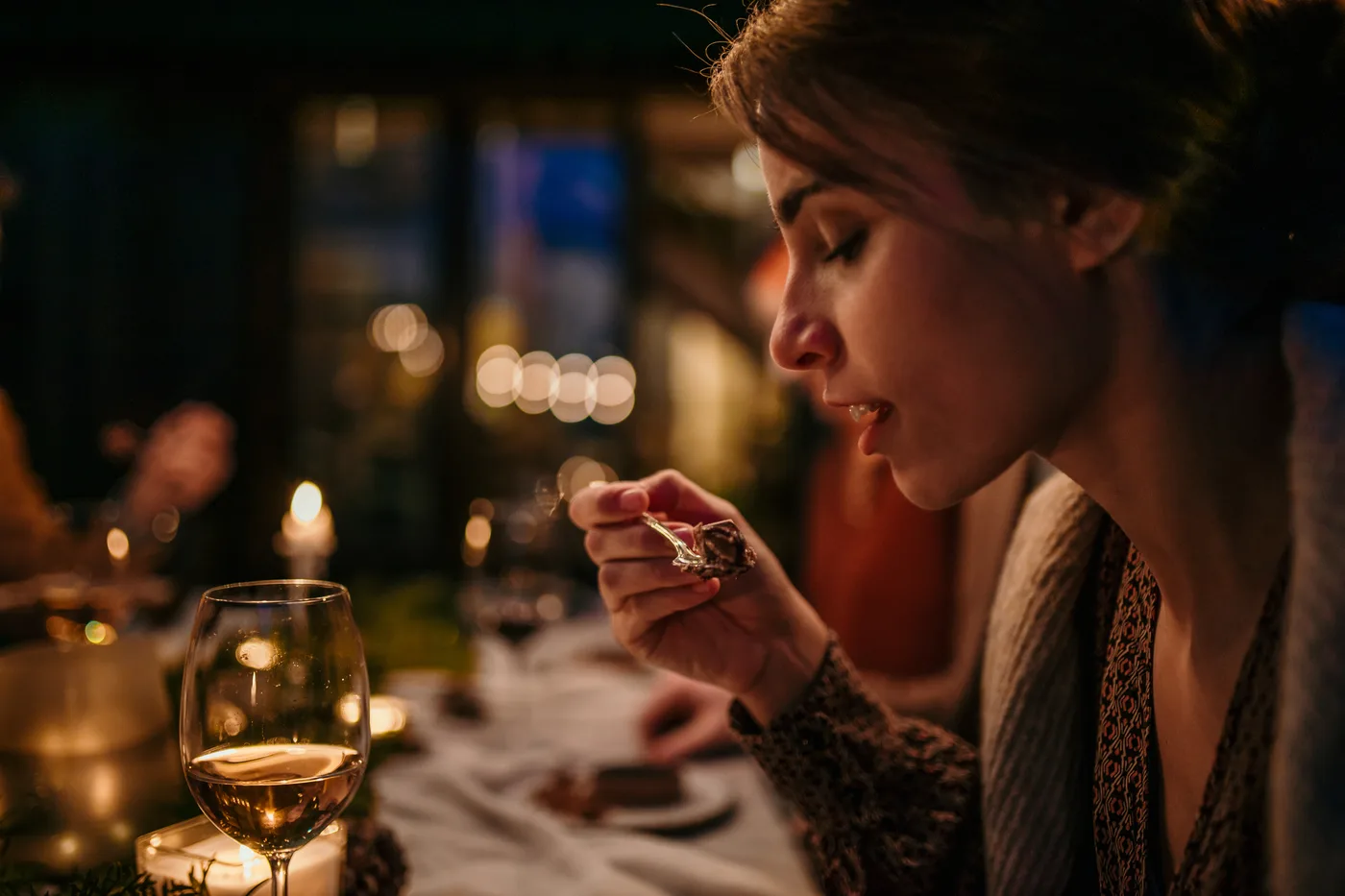
The host looks up and asks how many. You say one, and for half a second you feel it: the small heat in the face, the sense that the room has turned to look. It has not, of course. But the feeling is strong enough that a great many women, asked whether they ever eat out alone, will say they would love to and somehow never do. This is about the table for one, why it feels harder than it is, and how to sit down at it anyway.
The room is not watching
Psychologists have a name for the conviction that everyone is noticing you. They call it the spotlight effect, and it has been measured many times. In the classic experiments, people were sent into a room wearing something mildly embarrassing and asked to guess how many others had noticed. They guessed far too high. Most of the room had not registered them at all, because most of the room was busy thinking about itself.
A restaurant is a nearly perfect spotlight-effect machine. Everyone else is at a table with someone, talking, ordering, checking the time. The couple by the window is having a conversation about their kitchen renovation. The family in the corner is negotiating with a five-year-old. The server has eleven tables. If anyone glances at you, the glance lasts a second and carries no story. The story is the one you are telling.
Consumer researchers have found something related and more useful. People routinely skip outings they would enjoy, a film, a museum, a meal, because they expect to look lonely doing them alone. When they are persuaded to go anyway, they tend to enjoy themselves far more than they predicted. The obstacle is almost entirely in the forecast.
Why it sits differently for women
Men eat alone at counters and bars across this country every day without comment, and it is worth being honest that the experience is not identical for women. Some of it is old habit: a generation of women raised to understand that a woman alone in a restaurant was either waiting for someone or being judged for not having anyone. Some of it is practical. A woman alone may be approached, interrupted or seated in the worst table by the kitchen door, and it is reasonable to want to choose the conditions.
But a lot of it is simply that many women have spent decades eating in the company of other people's needs. The meal out was for a birthday, a client, a friend's bad week, a child's celebration. The idea of a meal whose only purpose is that you are hungry and want to eat something good, in a pleasant room, at your own pace, can feel almost illicit. That feeling is the best argument for doing it.
What you get from it
Eating alone in public is a different thing from eating alone at home. At home, the meal tends to happen standing at the counter or in front of a screen, and it is over before it registers. In a restaurant, the meal has a shape. Someone brings bread. There is a pause between courses. You are, for an hour, a guest.
Without a companion to talk to, you taste more. You notice the room: the way light falls on the bar, the sound of the kitchen, the small theater of other tables. Many people describe a pleasant, alert kind of solitude, quite different from loneliness, in which they are alone but not apart. And there is a quieter benefit. Every time you do something you were nervous about and discover it was fine, the next uncertain thing becomes slightly easier. Confidence is mostly built from evidence, and this is cheap, pleasant evidence.
How to start
Begin with the easiest meal. Breakfast and lunch are the gentlest introduction. A diner counter at nine in the morning or a café at one in the afternoon is full of people eating alone, and nobody thinks twice. Dinner on a Friday night is the advanced class; save it for later.
Choose a place you already know. A familiar room removes half the uncertainty. You know where the restroom is, what is good on the menu, how the tables are arranged.
Sit at the bar or the counter if you like. Bars are designed for single diners. The bartender is a built-in, low-stakes conversation if you want one and a polite presence if you do not. Many restaurants now serve their full menu at the bar.
Say it plainly. When the host asks, say "Just me" or "One, please" in an ordinary voice. If you are offered a poor table, it is perfectly fine to ask for a different one. You are a full customer.
Decide in advance about the book. There is no rule. A book or a notebook can make the first few times more comfortable, and that is fine. Some people find that the real pleasure arrives the first time they leave it closed and just watch the room. Try both. The phone is the one to be wary of: it turns a meal out into a meal at home with better plates.
Take your time. Order an appetizer. Have the dessert if you want it. Nobody is waiting for you to finish. The temptation for a first-time solo diner is to eat quickly and escape; resist it for one course, and notice what happens to your shoulders.
Use ordinary judgment about safety. Pick places where you feel at ease, sit where you can see the room if that settles you, and arrange your way home before the evening, not after. None of this is a reason not to go. It is the same sense you would use anywhere.
Tip well and come back. A regular is a known quantity, and the second visit to the same place is always easier than the first. Before long the server recognizes you, and the table for one becomes your table.
The meal you give yourself
There is a small, private dignity in taking yourself out. It says, without anyone needing to hear it, that your own company is worth a nice room and a proper meal. It says that your hunger counts even on a night when nobody else is hungry with you.
Pick one meal this week. Breakfast at the counter, lunch at the café, a glass of wine and a plate of something good at the bar. Walk in, say one, sit down. Notice how quickly the heat in your face fades, and how good the bread is.

Loading comments…