
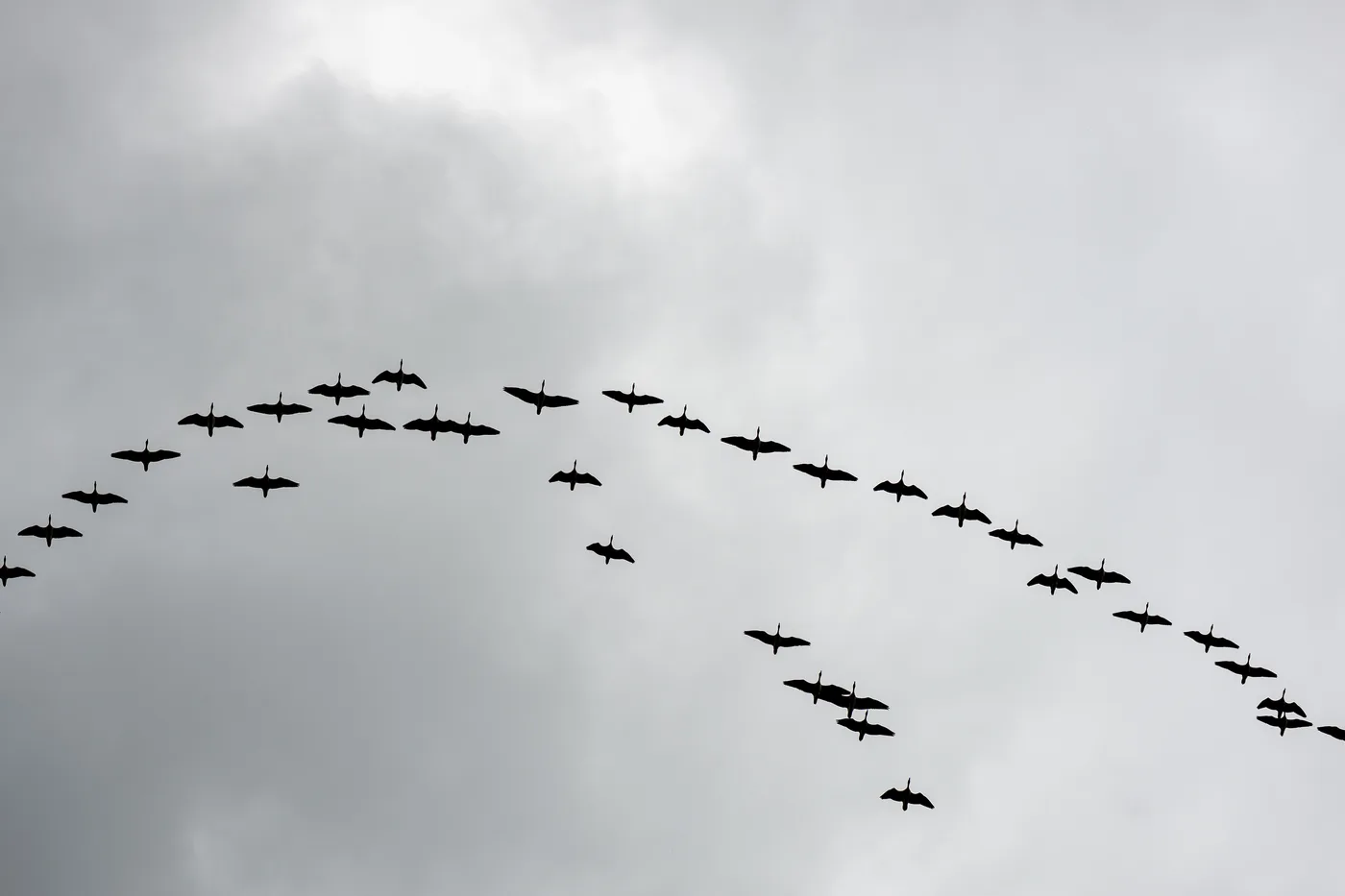
It starts as a sound, somewhere behind you: a far-off, uneven honking that does not belong to traffic. You are carrying groceries to the car, or raking, or waiting at a crosswalk, and before you have decided anything your head has gone back and your eyes are searching the sky. Then you find it, a long wavering V sliding south over the parking lot, and for a few seconds everyone who noticed is standing still in October, looking up at the same thing.
Geese have been pulling this off for as long as people have had necks. The V overhead is one of the few wild spectacles that comes to you, unscheduled and free, over supermarkets and school pickups and the Southern State at rush hour. Most of us have seen it hundreds of times. Far fewer of us could say what the shape is actually doing, or who, exactly, is up there.
What the shape is doing
A flying bird leaves the air behind it churned. Off each wingtip, the air curls into a spinning vortex: downward just behind the body, upward off to either side. That rising air does not vanish right away. It trails behind the bird like a wake behind a boat.
A second bird that positions itself behind and slightly to the side of the first can ride that rising air. Part of the lift it needs is already there, paid for by the bird ahead. A third bird lines up off the second, a fourth off the third, and the flock resolves into the shape you see from the ground: not a tidy arrowhead but a loose, trembling V, each bird surfing the upwash of its neighbor.
This was an engineer's theory long before it was an observed fact. Then researchers fitted a flock of northern bald ibises with small GPS units and motion sensors and let them fly, and the data showed the birds doing something more refined than anyone had assumed. They were not just holding position in the good air. They were timing their wingbeats to the bird in front, phasing each stroke to catch the rising part of the wake as it arrived. When a bird ended up directly behind another, in the sinking air instead of the rising air, it changed its timing to soften the cost. Studies of pelicans flying in formation point the same way: lower heart rates and longer glides than birds making the trip alone.
The one position with no free lift is the front. The lead bird is breaking trail through unworked air, and it works measurably harder than the birds behind it. Which is why, if you watch a V long enough, you will see the point of it dissolve and reform. The leader drops back into the line, another bird slides forward, and the flock trades the expensive seat around rather than asking one bird to hold it for three hundred miles. The honking you hear is the sound of the line talking to itself, calls passing up and down the formation that keep a flock together across a mile of sky and through the dark, since much of the traveling happens at night.
Who is actually up there
Here is the part most of us get wrong. The geese on the soccer field, the ones grazing the office park and holding up traffic by the pond, are mostly not travelers resting. They are residents. Long Island hosts a year-round population of Canada geese, descended from birds introduced and relocated by people over the last century, and those geese have looked at our winters, our lawns, and our retention ponds and concluded, reasonably, that there is nowhere better to be. They may shift a few towns over as water freezes, but they are home.
The high Vs of October are a different story. Those are largely birds from far to the north, out of breeding grounds in northern Quebec and beyond, riding the Atlantic Flyway south. Some are passing over us entirely. Some are arriving, joining the bays and fields here for the winter. The goose in the parking lot and the goose in the V may look identical, but one is a commuter and one is mid-journey on a route its family has flown for generations.
And the Canada geese are not even the whole of it. By late fall, Long Island's south shore bays fill with brant, a smaller, darker sea goose down from the high Arctic, where it nests closer to the pole than almost any other bird on our calendar. Brant skip the lawns and keep to the salt water, rafting in the shallows of the bays and feeding on sea lettuce and what remains of the eelgrass beds. They are easy to tell from their larger cousins once you look: no white chinstrap, a black head and neck with only a small pale necklace, and a low, murmuring call that sounds less like honking and more like a crowd heard through a wall. A gray December day on the Great South Bay with a thousand brant muttering on the water is one of the Island's quiet seasonal astonishments, and most people drive past it their whole lives.
How to read the sky this month
None of this requires equipment, a trip, or a free morning. It requires about ninety seconds at a time, taken when the sound finds you.
When you hear the honking, stop and actually find the flock before it crosses out of view. Notice the direction it is headed and the height it is flying. A high V moving with purpose, especially on a day after a cold front when the wind has swung to the northwest, is very likely true migration: birds using the tailwind to make distance. A low, loose group flapping from the park pond toward the harbor and back is the local commute. Once you know the difference, you cannot unsee it, and the sky in October becomes legible in a way it was not before.
Watch the front of the V for a minute and you may catch the handoff, the point bird falling back along the line while another takes the unbroken air. Listen for how the calling thickens when the formation shuffles and settles once it reforms.
If you want the fuller version, give it one errand's worth of time: a parking spot at any south shore marina, bay beach, or fishing dock from now through winter, around dusk. Bring binoculars if you have them; you do not need them. Look for the dark strings of brant low over the water and the Vs of Canada geese coming in high behind them, dropping toward the bays to raft up for the night. It costs nothing and it is better than most things you could stream that evening.
The part worth carrying
It would be easy to end on the obvious moral, the one printed on posters in break rooms: teamwork, shared leadership, honking encouragement. The real thing is better than the poster, because nothing up there is being selfless. Every bird in the V is acting in its own interest, saving its own strength, and the formation emerges anyway. The flock's arrangement makes each bird's effort worth more than it would be alone, and the cost of leading is survivable because nobody is asked to pay it for long.
That is not a metaphor so much as a set of terms worth borrowing. Most of us spend parts of every year at the point of some V, breaking air for a family or a team or an aging parent, and parts of every year riding in someone else's upwash, whether we have noticed it or not. The geese suggest the arrangement works best when the front seat rotates and when nobody mistakes a turn at the point for a permanent job.
But that is the part to think about later, after the flock has gone. In the moment, the only assignment is the original one: when the sound comes over the rooftops this month, put down what you are holding and look up until the V finds the trees and is gone. It is passing over whether you watch or not. Watching is the only part that was ever yours.

Loading comments…