
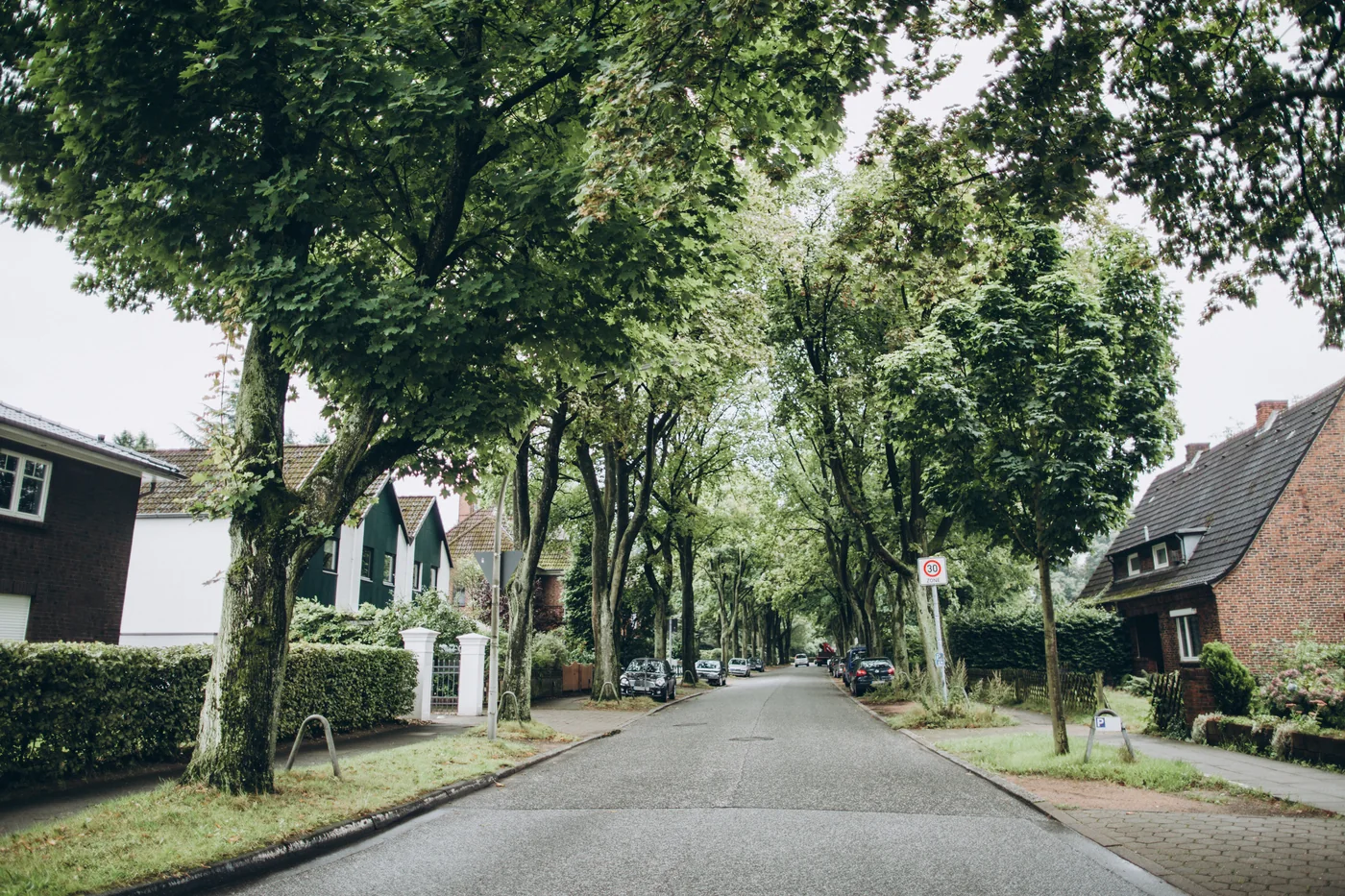
Stop for a moment and picture the tree closest to where you sleep. Most people can see it immediately: its position, roughly its size, the way it moves in a storm. Then ask yourself what kind it is, and for a great many of us the answer arrives with a small jolt of embarrassment. We have lived beside this thing for years. We would notice within a day if it were gone. And we have no idea what to call it.
The Ones You Are Not Counting
When we talk about nature we tend to mean somewhere else. The woods, the shore, a preserve you drive to on a Saturday. That framing is doing quiet damage, because it puts nature in the category of things that require a trip, which means it competes with everything else that requires a trip and usually loses.
Meanwhile the actual green in your life is not out there at all. It is the row of maples on your street, the oak in the neighbor's yard whose shade crosses your kitchen at four o'clock, the scrappy line of trees between the parking lot and the road that nobody planted on purpose. This is what you look at every day. This is your nature exposure, whether or not you have ever thought of it that way.
And it turns out to be doing more than we assumed.
Researchers in Toronto once did something unusual: they took the city's inventory of its street trees, hundreds of thousands of them, mapped block by block, and set it beside how residents described their own health. The pattern that came out was hard to explain away. People on blocks with more trees rated their health the way people several years younger rate theirs. Ten additional trees on a block tracked with a difference in wellbeing comparable to changes we normally associate with income or with age.
Nobody in that study went to a forest. They just lived on a street that had trees on it.
There is an older and stranger finding in the same direction. In the early eighties a researcher looked at patients recovering from the same operation in the same hospital, some in rooms facing a small stand of trees, some facing a brick wall. The ones with the trees went home sooner and asked for less of the strongest pain medication. They were not doing anything. They were lying in bed, looking out of a window, at a view.
Why a View Should Do Anything at All
It is a fair thing to be skeptical about, and the honest answer is that we do not fully know. But there are two ideas that fit what people actually report.
The first has to do with the kind of attention a tree asks for. Most of what a modern day requires is directed attention: the deliberate, effortful focusing on a screen, a task, a road, a conversation you must track. That kind of attention is a finite resource and it depletes, which is why by six in the evening you can read the same paragraph three times.
A tree does not ask for that. It holds the eye without demanding anything, and the gaze can rest on it and drift and come back. Whatever is depleted by a day of concentrating appears to refill during exactly this sort of soft, undemanded looking. It is why people stare out of windows, and why the staring, which looks like nothing, so reliably helps.
The second is simpler and probably older. A tree is one of the few things in an ordinary landscape moving on a timescale that is not ours. It was here before this street was paved. It will very likely be here after. Standing under something that is patient at a scale you are not is, for most people, immediately steadying, and it does not require any belief about it to work.
Late Summer Is the Best Time to Start
August is an odd and useful month for this on Long Island. The canopy is at its heaviest, fully leafed and dusty and a little tired, and it is the last stretch before everything begins the long change.
Things are already in motion if you look. The greens have gone deeper and slightly duller than they were in June. Some maples will start turning at the edges well before anyone expects it, often a single branch first, usually the one that is most stressed. The oaks are dropping acorns, some years enormously, some years hardly at all, and nobody can reliably predict which kind of year it is until it happens. On the beach plum and the wild cherry the fruit is going over. Cicadas are running the afternoons and crickets have taken the evenings.
This is the month when noticing pays best, because everything is about to visibly change and you will have a before to compare it to. A tree you learn in August is a tree whose autumn you get to watch happen to somebody you know.
Learn One, Properly
The instinct is to try to learn them all, which is why most people give up in a fortnight. Field guides are organized as if the goal were coverage. It is not, and coverage is a poor way in.
Pick one tree. Not a species, a tree, an individual, the one you can see from a window or pass every morning. Then find out what it is, once, which now takes about eleven seconds with a phone and a photograph of a leaf.
Something specific happens after that, and everybody who has done it reports the same thing. Once you can name one, you begin involuntarily seeing that species everywhere: on the next street, outside the supermarket, in the background of a film. The category, once it exists in you, populates itself. One tree learned properly generally brings a dozen with it for free.
Then keep visiting the one. Notice when it leafs out next spring, and note the date, because you will be curious the year after whether it is early. Notice which side has better growth and work out why. Notice what lives in it. Notice what it does in a hard wind, which is a genuinely beautiful thing to watch once you have any relationship with the tree doing it.
This is not a hobby that requires equipment or a free Saturday. It requires that you look up on a walk you were already taking.
Where to Begin This Week
Identify one tree. The nearest one. Photograph a leaf, the bark, and the whole shape, and look it up. Say the name out loud once so it sticks.
Sit within sight of it for ten minutes. No phone, no podcast, no task. This will feel unproductive for about four minutes and then it will not.
Move one chair. If you work at home, this is the single highest-return thing on the list. Turn the desk so the window is in your field of view rather than behind you. People who do this rarely move it back.
Take the walk with trees on it. Most of us have two routes to the same errand and take the faster one by default. Take the other one for a week and notice, honestly, how you arrive.
Look up on a street you know well. We navigate by shopfronts and ground level. The upper third of most familiar streets is genuinely unexamined territory, and it is free to visit.
Learn the second tree only when the first one is easy. There is no rush. This is a practice with a fifty-year horizon.
The Standing Company
There is something quietly reassuring about the fact that the good this does you does not depend on you doing it well. The tree outside your window has been working on you the whole time you have failed to notice it, on every walk you took while thinking about something else.
Noticing simply gets you the rest of it. A street you can read is a different street to live on than a street you move through, and the change costs nothing and takes about a week.
Start with the closest one. It has been waiting a long time and it is in no particular hurry.

Loading comments…