
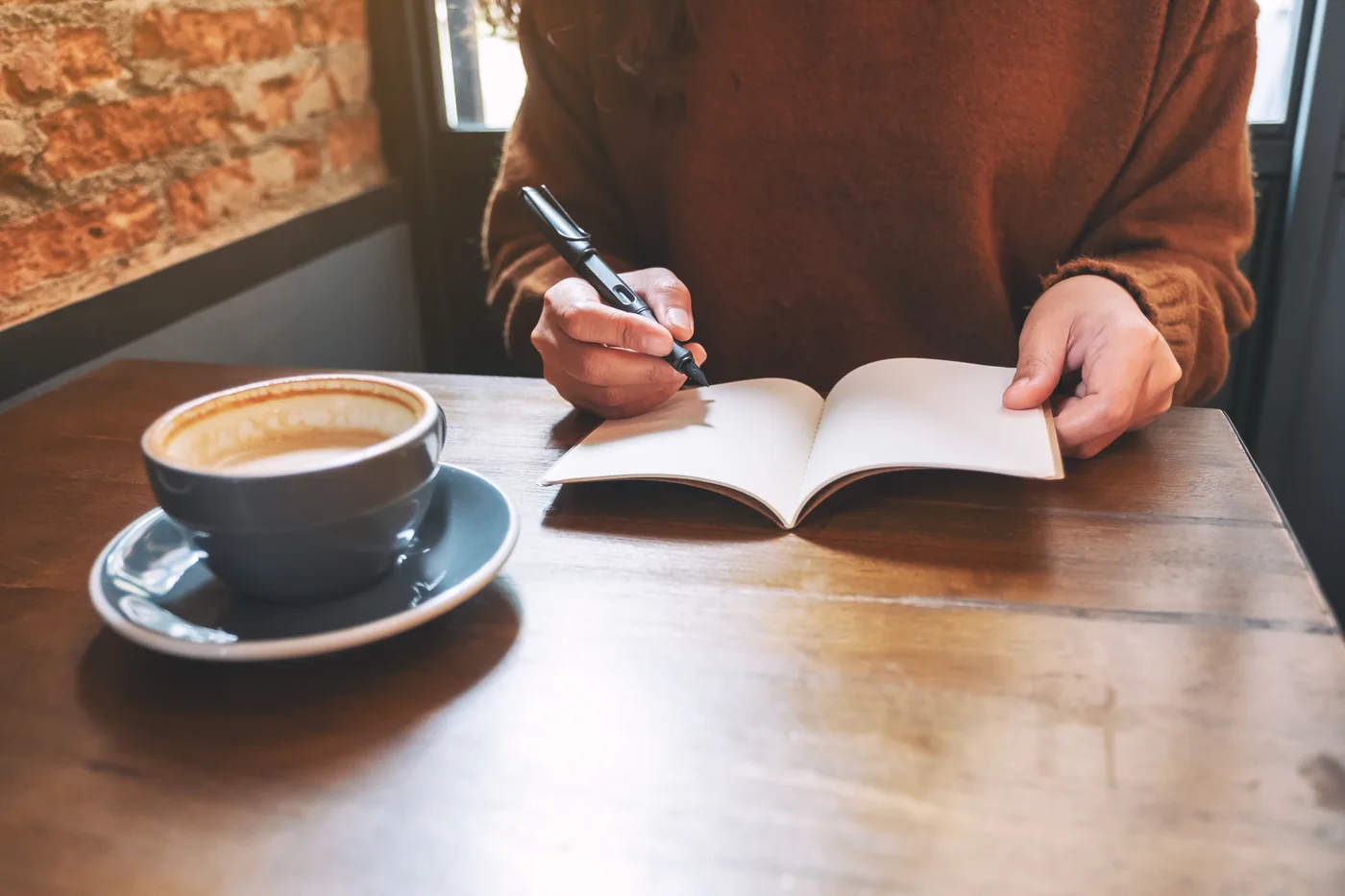
Somewhere in the second half of a long phone call, your pen starts moving on its own. A spiral blooms in the margin, a row of boxes gets shaded dark, a vine climbs the edge of the agenda. You did not decide to draw, and you would cover the page, a little embarrassed, if someone leaned over to look. Most of us learned early that a doodle is the signature of a wandering mind. The small amount of research that has actually looked at the doodle says the opposite: the pen was holding you in the room.
The experiment with the dull message
In 2009, the psychologist Jackie Andrade at the University of Plymouth published one of the only experiments ever aimed squarely at doodling. Volunteers listened to a recorded telephone message that was built to be boring: a flat voice running through the details of a party, names and places buried in digressions. Half the listeners were given a pencil and a sheet of printed shapes and asked to shade them in while they listened, with no instruction to be neat or artistic. The other half simply listened, the way we are all taught good listeners should.
The shaders did better. They caught more of the names they had been asked to track, and on a surprise memory test afterward they recalled about twenty-nine percent more of the message overall than the people who had given the recording their full, unoccupied attention.
Twenty-nine percent is not a rounding error. It is the difference between leaving a meeting with the date, the room and who is bringing what, and leaving with a vague sense that something is happening on a Tuesday.
Why an idle pen helps
The result sounds backward until you watch what a bored mind actually does. Attention during a dull stretch does not dim evenly, like a lamp on a fader. It cuts away. One moment you are following the voice on the call, and the next you are somewhere else entirely, rehearsing a conversation, planning dinner, replaying yesterday. Daydreams of that kind are not cheap: they recruit the same machinery you were supposed to be listening with. When you surface, ninety seconds of the meeting are simply gone, and you spend the next minute reconstructing what you missed.
The doodle seems to work as ballast. Shading a shape takes a small, steady amount of effort, just enough to keep the mind from casting off into a full daydream, and that was the reading Andrade herself offered: the pen gives the restless remainder of your attention somewhere cheap to live. Crucially, it asks nothing of the channel the words are on. Listening runs through language. Shading a box runs through the hand and the eye. They can share you.
Notice that the phone in your other hand cannot make that claim. A feed is made of language, faces and small narrative hooks, exactly the materials the meeting is made of, which is why glancing at it costs you the thread in a way a spiral never will. The doodle is not one more distraction. It is the rare occupation that competes with the daydream instead of with the speaker.
The scolding that stuck
If the doodle is helpful, it has had terrible publicity. Nearly everyone can remember a teacher's hand arriving flat on the desk beside a drawing, and the lesson underneath it: a moving pen means an absent student. The scolding worked on the drawing but not on the habit. Most adults stopped sketching on purpose around the age of ten, at the moment the inner critic learned to say that the horse did not look like a horse. The doodle survived that purge for one reason: it never asked to be good. It happens at the edge of the page, at the edge of your awareness, with the judge off duty.
It is also everywhere once you look. Archivists have assembled an entire published collection of the doodles of American presidents, margins of cabinet-meeting notes filled with boats, faces and geometry by the people running the country. The men signing treaties were shading boxes too. They were not failing to pay attention at the highest level; the marks and the listening were happening together.
The lowest-stakes drawing there is
This magazine returns often to the idea that making things matters, and that most adults quietly stopped. The doodle deserves a place in that conversation, because it is the one form of drawing almost no one abandoned. It costs nothing, shows no one, finishes nothing, and resembles nothing, which means there is nothing for it to fail at. A spiral cannot look wrong.
That makes the margin a side door for anyone who misses making marks but cannot face a sketchbook with its implied standards. Let the doodle stay abstract and it stays safe: hatching, honeycombs, interlocking loops, the same motif repeated until it tiles the corner of the page. You will notice, over weeks, that you have preferences, that your hand has a vocabulary, that certain patterns come back. That is a creative practice, however small, running entirely below the level at which you judge yourself. It is worth protecting precisely because it stays unserious.
Where it stops helping
The honest version of this piece includes the boundaries. The doodle earns its keep during listening, and specifically during listening that threatens to put you under: the status call, the recorded training, the meeting that should have been an email but is instead an hour. When the material is visual, a slide, a diagram, a demonstration, your eyes are part of the listening, and the pen starts competing instead of helping. Put it down.
There is also a stronger tool for the moments that matter. Researchers studying memory at the University of Waterloo have shown in a series of studies that drawing the content itself, even badly and in a few seconds, beats writing it down for later recall. The quick ugly sketch of the supply chain, the three-box diagram of who reports to whom: that is not doodling, it is note-taking in its most durable form, and the two work in sequence. The spiral keeps you present for the boring stretch; the ugly diagram captures the one idea worth keeping.
And an elaborate scene is its own warning. If you have moved from shading shapes to composing a drawing, with foreground and perspective and corrections, the pen has stopped being ballast and become the voyage. The helpful doodle is the one you could abandon mid-stroke without regret.
Letting the pen work
The practice is almost embarrassingly simple, which may be why nobody practices it. Put a pen and a piece of paper where your calls happen, and let the pen move while you listen. Keep the marks abstract: shade, hatch, repeat a motif, fill a corner. Use the agenda's margin, the back of the envelope, the last page of the notebook. When a concept in the meeting suddenly has a shape, give it its three ugly boxes and an arrow, then go back to the spiral.
Resist the urge to apologize for the page or to hide it. If someone raises an eyebrow, you are allowed to say, accurately, that this is how you listen. And try it for one week before you decide: three calls with the pen moving, and notice what you can reconstruct afterward against the calls where you sat still and behaved.
The page you carry out of the meeting, with its vine and its shaded boxes, is not the record of an absence. It is closer to a seismograph: proof that for that hour, something in you stayed, and left a line to show for it.



Loading comments…