
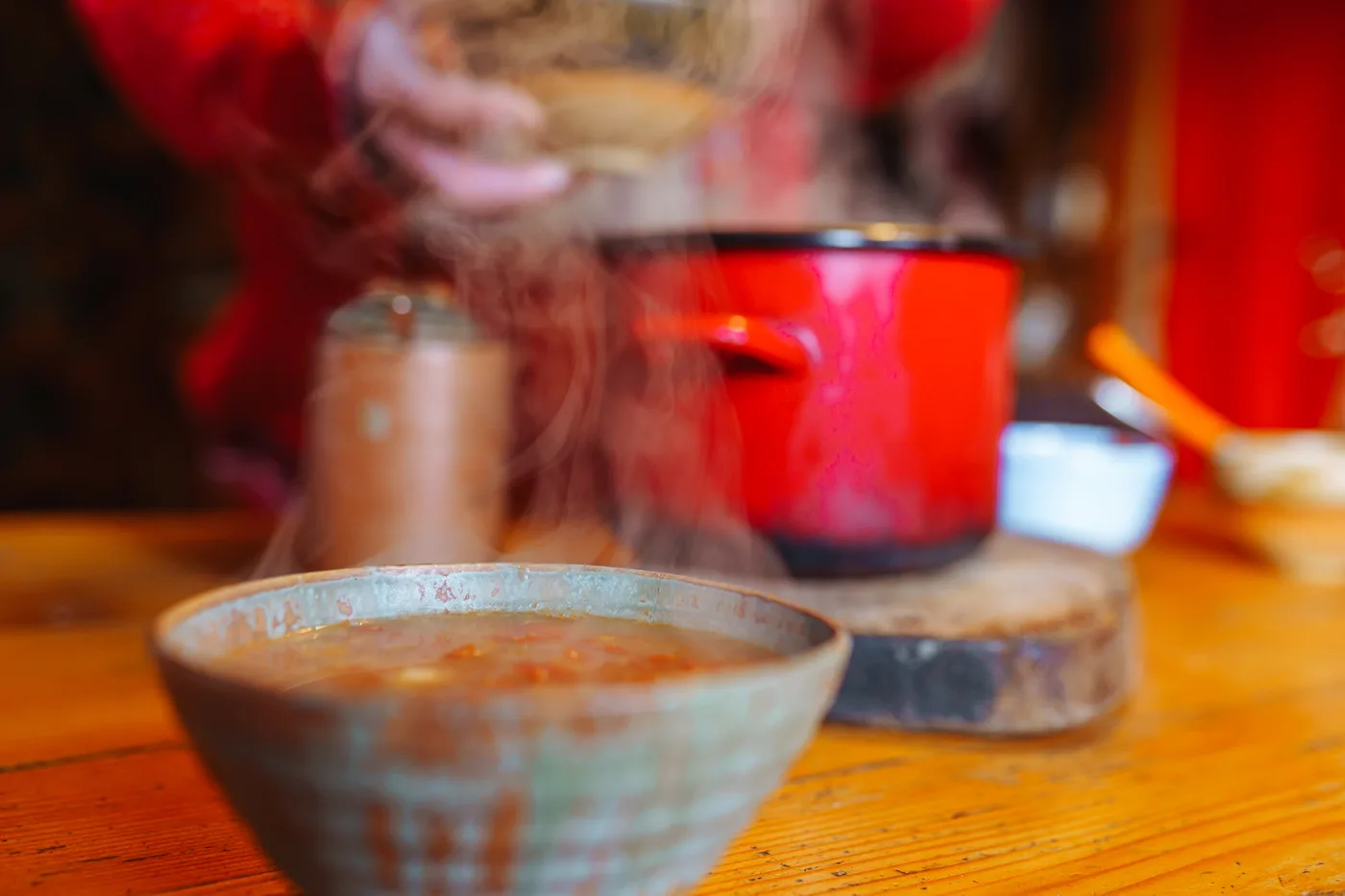
There is a sound a sick person knows without opening their eyes: someone else moving around the kitchen on your behalf. A cabinet closing, a pot meeting the stove, the tap running longer than a glass of water needs. You are under a blanket feeling like a damp coat, and down the hall a person is making soup you did not ask for. By the time the bowl arrives you already feel a little better, and the first spoonful has not happened yet. That is not your imagination, and it is not a small thing. It is one of the oldest effects in medicine, one of the better documented, and almost nobody learns to use it on purpose.
What is actually in the bowl
Start with the soup itself, because it is real and it is modest. A warm, salty broth hands a feverish body fluid it is losing, salt it can use, and a few easy calories at a moment when appetite has left the building. The steam loosens what a cold has packed into your head. The warmth is kind to a raw throat. All of this is true, and all of it is replaceable. Tea does most of it. So does the pasta water your grandmother never wasted.
Researchers have gone looking for more, and found a little: laboratory work has suggested that chicken soup may mildly settle some of the inflammatory activity that makes a cold feel like a cold. It is the kind of finding worth exactly one raised eyebrow. The effect is small, it was measured in a dish rather than a person, and no one has ever gotten up from a bowl of soup cured. If soup were a drug, it would not be approved for anything.
And yet the bowl works. Ask anyone who has been handed one. The explanation is not in the broth. It is in the bringing.
The part that is not in the bowl
For most of the last century, medicine used the word placebo as a synonym for nothing: the inert pill, the effect to be subtracted so the real treatment could be seen. In the last couple of decades that picture has quietly turned over. The placebo response is not gullibility and it is not nothing. It is the measurable thing a body does with the information that care has arrived.
Some of the clearest evidence comes from studies where the treatment was held constant and the care was the variable. In one well-known trial, people with irritable bowel syndrome received the same sham acupuncture, but half got it from a practitioner who was warm, attentive and unhurried, and half from one who was strictly businesslike. The warm version produced substantially more relief. Nothing about the needles changed. The dose that varied was the human being.
Stranger still are the open-label placebo studies, in which patients are told plainly that the pills contain nothing active, and take them anyway inside the full ritual of treatment: the bottle, the schedule, the check-ins. In conditions like irritable bowel syndrome and chronic low back pain, many of those patients still reported meaningful improvement compared with people who got no pills at all. The sugar was never the point. The being-attended-to was.
Some researchers prefer to call all of this the meaning response, which is a better name. Symptoms like pain, nausea and fatigue are not raw readouts from the tissue. They are produced, partly, by a brain deciding how much protection you need right now. When the context says you are safe, help is here, someone competent is on this, the brain can afford to turn the alarms down. The soup is a signal. The tray is a signal. The person standing in your doorway asking if you want the good blanket is a signal, and your physiology reads it.
Safety is the quiet ingredient
There is a reason the signal lands as deeply as it does. A body that believes it is on its own stays braced: vigilant, tense, spending its budget on watchfulness. A body that believes it is kept can stand down, and standing down is where the slow work of recovery happens, the deep sleep and the repair that no one applauds because no one sees it. Being tended is the oldest safety signal our species has. We are animals that have always healed in company, and the difference between being sick in a house where someone knows and being sick alone is one your nervous system registers whether or not you would put it in those words.
The research on social connection points the same direction, gently: people with strong support tend to weather illness and recovery better across a wide range of conditions, and prolonged loneliness tends to run the other way. None of this means care cures anything, and it is worth saying plainly that the care effect rides along with real treatment rather than replacing it. A cold wants soup. A fever that will not break, a symptom that lingers or frightens you, wants a clinician, and no amount of tenderness substitutes for one.
But alongside treatment, care is not decoration. It is part of how the treatment lands.
How to tend to someone
Which means tending is a skill, and most of us were never taught it. The standard offer, let me know if you need anything, is kindness with all the work left inside it. A sick person now has to invent a task, decide it is worth bothering you, compose the request and manage the gratitude. Most will not. The offer evaporates, sincerely meant and never used.
Tend specifically instead. Do not ask whether they want soup; tell them it is coming at six and ask only whether the door code still works. Bring the thing without a menu of options. Specificity is not pushiness. It is the removal of every small decision from a person who has no spare capacity for deciding.
Let the tray be slightly nice. The cloth napkin, the real bowl, the spoon that matches. This is not performance, it is information: the extra thirty seconds say you are worth looking after, and that sentence, delivered by objects, is the one a sick body most needs to hear.
Keep the visit short. Sick people are exhausted by company they love. Ten minutes, the bowl, one piece of unremarkable news from the outside world, and out. The point is not entertainment. The point is that the house briefly held two people and one of them was well.
Then come back, or call, on day three. The first day of an illness gets the flurry. By the third day the texts have stopped and the sick person is alone with the boring middle of it. The second soup, the one nobody else thought to bring, is the one that gets remembered.
Letting it be brought to you
There is a last practice here, and for some readers it is the hard one: being the person in the bed. If you are the one who usually does the tending, you may notice how much you would rather be the deliverer of the tray than its recipient, how quickly you say you are fine, how the sound of someone else in your kitchen makes you want to get up and supervise. Stay down. Receiving is not the weak half of this exchange. The whole mechanism runs on the signal landing, and the signal cannot land on a person who keeps intercepting it.
So the next time someone you love is sick, make the soup, and understand what you are actually carrying down the hall. The broth is the least of it. What arrives on the tray is the news that they are not alone and not unguarded, delivered in a form a body can absorb. And the next time the sick person is you, let the bowl come. Eat what you can. The part of you that is deciding how hard to sound the alarms is listening for exactly this.


Loading comments…