
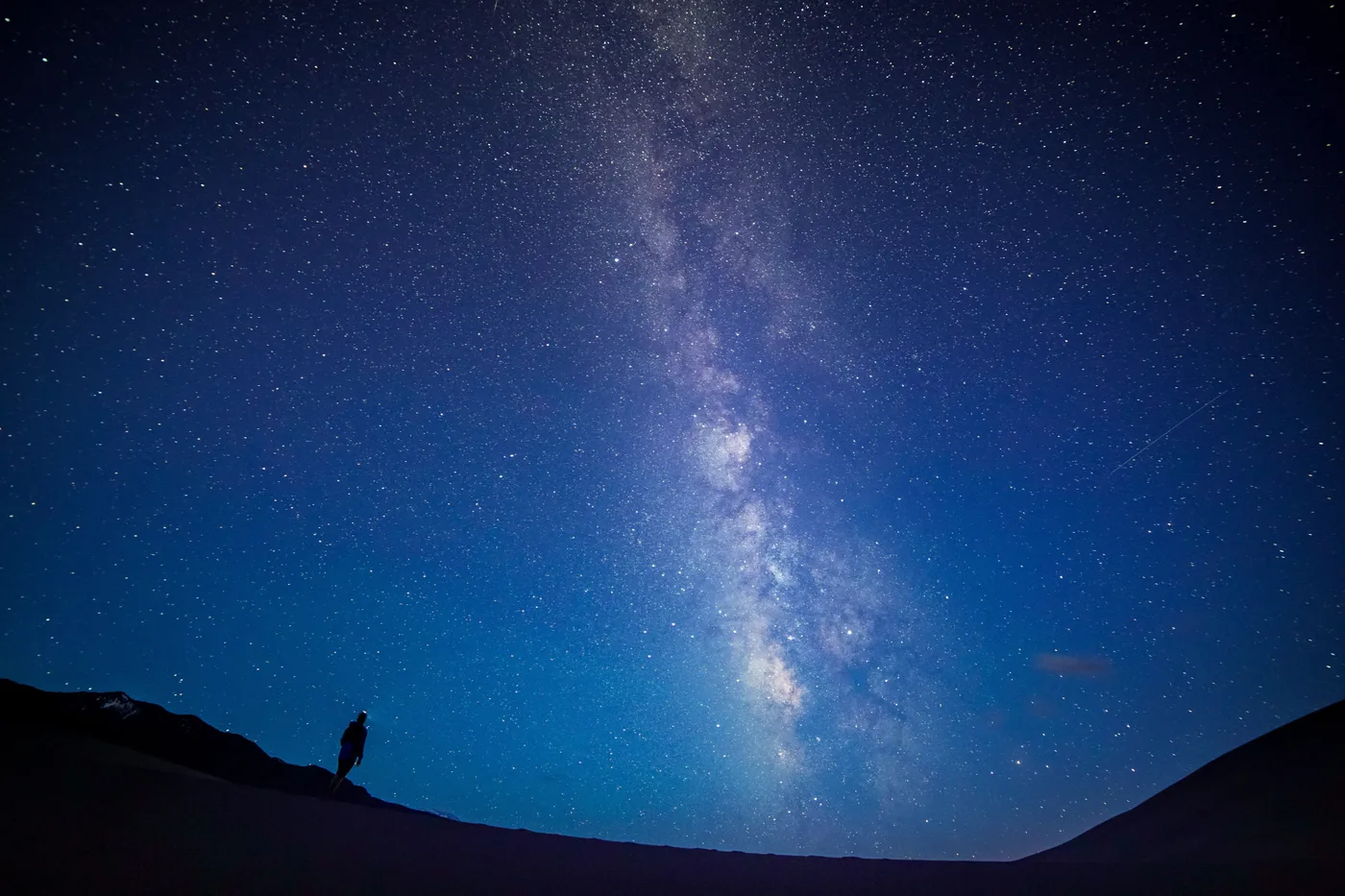
On the night of August 12 the sky over Long Island will do something it has not done well in about a decade. The Perseids will be at their peak, and this year the peak lands on a new moon, which means no moonlight washing out the faint ones and no need to time your evening around a moonset. Under a genuinely dark sky the rate can approach a hundred an hour in the hours before dawn. It is free, it requires no equipment and no belief, and if you go, something will happen to you that psychologists have spent the last twenty years learning how to measure.
The Emotion Nobody Studied
Awe went unexamined for most of the history of psychology, largely because it did not fit. It is not happiness. It is not fear, though it borders on it. It is what happens when you encounter something too large for your existing mental furniture and have to rearrange the furniture, and for a long time the field had no place to put an emotion whose defining feature is that it makes the person feeling it seem less important.
The work that opened it up centered on that last part. Researchers gave it a name that has stuck: the small self. The shrinking of self-focus, self-relevance and self-concern that happens when attention is pulled outward by something vast.
What made this more than a poetic observation was that the small self appears to do something. In a set of five studies published in 2015, covering just over two thousand people, people disposed to experience awe more often were more generous in economic games. Awe inductions increased ethical decision-making and prosocial values. In one study people were simply asked to stand for a minute in a grove of very tall trees, and afterward they helped a stranger who dropped a handful of pens more readily and scored lower on measures of entitlement than people who had spent the same minute looking at a tall building.
A meta-analysis published in 2024, pooling thirty-eight articles and fifty-seven effect sizes across roughly twenty-one thousand people, found the relationship between awe and prosocial behavior holds up at a moderate size, for both the trait and the state, with age and cultural background shifting the strength of it.
Moderate is the right word and worth keeping. This is a real effect of ordinary size, not a conversion experience.
Fifteen Minutes a Week
The study that matters most for anyone deciding whether to bother is smaller and stranger and more practical than any of that.
Researchers at the University of California, San Francisco took a group of older adults and asked half of them to take a fifteen minute walk once a week for eight weeks. Not to a canyon. Just a walk, with one instruction: approach it with fresh eyes, the way a child would, and let attention be pulled by whatever is genuinely worth attending to. The control group took the same walk without the instruction.
Over the eight weeks the awe walkers reported increasing daily experience of what the researchers called prosocial positive emotions, meaning compassion and gratitude specifically rather than good mood in general, along with decreased distress. The increase built with each walk, in the manner of a dose.
The detail everyone remembers is the selfies. Participants were asked to photograph themselves on each walk. Across the eight weeks, in the awe group and not the control group, the person got smaller in the frame and the landscape got bigger, and the smiles measurably widened. The small self, showing up in the composition of a photograph, without anyone being asked to change how they took it.
Fifteen minutes. Once a week. An ordinary neighborhood.
The Clinical Evidence, With Its Caveats
In 2025 a randomized controlled trial tested an awe intervention in people living with long COVID, delivered in live online sessions. Thirty people received it, thirty-eight were controls. Stress fell, depressive symptoms fell, wellbeing rose, with effect sizes between 0.78 and 0.96, which in this literature is medium to large. Anxiety did not differ between the groups.
That result is genuinely encouraging and it needs its caveats stated plainly. Sixty-eight people in total is a small trial. The outcomes are self-reported. The population is specific, and people living with a debilitating and frequently dismissed illness may respond to being offered something with unusual strength. Awe research is young enough that it has not yet been through the sustained replication effort that has reshaped other corners of social psychology, and some of it will not survive that process.
What is fair to say is this. There is a consistent, measured, moderate association between awe and behaving better toward other people. There is a small but decent trial suggesting it can be deliberately induced to clinical benefit. And there is an eight week study showing that the induction does not require anything expensive or far away.
Why the Smallness Is the Good Part
There is an obvious objection to all of this, which is that being made to feel insignificant does not sound like a wellness intervention.
But the small self is not humiliation. Humiliation is a self that has been reduced by other people and is still, painfully, the center of its own attention. The small self is a self that has stopped being the subject for a few minutes. Those are almost opposite experiences, and anyone who has stood in front of an ocean in a bad week knows the difference in their body before they can explain it.
Rumination, the mechanism underneath a great deal of anxiety and depression, is self-referential processing that will not stop. Awe interrupts it by making something else genuinely more interesting than you are. Not by insisting your problems do not matter, which never works, but by briefly demoting them without argument.
The traditions got there first, as usual. Every contemplative practice worth the name has a stage that involves the dissolution of self-importance, and every one of them treats it as relief rather than injury. What the research adds is the more surprising claim: that the relief is not the end of it, and that people who have just been made small are measurably kinder to the person next to them.
Where to Stand This Month
The Perseids peak overnight on August 12 into the morning of the 13th, and the hours worth having are between midnight and first light, when the Earth has rotated you into the debris stream and the radiant is high. Go after midnight if you can. Look up and slightly away from the northeast rather than straight at the radiant, because the trails are longer off to the side. Give your eyes twenty minutes to adjust and then keep them off your phone, which undoes the twenty minutes in four seconds. Bring something to lie on. Bring more layers than August suggests.
The eastern end of the Island and the barrier beaches will always beat anywhere west of the Nassau line, for reasons of light rather than sky, and the Pine Barrens are dark enough to be worth the drive.
But the finding from the walking study is that you do not actually need any of that. The instruction was fresh eyes, not a destination. Which means it is also available on a Tuesday, at the end of your own street, in the fifteen minutes you would otherwise have spent on your phone: the light doing something on the water at Stony Brook Harbor, the size of a beech tree you have driven past for nine years, the fact that the ospreys are still here and will not be for much longer.
It costs nothing and it appears to work in doses. The sky on the 12th is simply the easiest possible place to start.
Loading comments…