

Somebody has told you to take a deep breath. A friend, a nurse, a stranger in traffic, the voice inside a meditation app. And you have obeyed, most likely, by hauling in a great chestful of air, lifting your shoulders toward your ears, holding it a beat, and letting it drop. If that never seemed to do much, you were not doing it wrong so much as doing the wrong half. The inhale is not where the calming happens. The body does its settling on the way out.
Two pedals, one breath
Your nervous system runs on two systems that work like pedals. One mobilizes: it raises the heart rate, tightens the muscles, sharpens the eyes, and gets you ready to act. The other restores: it slows the heart, softens the gut, and signals that it is safe to digest, repair and rest. Neither is good or bad. You need both every day, and health is mostly the ability to move between them freely.
What makes the breath interesting is that it is wired into both pedals, and it is the only part of this machinery you can operate on purpose. You cannot decide to lower your heart rate. You cannot instruct your stomach to relax. But you can decide how to breathe, and the rest of the system listens.
It listens in a specific, lopsided way. When you inhale, the heart speeds up slightly. When you exhale, it slows. This rhythm has a name, respiratory sinus arrhythmia, and it is not a malfunction; it is one of the ordinary signatures of a healthy heart. On the in-breath, the body leans a little toward mobilizing. On the out-breath, the restorative side, carried largely by the vagus nerve, takes the wheel back. Every breath you have ever taken has rocked you gently between the two.
Which means the familiar advice contains a mistake of emphasis. A deep breath, performed as a mighty inhale, mostly presses the mobilizing pedal, which is why it can leave you feeling wound tighter than before. The calming instruction hiding inside it was always about the other half.
The lever is the long way out
Once you see this, the design of nearly every calming practice becomes legible. Practices that look unrelated on the surface, a sung phrase held to the end of the breath, a slow hum, the pursed-lip breathing taught in pulmonary rehab, counting to a longer number on the exhale than the inhale: all of them are ways of spending more of each minute breathing out than breathing in. The traditions arrived there by feel, centuries before anyone could measure a vagus nerve. The measurement has since caught up with the feel.
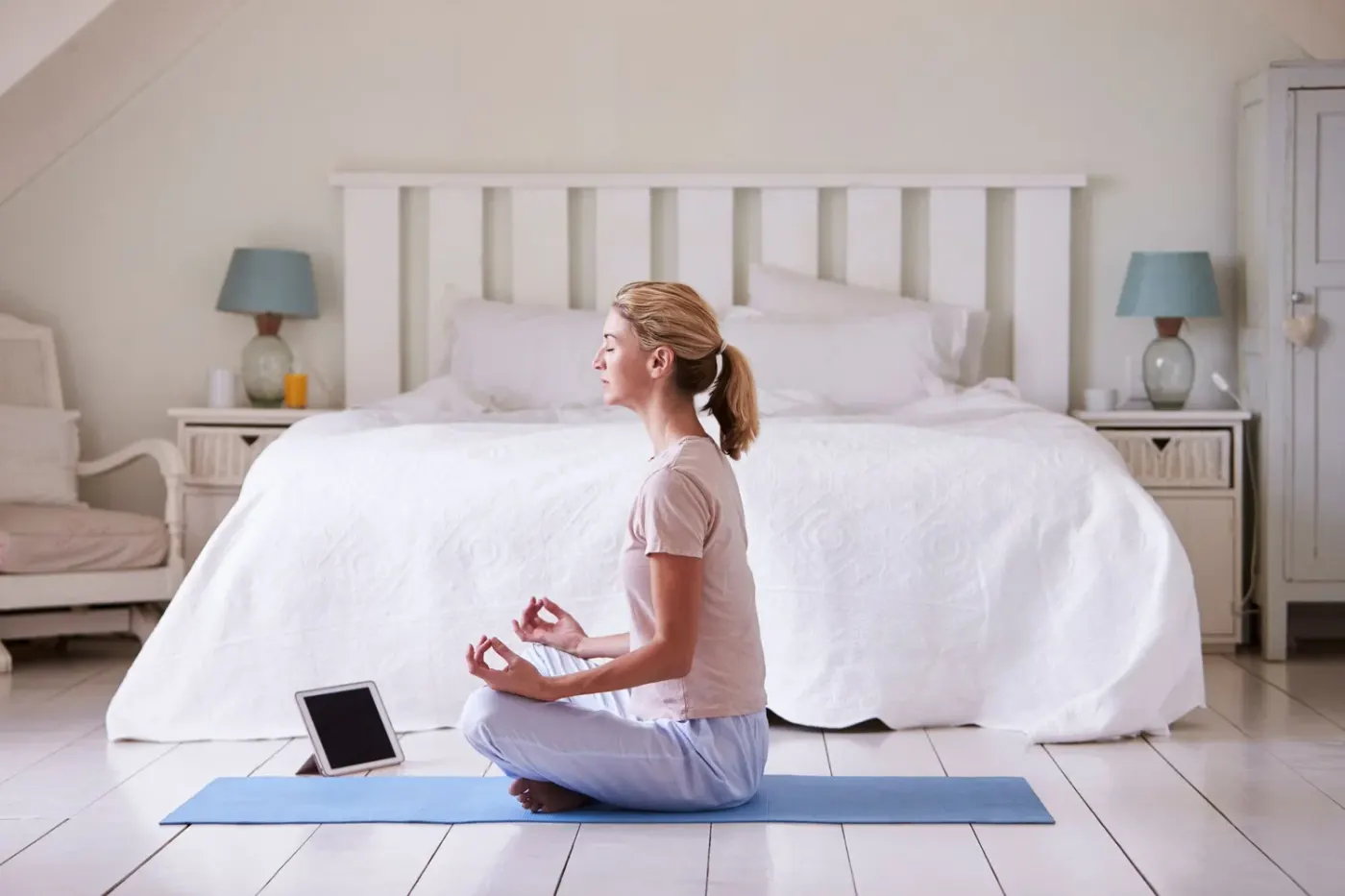
The simplest version needs no app and no cushion. Breathe in through the nose, unhurried, and then let the exhale take longer than the inhale took. In for a count of about four, out for a count of six or eight, whatever is comfortable enough to repeat. Do not force the air out or squeeze the last of it; a long exhale is loose, more sigh than effort. A few minutes of this, and most people can feel the shift they were promised by all those deep breaths: shoulders down a floor, jaw unclenched, the inner speedometer easing.
There is a stronger version worth knowing for sharper moments. Take a normal breath in through the nose, and when it feels complete, sip in a second, smaller breath on top of it. Then let everything go in one long, slow exhale through the mouth. The double inhale pops open the small air sacs in the lungs that deflate and stick during shallow breathing, so the long exhale that follows can move more air and carry off more carbon dioxide. You already know this maneuver. It is the shape of a sob, and of the involuntary sigh your body produces on its own every few minutes, precisely because sighing is how the lungs and the nervous system reset themselves. Doing it deliberately, two or three times, is often enough to take the top off a spike of stress while it is happening.
Researchers have begun testing these exhale-weighted patterns directly, and in one month-long trial, five minutes a day of deliberate sighing improved participants' day-to-day mood and slowed their resting breathing more than an equal daily dose of mindfulness meditation. That is one study, not a settled science, but it points at something practitioners have long reported: for calming the body specifically, how you breathe seems to matter at least as much as how you attend.
A practice small enough to keep
The trouble with breathing practices is rarely the practice. It is that the moment you need one is the moment you are least likely to remember it exists. The repair for that is to stop treating the long exhale as an emergency tool and start treating it as punctuation.
Pick two or three seams in your ordinary day: the pause after you park and before you unbuckle, the wait while the kettle heats, the moment a phone call ends and before you look at the screen again. In each seam, take three breaths with a long way out. Nobody around you will know. You are not meditating, exactly. You are letting the restorative pedal have ten unclaimed seconds it was not going to get otherwise.
Done this way, the practice compounds quietly. The seams are already in your day; you are only filling them differently. And because you rehearse in calm moments, the pattern is actually available in hard ones, the way a fire drill is what makes the real alarm survivable. When the difficult email lands or the name is called in the waiting room, the long exhale is no longer an idea you once read about. It is something your body has done a thousand times.
What it will and will not do
Honesty matters here, because breathing advice is often sold with a promise it cannot keep. A long exhale changes your physiology for minutes, not months. It is a way of turning down arousal you do not need right now: before a difficult conversation, in the dentist's chair, at two in the morning when the mind is loud. People who practice it regularly often report sleeping more easily and recovering from stress faster, and slow breathing in general, somewhere near six breaths a minute, is associated with the kind of flexible heart rhythm that reflects a nervous system able to shift gears.
What it is not is a treatment. An anxiety disorder, panic attacks, depression, trouble breathing of any kind: these deserve a clinician, and nothing in this piece is a substitute for one. A few people find that attending closely to the breath makes them more anxious rather than less, especially those with a history of panic, and if that is you, the right move is not to push through but to work with someone who can tailor the practice or offer a different door entirely.
For everyone else, the invitation is almost embarrassingly small. You will breathe roughly twenty thousand times today regardless. Somewhere in there, a handful of those breaths could have a long, loose, unhurried way out. The inhale gathers; the exhale releases. You have been carrying the brake pedal with you your whole life. It is worth knowing which half of the breath it is.
Loading comments…