
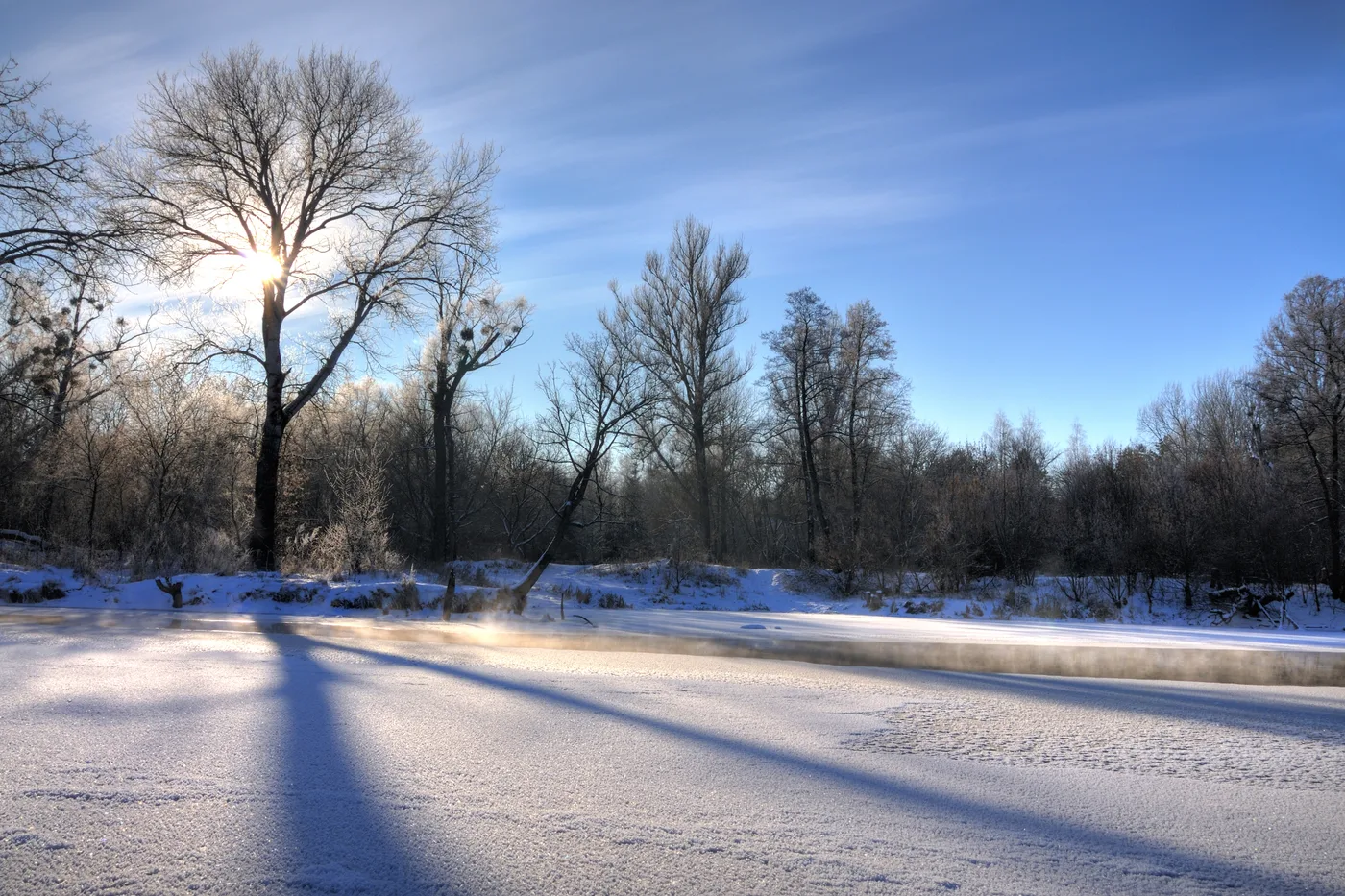
Stand outside at noon on a clear November day and look down. Your shadow stretches out ahead of you, longer than you are tall, and at midday it will stay that way until spring. It is a small, easily missed fact, and it tells you something precise about the light you are standing in: the sun is shining on you, but it is no longer doing one of the things it did all summer.
What the shadow is measuring
The length of your shadow is simply a reading of the sun's height in the sky. When the sun stands high, overhead or close to it, your shadow pools around your feet. As the sun sinks lower, the shadow lengthens. When the sun is exactly halfway up the sky, at forty-five degrees, your shadow is the same length as you are tall. Below that, it grows longer than you.
That halfway point matters for a reason most of us never think about. Sunlight arrives as a mix of wavelengths, and one narrow band of it, ultraviolet B, is what your skin uses to make vitamin D. UVB is also the band the atmosphere is best at filtering out. When the sun is high, its light takes a short, steep path through the air and plenty of UVB gets through. When the sun is low, the light comes in at a slant and travels through far more atmosphere, and the ozone layer absorbs most of that band along the way. What reaches you is still bright, still warm on your face, and nearly empty of the part your skin was using.
So the shadow becomes a rule of thumb that people who study this have used for years: when your shadow is longer than you are, your skin is making far less vitamin D than it could, and in the darkest months, close to none, however long you stay out.
Where Long Island sits
Long Island lies a little north of the fortieth parallel. At that latitude, the midday sun spends roughly November through February too low in the sky for the skin to make meaningful amounts of vitamin D, and the shoulder months of October and March are thin. It is not a question of clouds or cold or how much time you spend outdoors. On the brightest, bluest day in January, the sun simply never climbs high enough.
This was measured carefully decades ago in Boston, which sits at nearly the same latitude, and the finding has held up: a winter gap of about four months during which sunlight alone does not supply it. Farther north, the gap is longer. Farther south, it shrinks, and close to the equator it barely exists.
Your body does not run dry the moment the light changes. Vitamin D is stored in fat and in the liver, so a summer spent outdoors carries some of us partway through the winter. How far it carries you depends on things that differ enormously from person to person: how much sun you actually got, how much of your skin it reached, your age, your body size, and your skin tone, since more melanin means more sunlight is needed to make the same amount. Sunscreen, which is the right choice in July, also blocks most of the same band.
What this does not mean
It would be easy to take the wrong lesson here and stay indoors until spring. The low winter sun has stopped doing one job, but it is still doing others, and those matter more than ever in the short days.
Daylight is the main signal that sets your body clock. Light reaching your eyes in the morning tells your system that the day has started, which shapes when you feel alert and when you grow sleepy that night. Even an overcast winter morning outside is many times brighter than a well-lit room, because indoor lighting, however cheerful it looks, is dim by the standards your eyes evolved with. A walk at nine in the morning in December will do nothing for your vitamin D and a great deal for the rhythm of your day.
So the shadow rule is not a reason to skip the light. It is a reason to stop counting on the light for something it can no longer give.
Where it comes from instead
In winter, vitamin D comes from food, from supplements, or from what you stored over the summer. Food is the modest part of the answer. Fatty fish such as salmon, sardines, trout and mackerel carry real amounts. Egg yolks carry some. In the United States, most milk is fortified, as are many plant milks, some orange juices and some breakfast cereals; the label will say. Mushrooms are an interesting case: grown in the dark they have very little, but mushrooms exposed to ultraviolet light, which some growers now do on purpose and label as such, make it in much the way skin does.
For many people, food alone falls short in the dark months, which is why supplements are common. This is where it is worth slowing down. Vitamin D is fat-soluble, so unlike some vitamins, more is not harmlessly flushed away, and very high doses taken for long periods can cause real problems. The right amount depends on your own levels, your health and anything else you take, and a simple blood test can tell you where you stand. If you have never asked, a winter checkup is a sensible moment to raise it. This piece is not a substitute for that conversation with a clinician who knows you.
A small practice for the dark months
The shadow is worth turning into a habit of attention rather than a fact you read once. A few ways to use it:
Look at it on purpose. Sometime around midday, glance down and notice the length of your shadow. In November it will startle you. In early April, notice the week it shrinks back to your own height. It is one of the most exact signs of the turning year you will find, more reliable than the weather, and it costs nothing to read.
Go out for the light anyway. Make the morning walk a fixed part of the winter, ideally within an hour or two of waking, without sunglasses if your eyes are comfortable. You are not out there for vitamin D now. You are out there to tell your body what time it is.
Put winter foods back on the table. A tin of sardines on toast, salmon once or twice a week, eggs that keep their yolks. These are old winter habits in many northern kitchens, and they were not an accident.
Ask, once. If you have never had your level checked, ask at your next appointment, and decide about supplements with that number in hand rather than guessing.
Reading the light
There is something quietly instructive about the long shadow. It is a reminder that the same sun can be doing very different work at different times of year, and that a season can look generous and still be thin in one particular way. Winter light is beautiful, low and gold and raking across the fields, and it is also, for a few months, light that cannot feed you in the way summer light did.
Knowing that is not a cause for worry. It is just a reason to provide for yourself in the season when the sky has stopped providing. Look down at noon this week. When the shadow is longer than you are, take it as a small note from the sky: the light is still here for your eyes and your days, and the rest you will have to bring to the table yourself.



Loading comments…