
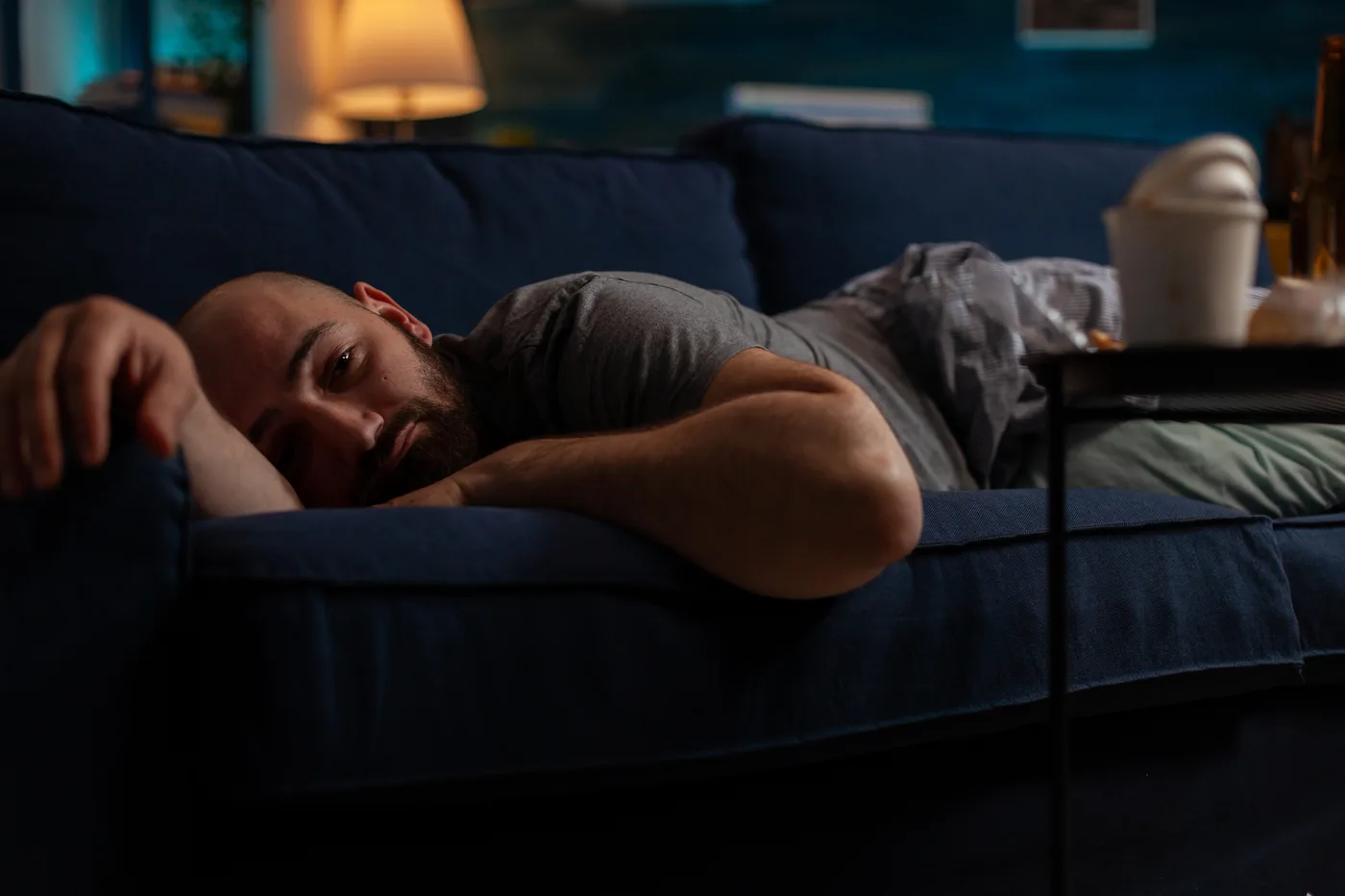
It is a quarter past nine and your eyes are heavy. The book keeps repeating a sentence, the show has become sound, and somewhere in your body a door is quietly swinging open. You think: I should go to bed. Then you load the dishwasher, answer one message, start one more episode. By eleven you are wide awake, scrolling with bright eyes, wondering where the sleepiness went. It did not go anywhere mysterious. You walked past it, and the body did exactly what it is built to do next.
Two systems, not one
Sleepiness feels like a single dial that turns up as the day goes on, but the body runs it as two systems working against each other. The first is sleep pressure: from the moment you wake, a chemical called adenosine accumulates in the brain, a slow tally of every hour spent awake. The longer the day, the heavier the tally. Caffeine works by blocking the receptors that read it, which is why coffee does not give you energy so much as hide the bill.
The second system is the circadian alerting signal, a wake-promoting drumbeat from the body's internal clock. It does something that surprises most people when they first hear it: it does not fade politely through the evening. It climbs. Through the late afternoon and into the hours before your habitual bedtime, the clock actively pushes alertness up, opposing all that accumulated pressure so you can cook dinner, hold a conversation and finish the day as a functioning person rather than sliding under the table at six.
Sleep researchers have a name for the stretch when that signal is near its peak: the wake maintenance zone. One early researcher called it the forbidden zone for sleep, because in the lab people find it genuinely hard to fall asleep during those hours even when they are exhausted. The system is working as designed. It is the last, strongest push of the day's wakefulness, and it sits directly in front of the door to sleep.
What the second wind actually is
Here is the sequence on an ordinary night. Somewhere in the evening, often earlier than you would like to admit, the pressure briefly gets the upper hand. That is the heaviness at a quarter past nine: the yawn that arrives mid sentence, the paragraph you read twice. It is not a suggestion. It is the two curves crossing, a window in which falling asleep would be easy.
Stay up through it, and the alerting signal is still high enough to reassert itself. The heaviness lifts. You feel clear, even pleasantly sharp, and it is tempting to read that clarity as proof that you were not really tired. You were. The tiredness has been outvoted, temporarily, by a clock that is still doing its evening job. That recovered brightness is the second wind, and it can carry you an hour or two past the door you meant to walk through.
What makes the modern version worse is that everything we reach for in that window pushes the same direction. Bright rooms and screens late in the evening can delay the clock's night program, and the things we do in the recovered hour, the feed, the plot, the one more level, are engineered to reward exactly the alertness the clock just handed back. The second wind is ancient. The uses we have found for it are new, and they are very good at keeping it inflated.
None of this is a moral failing, which is worth saying plainly because bedtime has somehow become a place people store guilt. You are not weak willed at eleven at night. You are standing downstream of a mechanism, and mechanisms do not care about resolutions. They respond to timing.
Sleepiness is a window, not a verdict
The practical shift is small: stop treating evening sleepiness as information about how tired you are, and start treating it as information about when the door is open. The heaviness is not a verdict you can appeal by pushing through. It is a window, and windows close.
For one week, try nothing more ambitious than noticing. Catch the first real wave of evening sleepiness, the genuine article, with the heavy eyes and the rereading, and note the time. Most people find it arrives with surprising regularity, within the same half hour night after night. That recurring time is worth knowing. It is your body publishing its own schedule, and it has likely been publishing it for years while you negotiated with it.
Then, on the nights you can, answer the wave instead of outlasting it. Not heroically, not instantly, just without the detour. The dishwasher will forgive you. If a full stop is impossible, at least stop adding fuel: lower the lights, put the phone where it cannot follow you upstairs, and let the evening get dim enough that the clock can hear itself. Dim evenings are the environment the whole mechanism expects, and they cost nothing.
It helps to have a closing ritual that starts when the wave does rather than at some aspirational hour you never hit. Three or four moves, always the same, short enough to finish while the window is open: curtains, kettle off, teeth, lamp. A ritual you can complete in ten minutes beats a routine you keep meaning to start at nine thirty.
Befriending the mechanism
There are honest uses for the second wind. Parents getting small children down, people on shift schedules, anyone whose evening is not fully theirs: sometimes the recovered hour is the only hour, and spending it on purpose is a fair trade, made with open eyes. The point is not that staying up is forbidden. The point is to know which hour you are spending, because the second wind's clarity writes checks the morning has to cash, and the morning always pays with interest.
It is also worth knowing that the mechanism explains one of the stranger bedtime experiences: lying down too early and finding yourself staring at the ceiling, mind humming, more awake than you felt on the sofa. If you climbed into bed inside the wake maintenance zone, before the wave, the clock is still pushing and the bed cannot override it. The old advice to go to bed only when sleepy is really advice to wait for the window rather than the hour on the clock.
What changes, when you start working with this instead of against it, is mostly a feeling of friction going out of the evening. Not perfect sleep, which nobody is owed, but fewer of those wired midnights that arrive out of nowhere, and fewer mornings spent paying for an hour you do not even remember enjoying. Anyone whose sleep stays hard despite honest timing deserves more than a mechanism essay, and that is a conversation for a clinician, not a column.
Tonight, somewhere in the evening, the wave will come. You will feel the book get heavy and the room go soft, and some part of you will reach for the thing that keeps you up. You do not have to win that argument forever. You only have to notice, once, that the door is open, and walk through it while it is.



Loading comments…