
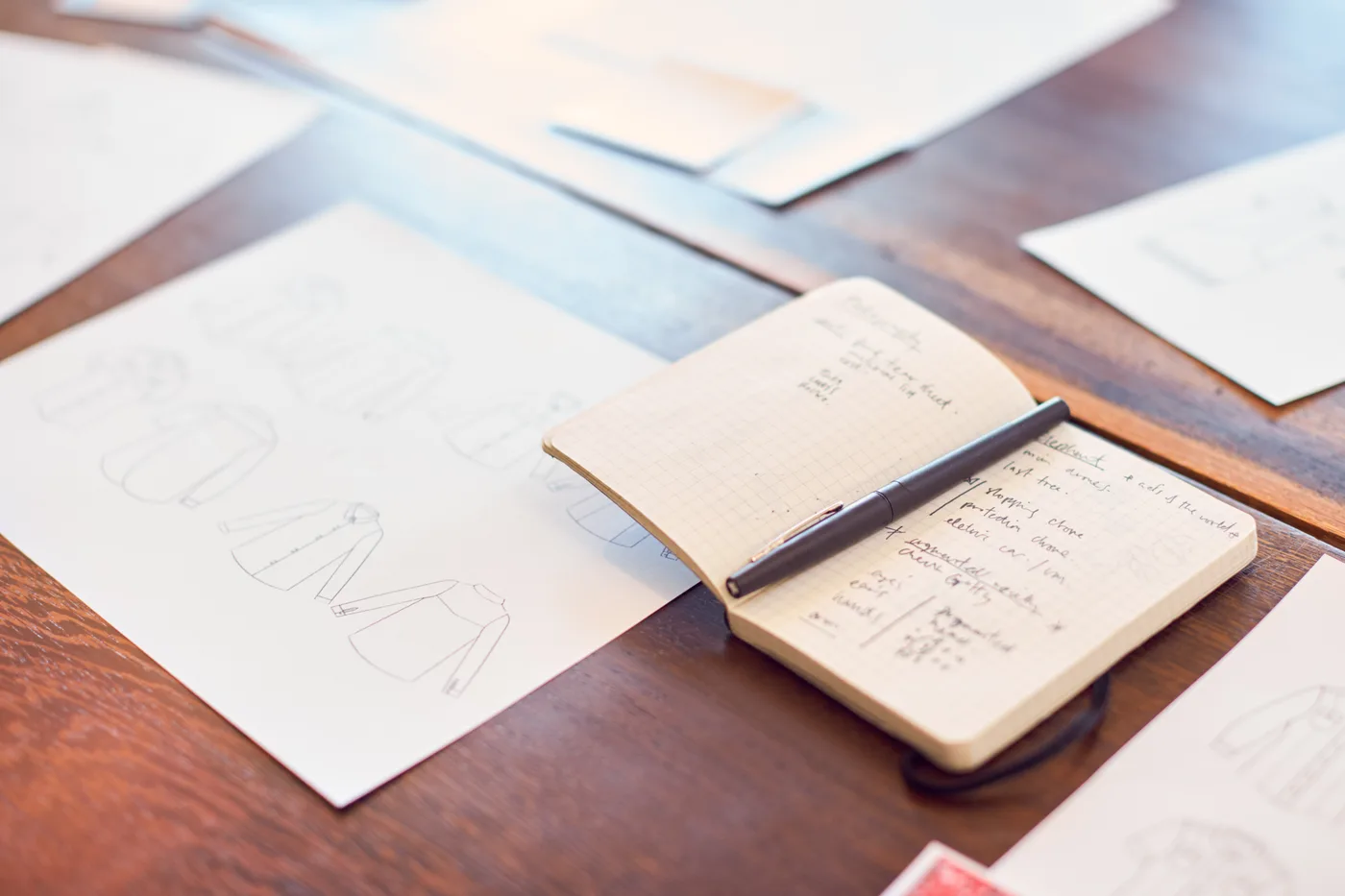
Somewhere in the middle of making anything, you arrive at the moment of the cut. A paragraph that took an hour to get right but belongs in a different piece. A verse that scans beautifully and says nothing. A plan for the garden bed that the garden has outgrown. Your finger hovers over the delete key, and something in you resists, because deleting feels like admitting the hour was wasted. So you leave it in, and the work gets heavier, or you delete it, and something small in you closes. There is a third option, older than the delete key, and it changes more than you would expect: keep a scrap file.
Why cutting is so hard
The difficulty is not really about the sentence, or the sketch, or the plan. It is about loss. People feel the removal of a thing far more sharply than they feel its absence would warrant, and the things we make are not exempt. By the time a paragraph exists, you have paid for it: the attention, the fiddling, the small victory of getting it to stand up. Deleting it means the payment bought nothing. Every maker knows the argument that follows, conducted silently in half a second: maybe it can stay, maybe the piece can bend around it, maybe it is better than I think.
That argument is where good work goes soft. Almost everything you make is improved by removal, and almost everyone resists removal, and the resistance is not a character flaw. It is the ordinary human response to throwing away something that cost you effort. Which suggests the fix is not more discipline. The fix is making the cut stop being a loss.
The practice, in one sentence
Keep one file, and everything you cut goes into it instead of into the void. That is the entire practice. Writers have kept a version of this for centuries under various names: the commonplace book, the bone pile, the outtakes folder. The form does not matter. What matters is that it is one place, that it costs nothing to add to, and that nothing in it ever has to justify its existence.
When the paragraph does not belong, you do not delete it. You move it. The gesture takes the same two seconds, but it means something entirely different. The hour you spent is not erased; it is banked. And with that one change, the silent argument ends, because there is nothing left to argue about. Nothing dies. You will be startled by how much more freely you cut when cutting is a relocation instead of an execution.
What the file actually does
The first effect is immediate, and it is the real point: the price of the cut drops to zero, so the editing part of you stops negotiating with the making part of you. Work tightens because nothing is defending its seat. You can be ruthless in the piece precisely because you are gentle in the file.
The second effect arrives later, and it is stranger. Fragments sit in the file out of context, and out of context they change. The paragraph that was wrong for the essay turns out to be the opening of a different one. The two lines cut from a poem in March combine, in October, with an image you wrote down in a parking lot. This is not mysticism; it is what happens when material is allowed to wait. Inside a draft, a fragment can only be what the draft needs. In the scrap file, it can become anything, and given enough time some of it does.
The third effect is quieter still. The file becomes a record of your own attention: what you noticed, what you almost said, what you were circling for a season without knowing it. Reading it back months later is like finding a box of photographs someone thoughtful took of your mind.
How to keep one
Resist the urge to build a system. The scrap file works because it is a compost heap, not an archive, and composting fails when you try to alphabetize it. A few things help:
Keep it to one place. One document, one notebook, one drawer. The moment there are three scrap files you will hesitate over which one a fragment belongs in, and hesitation is the tax this practice exists to abolish.
Date the entries and nothing more. No tags, no folders, no titles. A date is enough to let a fragment carry a little of its original weather, and any structure beyond that turns two seconds of relocation into a filing decision.
Never clean it. The file is allowed to be a mess forever. It is allowed to contradict itself, repeat itself, and embarrass you. The whole arrangement rests on the guarantee that nothing put in will be judged, including by you, later.
Read it rarely, and read it whole. A few times a year, on an afternoon with nothing due, scroll from somewhere in the middle. You are not searching; searching is for archives. You are walking the heap to see what has ripened. Most visits you will take nothing. Some visits you will take the exact thing a current project has been missing, and you will notice it precisely because you were not looking for it.
Not just for writers
The practice travels well beyond the page. A cook keeps the variation that did not suit the dinner but might anchor another one. A gardener keeps the cuttings, literally, and also the sketch of the bed that never got built. A woodworker's offcut bin is a scrap file you can hold; ask one about it and you will hear the same logic: too good to burn, no job for it yet, its job will come. Photographers keep the frames that were almost right. Even someone whose making is mostly plans, for a business, a classroom, a household, can keep the ideas that were sensible but untimely, and stop confusing untimely with wrong.
In every one of these, the file solves the same problem: it separates the question of whether a thing belongs here from the question of whether it is worth keeping. Those are different questions. Our making gets clearer the moment they stop being answered with a single keystroke.
What to expect
Honestly: most of what you save will never be used. If you measure the scrap file by retrieval, it will look like a failure by spring. Measure it instead by what it does to the way you work today. The cut that used to cost a ten-minute internal negotiation now costs two seconds. The draft tightens sooner. The precious feeling that attaches itself to half-finished things loosens, because nothing is ever really at stake. The file earns its keep on the day you add to it, not the day you take from it. Whatever it gives back later is interest.
There is one more thing it gives, and it may be the deepest one. A scrap file is a running demonstration, in your own handwriting, that your effort is not wasted just because it did not fit. Something in that lesson leaks out past the file, into how you hold the detour that did not lead anywhere and the year that got interrupted. Kept, dated, and left in peace, the things that did not fit have a way of turning out to be material.
Start this week, with the very next thing you cut. Do not set up anything first. Open a blank page, title it nothing, paste the fragment in, and add the date. That is the whole beginning. The file does the rest by existing.



Loading comments…