
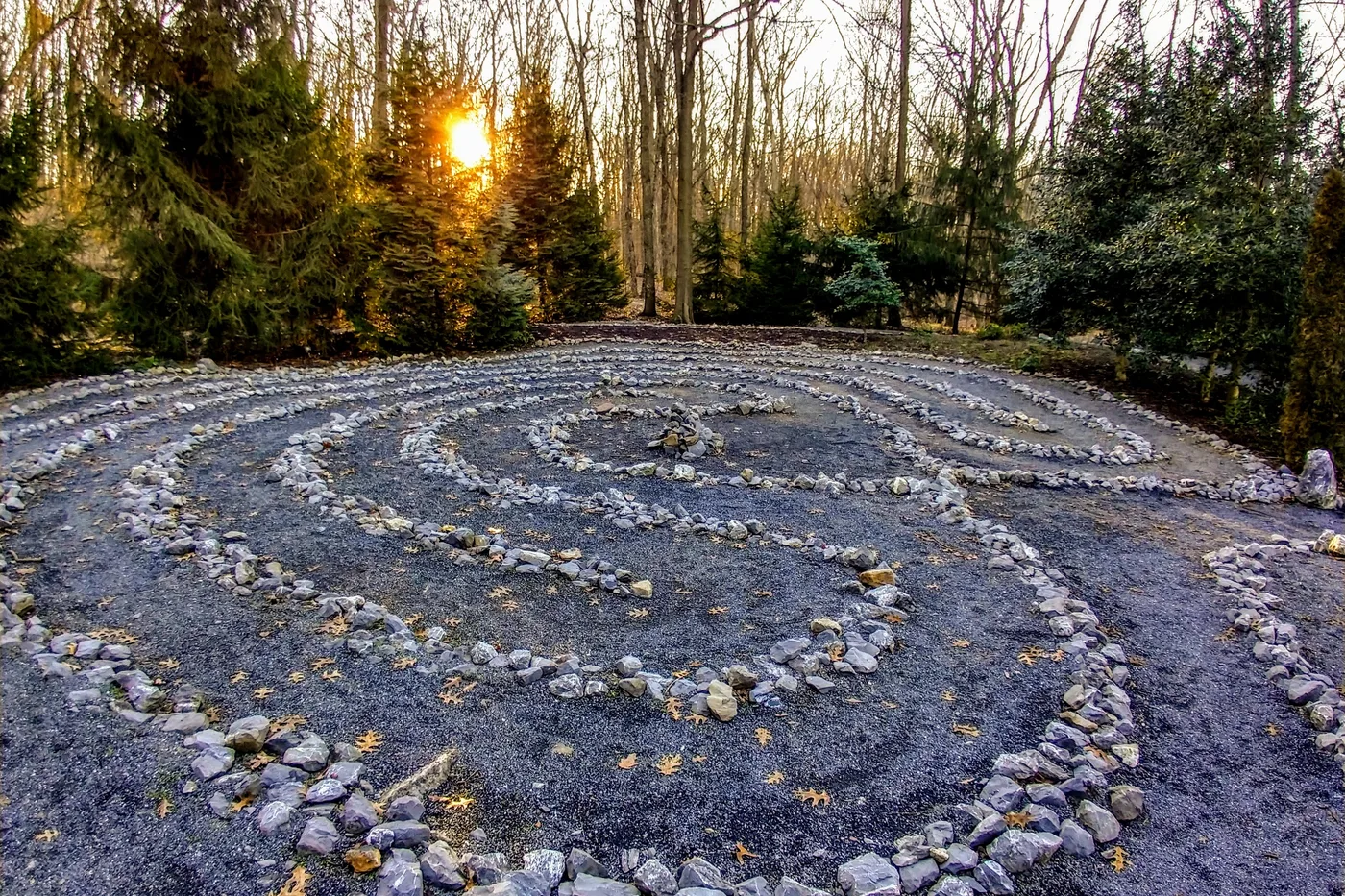
You step onto the path at the edge of the circle, and almost at once it carries you close to the center. You can see it a few feet away. Then the path turns and sends you all the way back out to the rim, and around, and in again, and out again, so that the center seems to come near and slip away a dozen times before you finally arrive. There is no wrong turn to take, because there are no turns to choose. There is only the path, folding back on itself, and your own feet following it.
Not a maze
People often use the words interchangeably, but a labyrinth and a maze are close to opposites. A maze is a puzzle. It is built to confuse, with branching paths, dead ends and the possibility of getting lost. It asks you to think hard and choose well.
A labyrinth has a single path. It winds and doubles back, but it never branches, and if you keep walking it will always bring you to the center and, by the same route, out again. Nothing is asked of you except that you keep going. That one difference changes everything about the experience. A maze engages the part of you that solves problems. A labyrinth gives that part of you nothing to do, which is exactly why people walk them.
The design is very old. The classical seven-circuit pattern appears on coins from ancient Crete and turns up, in nearly identical form, carved in rock and drawn in manuscripts across many cultures. In the early 1200s builders set a larger, more intricate version, eleven circuits around a six-petaled center, into the stone floor of Chartres Cathedral in France, where it can still be walked. Over the past few decades labyrinths have returned in a quiet way, and today they can be found at churches and retreat centers, in hospital gardens, on college campuses and in public parks, often marked out in stones or turf on open ground.
What happens while you walk
Walking a labyrinth is a form of moving meditation, and like most such practices it works through a kind of gentle constraint. Because you cannot get lost, you stop navigating. Because the path keeps turning, you cannot stride ahead on autopilot. Your attention settles onto the next few feet of ground, the sound of your own steps, the breath, the slow swing of the body around each bend.
The path also has a way of teaching without saying anything. Just when you feel you are almost there, it takes you to the farthest edge. Just when you feel hopelessly far away, you round a turn and the center is right in front of you. Many walkers find that this mirrors something true about their lives: progress that does not look like progress, distance that is really part of the approach. Nobody has to point this out. The feet learn it.
Different traditions have their own language for the walk, and you do not need to adopt any of them. One common way of describing it, used in many contemplative circles, divides the walk into three movements. On the way in, you let go: of hurry, of the list in your head, of whatever you brought with you. At the center, you pause and receive, which may mean praying, sitting quietly, or simply standing still for a minute. On the way out, you return, carrying whatever you found back toward ordinary life.
How to walk one
There is no wrong way, but a few suggestions make a first walk easier.
Pause at the entrance. Before you step in, stand still for a few breaths. Some people bring a question or an intention, a situation they are carrying or a person they are holding in mind. Others bring nothing at all. Both are fine.
Walk at your own pace. Slower than usual is good, but it does not need to be ceremonial. If you share the labyrinth with others, you will meet them on the path. Simply step aside to let them pass, or pass them quietly. There is no etiquette beyond kindness.
Let your thoughts do what they do. You are not trying to empty your mind. When you notice you have drifted into planning or replaying, bring your attention back to the feel of the ground under your feet and the next turn of the path.
Stay at the center as long as you like. A minute or ten. Sit if there is room. Notice how you feel without trying to make it into anything.
Walk out the same way you came in. The return is not an afterthought. Many people find it is where the walk settles into them.
Take a moment at the end. Before you leave, stop and turn back to look at the path you walked. It is a small gesture of completion, and it marks the shift back into the rest of the day.
Finding one, or making one
Labyrinths are more common than most people realize. There may well be one at a church, retreat house or garden near you, open to anyone who comes to walk. The World-Wide Labyrinth Locator, a free online directory, lists thousands of them and is a good place to start. A phone call ahead is wise for those on private grounds.
If there is none nearby, a finger labyrinth works surprisingly well. You can print one, carve or buy a wooden one, or draw a classical seven-circuit design yourself, which is easier than it looks: it grows from a simple seed of a cross, four right angles and four dots, connected in order with arcs. Trace the path slowly with a fingertip, eyes half closed if you like, and the same settling happens on a smaller scale. Some people keep one on a desk and trace it before a difficult call.
On a clear day you can also make a temporary one outdoors, scratched in the sand at low tide or laid out with stones in a corner of the yard. It will not last, and that is part of its charm.
What you carry out
A labyrinth will not solve anything for you. It does not promise insight, and on many walks nothing remarkable happens at all. What it offers is quieter: twenty minutes in which there is only one thing to do and no way to do it wrong. In a life full of choices, that is rare enough to be worth seeking out.
And the lesson of the folded path tends to come home with you. The next time something important seems to be moving away from you just when you thought you were close, you may remember the turn at the edge of the circle, the one that felt like going backward and was really the way in.


Loading comments…