
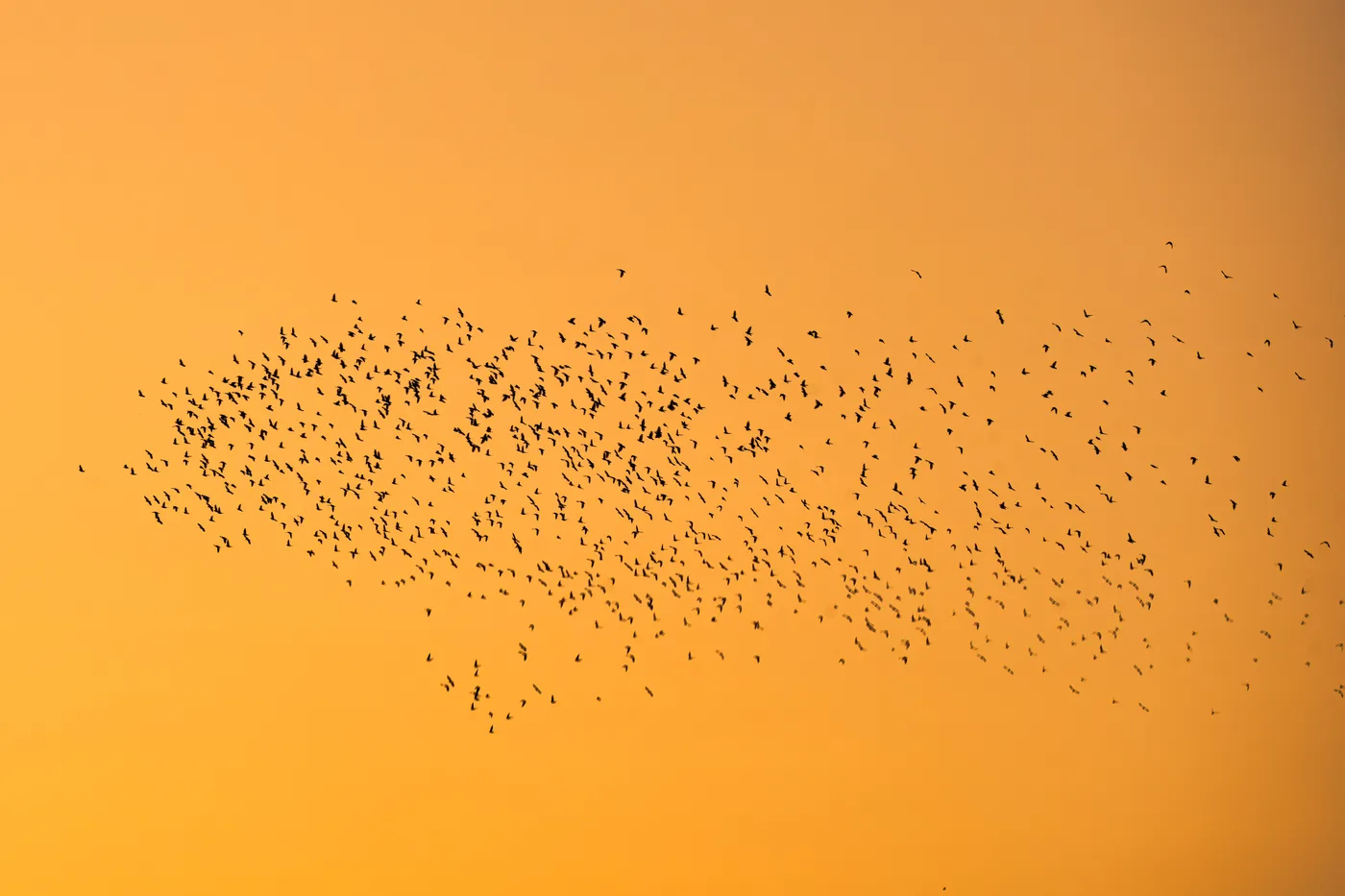
Some night this week, probably after you have gone to bed, the sky over Long Island will fill with birds. Not a stray flock but a broad, continuous passage: warblers, thrushes and sparrows in the hundreds of thousands, moving south at anywhere from a few hundred to a few thousand feet, most of them small enough to sit in your palm. They pass over your roof, your street, the parking lot of the grocery store, and almost nobody sees them. Fall migration is one of the largest movements of animals on the planet, and a good portion of it happens directly overhead, in the dark, while the neighborhood sleeps.
They travel while you sleep
It surprises people to learn that most songbirds migrate at night. The picture in our heads is the daytime one, geese in a ragged V against an afternoon sky, and geese do fly by day. But the small birds, the ones that weigh about as much as a few coins, lift off around dusk and fly through the dark, often until close to dawn.
Night suits them for practical reasons. The air is calmer after sunset, so a small body spends less energy fighting turbulence. It is cooler, which matters more than you would think: hours of continuous flight generate real heat, and cool air keeps a working bird from overheating. The hawks and falcons that hunt songbirds are daytime fliers, grounded after dark. And a night spent traveling leaves the daylight free for the other half of the job, which is eating enough to fuel the next leg.
There is also the matter of finding the way. Songbirds carry several compasses, and one of them is the night sky itself. In a series of planetarium experiments in the 1960s, young buntings raised under an artificial sky learned the point around which the stars appeared to rotate and used it to orient, the way a sailor uses the north star. Put simply, the birds over your house tonight are steering by the same sky you would see if you stepped outside and looked up.
The itch to go
Nobody sends out a signal on the first cold night of September. What happens instead is slower and stranger. As the days shorten, a migratory bird's body begins to change on its own schedule: it feeds heavily, lays down fat, and grows restless at night. Ornithologists borrowed a German word for that restlessness, zugunruhe, after noticing that caged migratory birds in autumn would flutter and hop through the night, and that they pressed toward the compass direction they would have flown if the cage had not been there. The urge to go south is not a decision. It is in the body, switched on by the length of the day.
Day length loads the spring; weather releases it. In fall, the signal is a cold front. When a front pushes through and the wind swings around to the northwest, the birds get a tailwind toward the coast and a clear sky to steer by, and they leave in enormous numbers. The biggest flights of the season almost always come on the first calm night after a front, which is worth remembering, because it means you can look at an ordinary weather forecast and know, within a day, when the river overhead will be running high.
How to listen
Here is the part you can do this week. Pick the first still night after a front passes. Step outside somewhere away from traffic and the hum of machinery, a backyard, a beach parking lot, a quiet corner of the block. Turn off the porch light. Give your ears ten minutes to adjust, which is longer than it sounds and is most of the discipline involved.
Then listen for something easy to dismiss: short, single notes from high overhead. A thin chip. A soft, breathy whistle. A note like a drop of water. These are night flight calls, brief contact notes that migrating birds give in the dark, and on a good night they come every few seconds, from different heights and directions, a loose acoustic thread holding the stream together as it moves. Thrushes tend toward the breathy whistles, warblers toward thin chips and buzzes. You do not need to identify a single one of them. Counting is enough. The point is not a list of species. The point is standing in the dark and hearing for yourself that the sky is occupied.
If you want confirmation, it exists at continental scale. Migrating birds show up on weather radar, the same radar that tracks rain, and on the biggest nights of fall the counts across the country run into the hundreds of millions of birds aloft at once. But the radar map is the abstraction. The chip note over your yard at midnight is the thing itself.
The porch light
There is one small act that goes with all this, and it costs nothing. Birds navigating by night sky are confused by artificial light. Bright lights can draw migrants down out of the flow, pull them into circling, and leave them exhausted in places with little cover and many windows. It is a hard problem at the scale of a skyline and a simple one at the scale of a house: during September and October, turn off the outside lights you are not using, aim the ones you need downward, and close the blinds in lit rooms late at night. A dark yard asks nothing of you and gives the travelers one less false star to steer by.
The morning after
The flight ends at dawn, and this is where it becomes visible. As the sky lightens, the birds that spent the night aloft drop down into whatever is below them to rest and refuel, and Long Island, sitting along the Atlantic flyway with water on every side, is very often what is below them. This is why a park or a backyard that held nothing on Tuesday can be busy on Wednesday: the oak suddenly flickering with small movement, an unfamiliar bird at the edge of the hedge, gone by the weekend. Nothing hatched overnight. The neighborhood was restocked from the air while you slept.
So the practice has two halves. The night half is standing outside and listening to the passage. The morning half is a slow ten minutes with the trees on the day after a front, looking for what came down. Neither requires binoculars, a checklist, or any skill beyond patience, though a pair of binoculars will not hurt.
What it mostly requires is the reframe: the sky over this island is not empty space between weather. Twice a year it becomes a river, running north in spring and south in fall, and everyone here lives on the riverbed. The commute, the school run, the light over the parking lot, all of it sits under a current of small determined lives moving at altitude in the dark. You do not have to do anything about this. But some night soon, when the front has passed and the air has gone still, it is worth standing out in the yard for a quarter of an hour, letting your eyes and ears open, and paying attention to the traffic.

Loading comments…