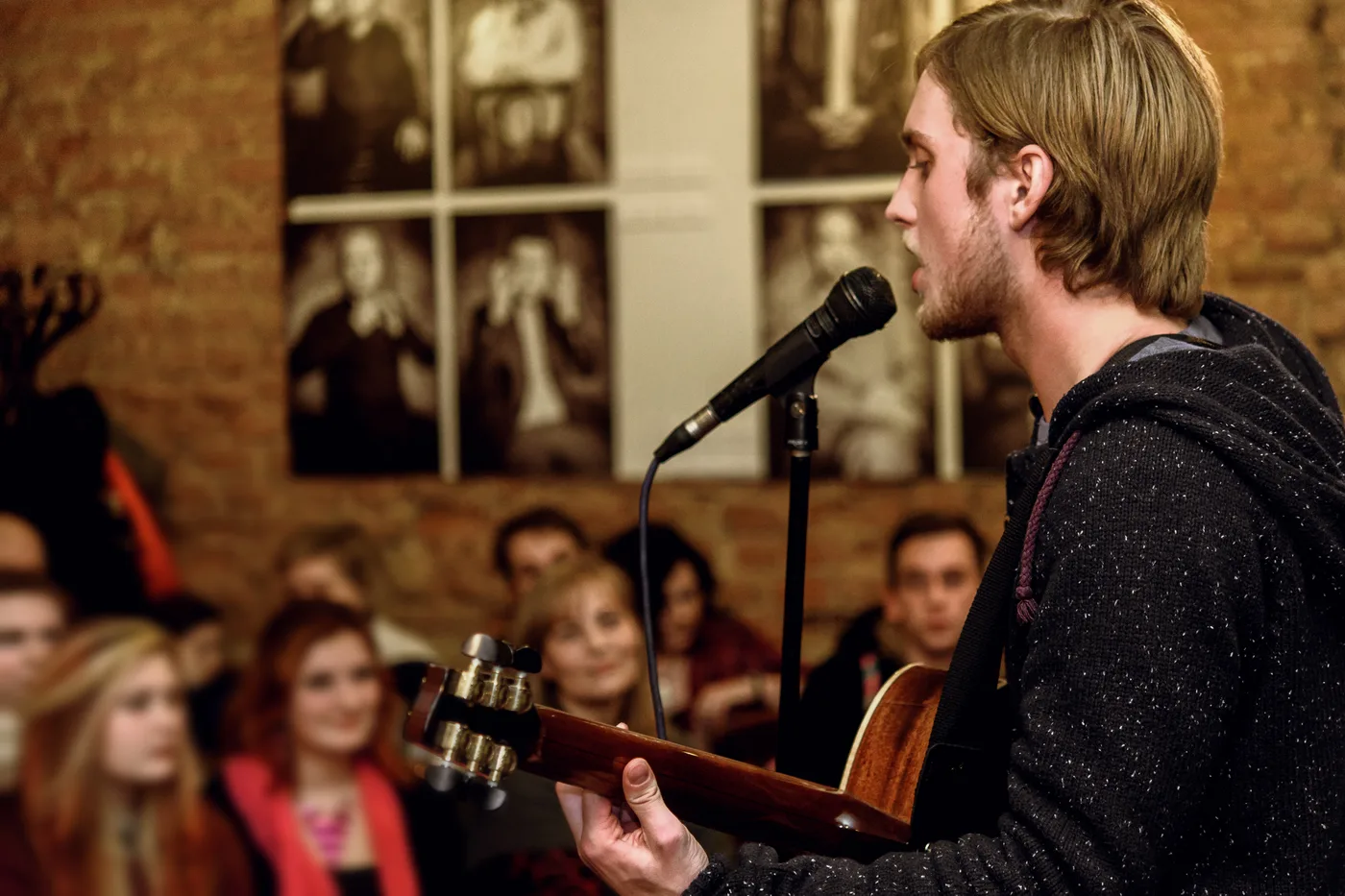
You have been circling it for a year, maybe longer: the class, the cold water, the manuscript in the drawer, the conversation you keep postponing. Then one evening you watch somebody do it. Not a professional, not a prodigy, just a person who could have been in your graduating class, standing up at an open mic with a shaking page, or wading into the October surf at Ditch Plains while everyone else keeps their shoes on. And something in you moves. The thing you have been circling did not get easier in that moment. It got possible.
Inspiration is evidence, not electricity
We talk about inspiration as if it were weather. It strikes. It visits. It dries up. The language makes it sound like something that happens to you, randomly, from above, and that picture quietly excuses us from doing anything about it.
The research tells a more practical story. The psychologist Albert Bandura spent decades studying what he called self-efficacy, the working estimate each of us carries of what we can actually pull off. That estimate is not a personality trait. It is a running calculation, and it updates on evidence. The strongest evidence is doing the thing yourself. But the second strongest, and the one available before you have ever tried, is watching somebody else do it. Bandura called this vicarious experience, and his point was almost unsettlingly mechanical: seeing a person you recognize as being like you succeed at something raises your own estimate of whether you could. Not your mood. Your estimate.
That is what the moment at the open mic actually is. It feels like a flutter in the chest, but underneath it is an update: the quiet math of what is possible for someone like me just changed, because the category someone like me just did it in front of you.
Why the near-peer beats the master
Here is the part the inspiration industry gets backward. We are forever pointed at the summit: the best-selling author, the champion, the master teacher glowing on a stage. And watching mastery is a pleasure. But as evidence about your own life, it is weak, and sometimes it is worse than weak. The gap between you and the master is so wide that the honest update is often downward. They are clearly a different kind of creature. The estimate does not budge, or it sinks.
The person who moves the needle is the near-peer: somebody a step or two ahead of you, close enough in age, history or starting point that your mind accepts them as a fair comparison. Researchers who followed Bandura's thread found this again and again, including in classrooms, where children struggling with math gained more confidence watching another child work through problems, hesitating and self-correcting, than watching a teacher glide through them flawlessly. The hesitation is not noise in the signal. The hesitation is the signal. It proves the performer is operating near their edge, the same edge you would be operating near.
This is why the wobble matters more than the polish. A flawless performance tells you what the activity looks like finished. A brave, uneven one tells you what it looks like begun, and begun is the only part you currently need.
The highlight reel teaches you nothing about starting
Most of what we watch now has been edited precisely to remove the part we need. The feed shows the finished kitchen, the published essay, the race medal, the pose finally held. The forty attempts, the three abandonments and the year of being visibly mediocre are cut, because nobody posts their middle.
A finished thing is almost useless as evidence about beginning, for the simple reason that the beginning has been deleted from it. If your main exposure to the thing you want is other people's highlight reels, you are mainlining exactly the wrong footage, and you can feel the result: admiration going in, discouragement coming out, on a loop.
The correction is not to watch less. It is to watch differently: live, local and mid-process, where editing is impossible. In a real room you see the false start and the recovery. You see the swimmer stop at the wall, breathe, and push off again. You see the reader lose her place, laugh, and find it. You see, over and over, the single most inspiring fact there is, which is that nobody dies of the wobble.
Where to stand this week
So treat inspiration as something you position yourself for, the way a photographer positions herself for light. One hour this week, in person, watching somebody a step or two ahead of you do the thing you have been circling. Not the gala performance: the working version. A masters swim practice rather than a meet. A life-drawing drop-in rather than a gallery opening. The open mic rather than the headline show. A rehearsal, a workday at the community garden, a friend reading you the rough chapter rather than the one she has already polished smooth.
While you are there, watch for the mechanics of nerve rather than the content of the performance. What does she do in the three seconds before she begins? Where does he put his eyes when it goes wrong? You are not there to evaluate the work. You are there to collect evidence about the crossing, the small physical act of starting, which is the part your own estimate is wrong about.
And if you can, ask the person afterward how they started. Pick the near-peer, not the veteran. People a step ahead remember the start vividly, in useful detail: which class, which month, what they were afraid of, what turned out not to matter. Masters often cannot remember the start at all. It has been polished out of them, the way the feed polishes it out of the footage.
You are somebody's evidence
There is a second half to this, and it is less comfortable. If estimates update on watched examples, then your visible attempt is someone else's permission, whether you intend it or not. The neighbor who sees you leave for the pool at seven. The coworker who hears you took the writing class. The teenager who watches you be a beginner at fifty and not apologize for it.
You do not have to be good to be proof. That is the whole point. The evidence a struggling beginner provides is not evidence of excellence, it is evidence of possibility, and possibility is the scarcer commodity. Every time you let yourself be seen in your middle stage, unedited, you fund the same quiet update in somebody watching that the person at the open mic once funded in you.
The chain runs further back than you think. Whoever you watched had somebody they watched. Nobody actually goes first. But in any given room, on any given evening, somebody has to be willing to go first in front of the people in that room.
This week, go stand where you can watch someone cross. And when you finally cross yourself, badly, at your own open mic or your own cold shoreline, know that the flutter moving through someone at the back of the room is not admiration. It is arithmetic. You just changed what is possible for someone like them.



Loading comments…