
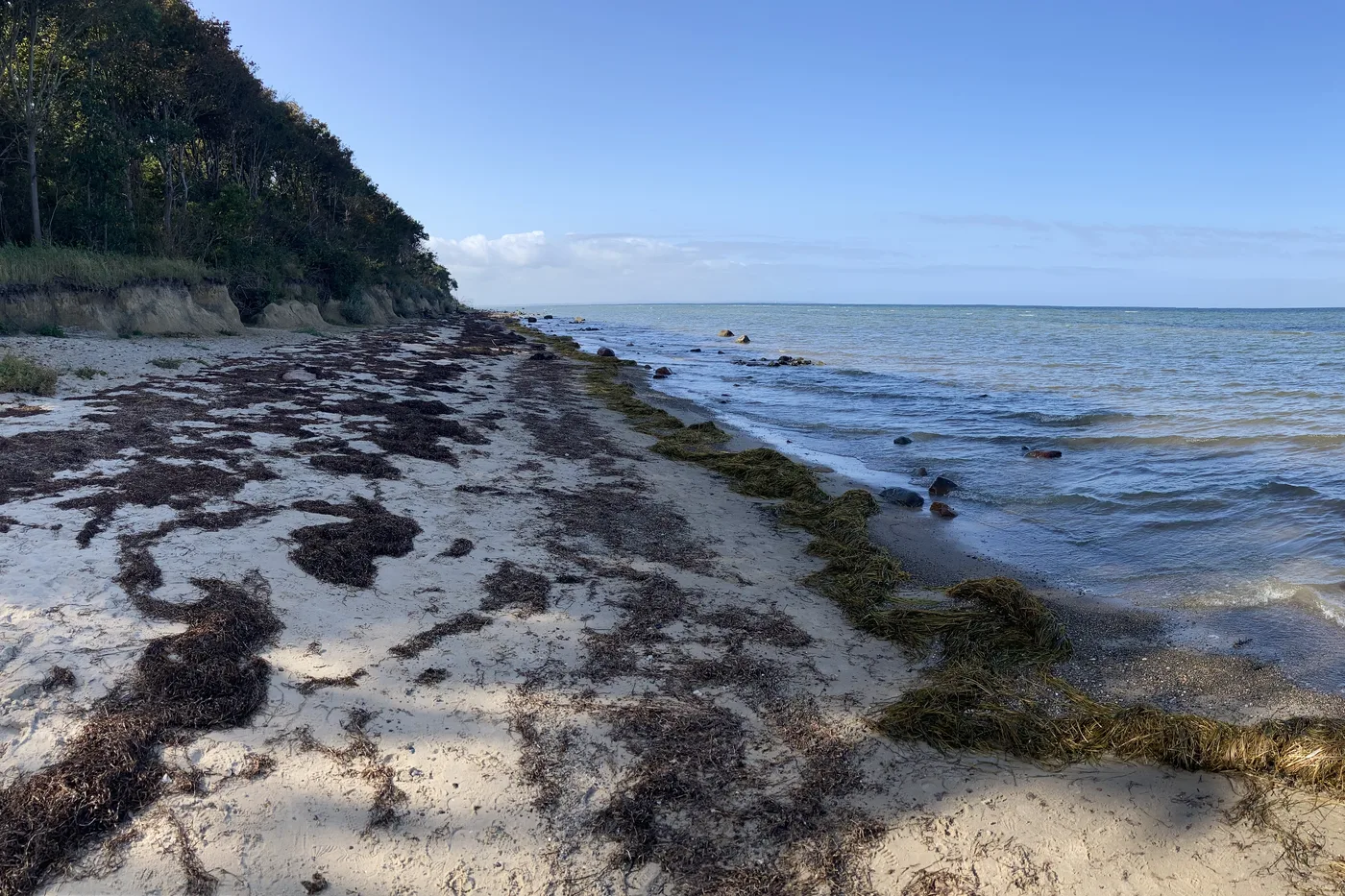
Every beach on Long Island carries a line you have stepped over a hundred times: a ragged ribbon of seaweed, shell and driftwood strung along the sand roughly where the last high tide gave up and turned back. Most people walk the firm sand below it or the dry sand above it and never look at the line itself. But that line is the most legible thing on the beach. It is a record of the night's weather, a census of what is living in the water just offshore, and the raw material the beach uses to rebuild itself. Learning to read it changes what a walk on the sand is for.
What the line actually is
The wrack line, as naturalists call it, is simple physics. Anything that floats rides the incoming tide as far as the water reaches, and when the tide turns, the water drains back and leaves its cargo stranded at the high point. Seaweed, eelgrass torn loose from the bay bottom, egg cases, feathers, the occasional sneaker: all of it settles in a band that traces the exact reach of the last high water.
Look closely and you will often find more than one line. The highest, driest band, up near the dune toe, marks a storm or one of the month's highest tides, the ones that arrive around the new and full moon. A fresher, darker line lower down marks last night's ordinary high. The space between them is a calendar. A beach with three distinct wrack lines is telling you about three different days, and once you notice that, you are no longer looking at debris. You are reading.
A census of the unseen
The pleasure of the wrack line is that it reports on a world you cannot otherwise see. You do not watch what happens on the bottom of the Great South Bay or beyond the ocean bar. The tide summarizes it for you, twice a day.
Those small black rectangles with a curved horn at each corner are skate egg cases, each one the emptied nursery of a single skate that hatched offshore. A papery spiral of stacked discs, sometimes a foot long and rattling like a maraca, is the egg case string of a whelk, the big snail whose shell is the one people hold to their ears. Find a clamshell with one neat round hole drilled near the hinge, countersunk like the work of a patient machinist, and you are holding evidence of a moon snail, which rasps through the shells of other mollusks and eats them where they sit.
Even the horseshoe crabs in the wrack are usually not what they appear. Most of the intact ones are not dead animals but abandoned suits of armor. A horseshoe crab grows by molting, walking out of its old shell through a split that opens along the front rim. Pick one up and look at the forward edge: if it is open there, light as paper and perfectly whole everywhere else, the animal that wore it is still out in the water, a size larger and doing fine. What looks like a small tragedy on the sand is usually the opposite.
None of this requires identification skills on day one. It only requires slowing from a walking pace to a reading pace for twenty yards. The names come later, if you want them. The habit of looking is the whole skill.
The beach is using it
It is tempting to see the wrack line as litter the ocean failed to take back. The beach sees it differently. That drying tangle of seaweed and eelgrass is the base of a food chain that runs the length of the island.
Turn over a mat of wrack that has sat for a day and the sand beneath it hops. Beach fleas, which are harmless little amphipods and not fleas at all, live under the wrack by the thousands, eating the decaying weed. They are why sanderlings and plovers work the wrack line so intently, stitching along it like sewing machines. The birds are not wandering. They are working a seam, and the seam exists because the tide keeps delivering groceries to it.
The wrack builds as well as feeds. A line of debris slows the wind where it meets the sand, and blowing grains settle out around it the way snow drifts against a fence. Seeds of beach grass and sea rocket, carried in the same tide, catch in the tangle, sprout through it, and hold what the wind piled up. That is how a dune begins: not with a planting program, but with a line of seaweed nobody raked away. Beaches that are groomed bare every morning for the sake of tidiness lose exactly this, which is part of why a raked beach so often needs trucked-in sand that a wilder one does not.
How to walk it
The practice is almost embarrassingly simple. On your next beach walk, give the first twenty minutes to the wrack line instead of the horizon. Walk just above it, slowly, and let your eyes work a few feet ahead of you. Crouch when something stops you. Turn one shell over. Smell the eelgrass, which is grassy and green when fresh and gets richer as it cures.
Two habits keep the practice honest. First, leave the line where it lies. The temptation to tidy a pocketful of it into a jar is real, but the wrack is occupied housing and working infrastructure, and it is doing more on the sand than it will do on a windowsill. One shell is a souvenir; the line itself is the beach's own project. Second, go back to the same stretch more than once. The wrack line is different after a southeast blow than after three calm days, different in whelk season than in molting season, different in a week when the bay bottom was churned. A single visit shows you objects. Repeat visits show you a system, and the system is the interesting part.
Take a child if one is available, because children already walk at reading pace and have no dignity invested in striding past things. But the practice works alone, and in the off-season, when the beach is empty and the light comes in low and the line is the only fresh thing on the sand, it may work best of all.
The beach you thought you knew
Long Islanders are proprietary about their beaches, and with reason. But most of us know the beach the way we know an airport: as a venue, a flat place where the activity we brought with us happens. The wrack line is the beach insisting it is not a venue. It is the visible edge of an enormous, busy, mostly hidden neighborhood that begins at your feet and runs out past the bar, and twice a day it files a report.
You do not need binoculars, a guidebook or a season. You need twenty unhurried minutes and the willingness to look down instead of out. The ocean has been leaving you notes your whole life. This week, read one.

Loading comments…