
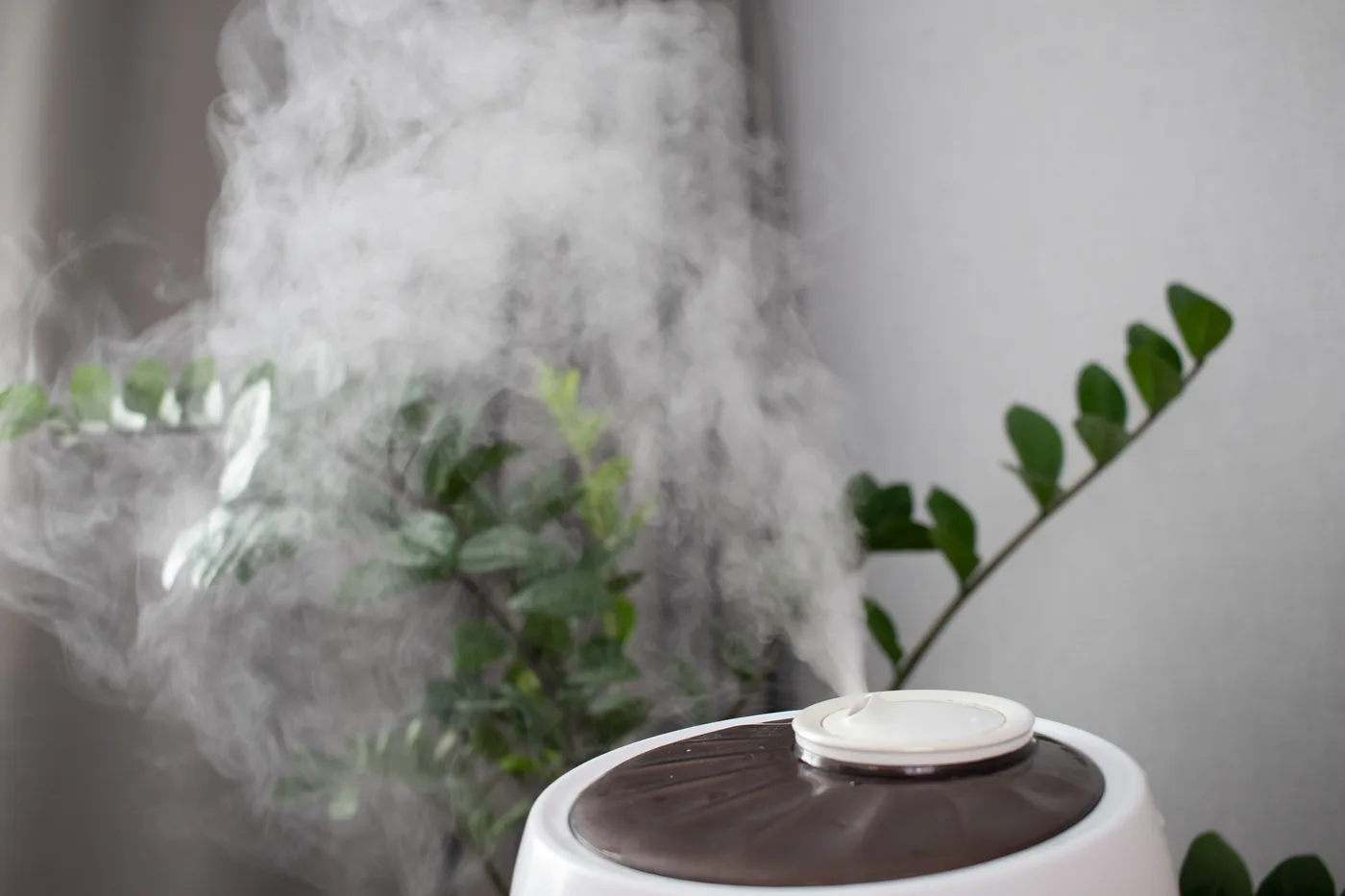
Sometime in the last few weeks, without anyone making a decision, the heat came on. The boiler ticked, the radiators warmed, the vents breathed, and the house crossed a line it will not cross back until spring: the air inside your home is now drier than the air over most deserts at midday. You will feel it before you name it. The scratch in your throat on waking. The lips that need balm by noon. The spark that jumps from the doorknob to your hand. The dry season is indoors, it runs until April, and unlike the weather, it is something you can actually adjust.
Why heating dries the house
Nothing removes water from your home in winter. What collapses is a ratio. Air can hold moisture in proportion to its temperature: warm air has room for a great deal of water vapor, cold air for very little. The figure on the weather report, relative humidity, says how full the air is compared with what it could hold at its current temperature.
Here is the trick of it. Outdoor air on a thirty-degree day might be at sixty percent humidity, which sounds comfortable. But cold air at sixty percent is holding only a small absolute amount of water. Pull that air indoors, warm it to sixty-eight degrees, and you have not taken a drop out of it, yet its capacity has multiplied. The same small amount of water now sits in a much larger container, and the relative humidity falls off a cliff, routinely into the twenties and sometimes the teens. That is the range of a desert afternoon, maintained around the clock, in the rooms where you sleep and breathe.
What the body notices first
Your nose and airways are lined with a thin, continuously moving film of mucus, swept along by microscopic hairs called cilia. This is the airway's housekeeping: dust, pollen and microbes land on the film and are carried up and out before they settle in. The whole system works because it is wet. In very dry air the film thickens and the sweeping slows, which is why the first complaint of the heating season is usually the morning throat, the crusted nose, or for some people the winter nosebleed, which is most often just the dried front of the septum giving way. Laboratory work has also repeatedly found that some winter viruses linger longer in very dry air, while the airway's defenses work best in a middle range of humidity. Dry air does not cause a cold, but it is a better friend to one than it should be.
The skin runs the same complaint outward. Its outer layer is a barrier whose job is to hold water in, and dry air pulls moisture through that barrier faster than the skin can replace it. The result is the itch across the back, the flaking shins, the knuckles that crack at the fold, and for people who carry eczema, the familiar winter flare. Eyes feel it as a tear film that evaporates faster than it is replenished, which contact lens wearers notice first. And sleep collects all of it: eight hours of breathing dry air, often through the mouth, is why January mornings so often begin parched.
Measure before you fix
The useful first move costs little: a small hygrometer, the humidity equivalent of a thermometer, set on a shelf in the bedroom. It turns a vague complaint into a number you can move. In the heating season, somewhere around forty to fifty percent is the comfortable band for most homes. The number matters in both directions, because the fix has a far side: push a house too damp in cold weather and water will condense on the coldest surfaces, beading on windowpanes and gathering in corners, and persistent condensation is how mold gets its start. If the panes are wet in the morning, ease back. The glass is your second instrument.
Putting water back
The workhorse is a humidifier, and the rule that matters more than which type you buy is hygiene. A tank of water left standing grows a film, and a neglected machine will cheerfully distribute what grows in it. Empty it daily, let it dry, refill it fresh, and clean it on the maker's schedule, which is more often than anyone wants. A clean modest machine beats an elaborate dirty one every week of the winter. Put it in the bedroom, where you spend a third of the season, and let the number on the hygrometer tell you whether it is keeping up.
Around it, the small old methods still add their share. A pot simmering while you cook. Laundry dried on a rack indoors. The bathroom door left open after a shower. Houseplants, which breathe water all day. A bowl of water set on a radiator, which is how houses did this before there were machines to do it. None of these will carry a whole house, but each adds a little, and in a closed room a little is noticeable.
Tending the body directly
Some of the season's relief goes straight to the tissue rather than the air. Plain saline, sprayed or rinsed through the nose, is as unglamorous as remedies get and keeps the airway's film moving the way it is meant to. Lip balm works far better applied before the damage than after it. Moisturizer does its best work in the two or three minutes after a shower, applied to skin that is still damp, because what it mostly does is trap water that is already there. Showers themselves are worth shortening and cooling slightly in winter; long hot water strips the skin's own oils exactly when it needs them most. And drink, even though winter thirst is quieter than summer thirst. Every breath you exhale leaves saturated with moisture, and the drier the air coming in, the more water each breath carries out.
What it is not
A humidifier is not a treatment for anything, and this piece is not medical advice. Nosebleeds that keep returning, sinus trouble that settles in and stays, skin that cracks and will not close: those belong to a clinician, not to an appliance. What humidity management actually offers is subtraction. It removes a constant low-grade irritant that the heating season would otherwise apply to your airways, your skin and your sleep for five months straight, and people who correct it mostly report the quiet kind of improvement: the morning throat gone, the itch gone, the balm lasting the day.
The weather inside
There is something satisfying in realizing that your home has a climate, and that you are its weather. The furnace made the house a desert without asking you; a cheap gauge, a clean machine and a few old habits can make it temperate again. Winter will go on doing what it does on the far side of the glass. The air on your side is yours to tend.



Loading comments…