
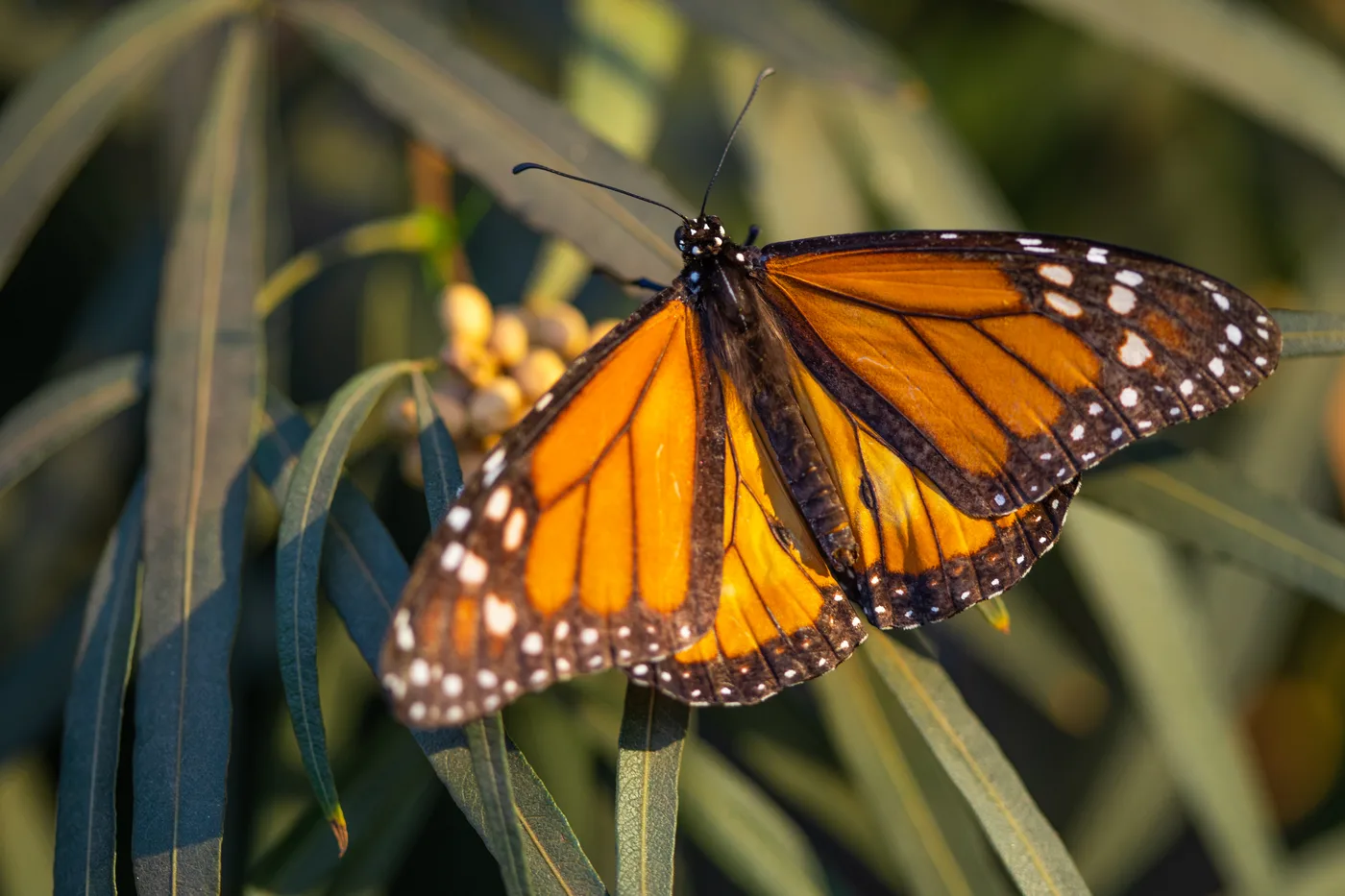
Sometime in the middle of August, on a morning when the wind has swung around to the northwest, the first of them will come down the beach. Then more. By early September there are mornings on the Fire Island dunes when the goldenrod is moving and it takes a moment to understand why, and evenings when a single pitch pine holds several hundred butterflies folded shut like dead leaves. It happens every year, roughly on schedule, about forty minutes from most of Long Island, and a remarkable number of people who live here have never gone to look.
What Is Actually Happening Out There
The monarchs arriving on the beach in late summer are not the same insects that arrived in June, and they are not really the same kind of animal.
Monarchs move north through the spring and early summer in a relay, each generation living two to five weeks, breeding, and dying somewhere further up the map. Then, in late summer, the physiology changes. The generation that emerges in August does not breed. It puts its energy into fat and into flight, it lives up to nine months rather than a few weeks, and it goes south, alone, to a place it has never been, where its great-great-grandparents spent the previous winter.
The destination is a handful of oyamel fir groves in the mountains west of Mexico City, over 2,500 miles away. Almost every eastern monarch on the continent ends up in an area you could walk across in an afternoon.
Long Island is on the route because of geography rather than luck. Butterflies moving south down the coast meet the water and turn, and the barrier beaches funnel them along a narrow strip of dune and thicket. The National Park Service puts the passage through Fire Island at mid-August through late September or early October. They fly by day, low, and they do not fly at night: at dusk they gather in the pines to hold their warmth, then hang there until the sun is strong enough in the morning to warm the flight muscles again. After Long Island, the next great gathering point is Cape May.
Goldenrod Is the Whole Story
Everyone who has heard anything about monarchs has heard about milkweed, and milkweed is genuinely essential. It is the only thing a monarch caterpillar can eat. On Fire Island the common and swamp milkweeds do that job through June and July.
But milkweed is a June problem. In September it has nothing to do with what is happening on the beach.
The butterfly on the dune in September is not laying eggs. It is buying fuel for Mexico, and it is doing that at flowers. The Park Service lists the nectar sources on Fire Island as seaside goldenrod, dogbane, aster, common boneset and groundsel tree, and of those the one that matters most is the first. Seaside goldenrod blooms late, blooms hard, tolerates salt and sand, and happens to be at its peak in precisely the weeks the migration is passing. It is, functionally, the last gas station on a very long road.
It is also, and this is the part worth saying out loud, a plant most people have been taught to regard as a weed and to sneeze at. Goldenrod does not cause hay fever. Its pollen is heavy and sticky and moves on insects, not on wind. Ragweed, which blooms at the same time and is genuinely responsible, is green and inconspicuous and gets away with it every year because goldenrod is standing next to it looking guilty.
The Numbers, Honestly
The eastern monarch population is measured once a year, and not by counting butterflies. Surveyors from Mexico's protected areas commission and the World Wildlife Fund measure the area of forest the overwintering clusters occupy, on the reasoning that a hectare of occupied fir holds something on the order of twenty million insects.
For the winter of 2025 to 2026 the figure came in at 2.93 hectares, up about 64 percent from the 1.79 hectares of the year before. That is the second consecutive increase, and it is genuinely good news after a decade in which the trend mostly went the other way.
It also needs the second half of the sentence. Researchers have put the area required to sustain a stable eastern migration at around six hectares. Two consecutive good years have brought the population to roughly half of what it would need to be to stop worrying, and single-year swings in this measurement track weather along the route at least as much as they track anything anyone did.
The legal picture is unresolved in a way that is itself worth knowing. In December 2024 the US Fish and Wildlife Service proposed listing the monarch as threatened under the Endangered Species Act, with a final decision due within a year. That year passed. The final rule was reclassified as a long-term action, and in February 2026 conservation groups filed suit to compel the agency to set a binding date. As of this writing the monarch is a proposed listing and nothing more.
Going to See It
Go in the morning, and go on a cool one. Monarchs cannot fly until their flight muscles reach temperature, which means that on a chilly September morning they are still hanging in the pines and cedars, wings shut, doing nothing, and you can stand three feet away and look at them properly. An hour later the same insects are unapproachable.
The best conditions follow a cold front, when the wind comes out of the northwest and pushes everything down the coast at once. Fire Island National Seashore is the obvious place. The William Floyd Estate in Mastic Beach, also part of the Seashore, is a quieter option on the mainland, and any stretch of ocean dune with goldenrod on it will do: Jones Beach, Robert Moses, Montauk Point.
Look for the goldenrod first and the butterflies second. And leave them alone. A migrating monarch is carrying the fat it needs for a continent, and being caught and handled costs it some of that.
If You Want to Do Something About It
The most useful thing a Long Island garden can do for monarchs is not what most people plant.
Plant native milkweed by all means. Common milkweed spreads and wants room, swamp milkweed is well behaved and takes a damp spot, and butterfly weed is the orange one that stays put and looks deliberate in a border. That feeds the caterpillars in early summer.
Then plant the late nectar, which is the part that gets skipped. Seaside goldenrod, New England aster, boneset, and anything else that is still in flower in the third week of September when the migration is overhead and most gardens have been cut back for the season. A garden that peaks in June and is tidy by Labor Day is closed exactly when it is needed.
A note on tropical milkweed, the tall one with red and orange flowers sold everywhere in spring. In the South it is a real problem: it stays green through mild winters, a protozoan parasite called OE accumulates on foliage that never dies back, and successive generations of caterpillars pick up heavier and heavier loads. On Long Island our frost cuts it down and removes most of that risk, so the warnings written for Texas do not transfer here unaltered. The better argument for our own gardens is simpler. The natives are perennial, they are adapted to this sand and this salt air, they come back on their own, and the plant that actually matters in September is a goldenrod.
Three Weeks From Now
There is something clarifying about an animal weighing half a gram setting off for a mountainside in Mexico it has no memory of, using a sun compass and a set of instructions nobody has fully explained, and stopping to eat on a sand dune in Suffolk County on the way.
The window is short. It opens around the middle of August and it is effectively over by the first week of October, and then the beach is just a beach again until next year. It is worth putting on a calendar now, while there is still time to notice the wind swing northwest one morning in September and know what it means.

Loading comments…