
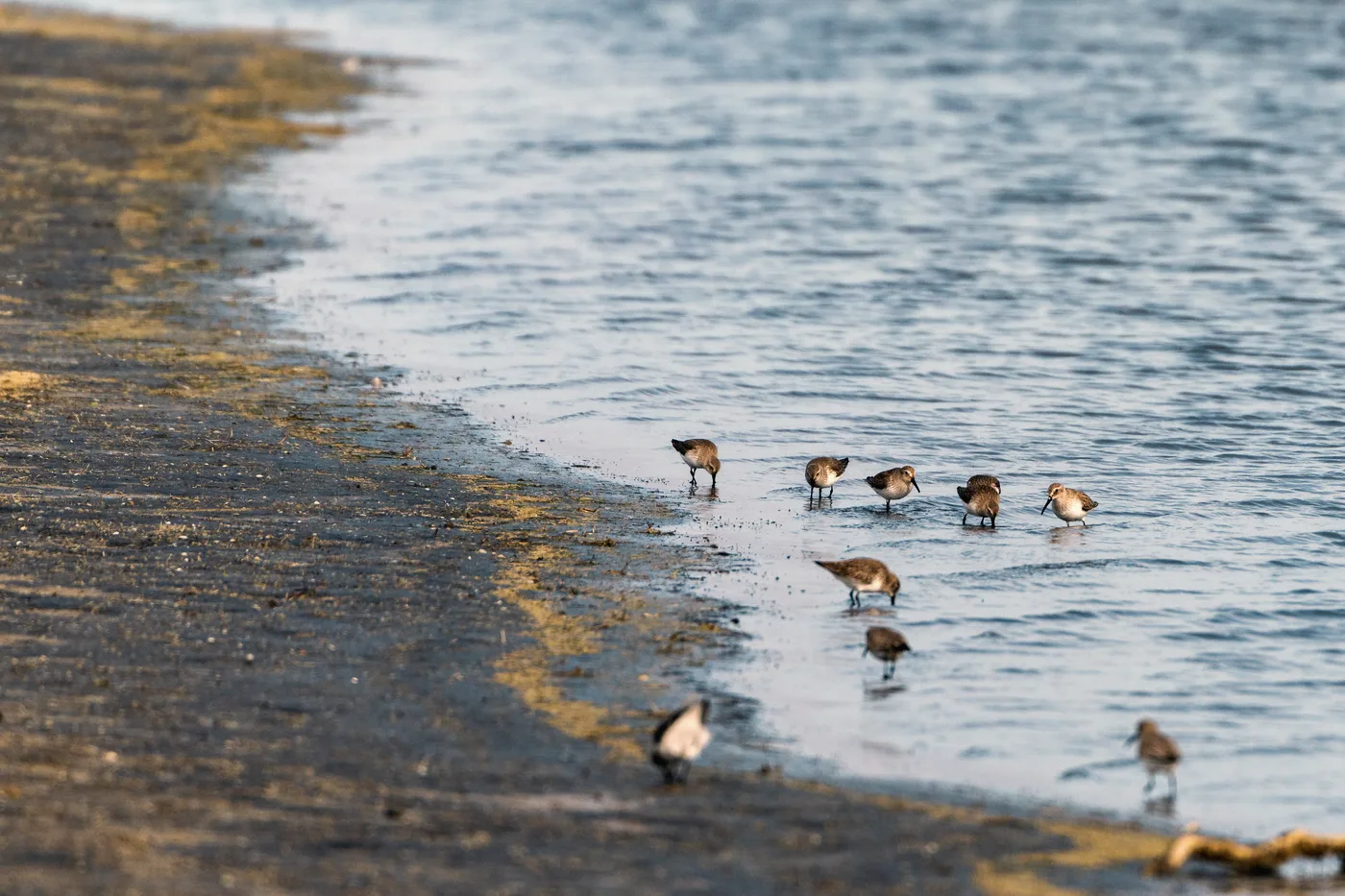
On a hot August afternoon at Jones Beach or Robert Moses, look past the umbrellas to the wet apron of sand where the waves slide out. There will be small pale birds there, running seaward after each retreating wave, stabbing at the sand, then sprinting back up the slope ahead of the foam like wind-up toys. They read as part of summer's furniture, as permanent as the lifeguard chairs. They are not. Many of them were standing on Arctic tundra in June, and some will be on a beach in South America by the time Long Island rakes its first frost off the windshield. The beach where you are swimming is not their home. It is their layover.
Autumn Starts in July
The calendar says fall begins in late September. For shorebirds, the season turns in high summer. The Arctic breeding window is brutally short, a few frantic weeks of continuous daylight, and the adults of many species finish nesting and simply leave, some of them in July, before their own chicks can fly. The young birds follow weeks later, flying routes they have never seen, over open ocean, without their parents, guided by an inheritance no one fully understands. Southbound migration is not an event that happens to Long Island in October. It is a procession that begins while the beach parking lots are still full.
By late August the procession is at its thickest. The wave-chasing birds are mostly sanderlings, pale and quick, fresh from the high Arctic. Mixed among them are semipalmated sandpipers, smaller and browner, and semipalmated plovers with their single dark neck bands, running and pausing like tiny mechanical shorekeepers. On the bay flats there are yellowlegs and black-bellied plovers; on the jetties, ruddy turnstones flipping pebbles for whatever hides beneath. What looks like a beach full of resident birds is actually a rotating cast, arriving lean, feeding hard, and leaving, replaced within days by the next wave coming down from the north.
What the Tideline Serves
They stop here because the tideline is a banquet, invisible to us because everything on the menu is buried. The swash zone, that strip the waves wash over, is packed with life: mole crabs backing themselves into the sand faster than the water can leave, amphipods, small clams, marine worms. Every wave rearranges the table, and the birds' entire sprint-and-stab routine is a harvest timed to the seconds when the prey is closest to the surface. Higher up the beach, the wrack line, that ragged ribbon of stranded seaweed and eelgrass most beachgoers step over, is its own pantry, alive with beach hoppers and flies and the things that eat them.
Fuel is the whole game. A migrating shorebird is a machine for converting invertebrates into fat, and the transformation is astonishing: in the weeks before a long overwater leg, some of these birds nearly double their body weight, and you can sometimes see the difference between a new arrival, trim and busy, and a bird nearly ready to go, round as a teacup. The stakes could not be plainer. A bird that leaves the beach fat crosses the water. A bird that leaves lean does not arrive. When you watch a sanderling working the tideline with what looks like obsession, you are watching arithmetic, and the answer decides everything.
The Cost of Being Flushed
Which is why the most useful thing to know about these birds is what it costs them to fly away from you. Every time a feeding flock startles into the air, it burns fuel it came here to gather, and it loses feeding time it cannot get back, since the buried banquet is only fully open around the lower tides. One flush is nothing. The fortieth flush of the day, from joggers and dogs and children who chase because the lifting cloud of wings is genuinely thrilling, starts to matter. Biologists who study stopover sites have a sobering observation: a beach can be rich in food and still fail its migrants, if they are disturbed too often to eat it.
The remedy asks almost nothing of us. Walk around a feeding flock rather than through it, higher up the dry sand. Keep dogs leashed near the birds, without exception, because to a shorebird a loose dog is a predator every single time, no matter how friendly its intentions. Let the wrack line lie where the tide left it. Give the roosting flocks at the tip of the beach, the ones standing still and facing the wind, a wide margin, because resting is part of refueling too. That is the whole list. It costs a detour of thirty feet, and it is the difference between a beach that feeds its travelers and one that only tires them.
How to Watch
If any of this makes you want to look closer, the watching is easy and better than television. Go at low tide, early, before the crowds, to any ocean beach or bay flat. Binoculars help but are not required. Pick one bird and give it a full minute, which is longer than most people ever watch anything wild, and the differences start to declare themselves: the plovers hunt by sight, in a run-pause-tilt rhythm, while the sandpipers hunt by touch, stitching the sand like sewing machines. Notice the birds standing on one leg with their bills tucked, conserving heat and resting half the brain at a time. Then hold in mind what the bird actually is: a creature weighing about as much as a couple of AA batteries, partway through a journey of several thousand miles, executed on muscle, fat, and inherited memory.
Do that once and the beach reorganizes itself around you. The umbrellas and coolers become the temporary thing, the shallow layer, and the tideline becomes what it has been all along: infrastructure on a hemispheric flyway, one refueling stop in a chain that runs from the tundra to Tierra del Fuego.
The Season Underfoot
There is something quietly correcting about all of it. We tend to experience seasons as things that arrive, with dates, announced by displays in the grocery store. At the tideline the seasons do not arrive; they pass through, overlapping, one leaving while another is still fully here. It is high summer on the dry sand and already autumn at the water's edge, and both are true at once. The next time you are at the beach, before the towels are even unrolled, spend one minute at the edge watching the travelers work. Nothing about the afternoon will change, except that you will know what you are standing in the middle of, and knowing turns out to be its own kind of wealth: the ordinary beach trip, quietly upgraded to a view of one of the great migrations on Earth.

Loading comments…