
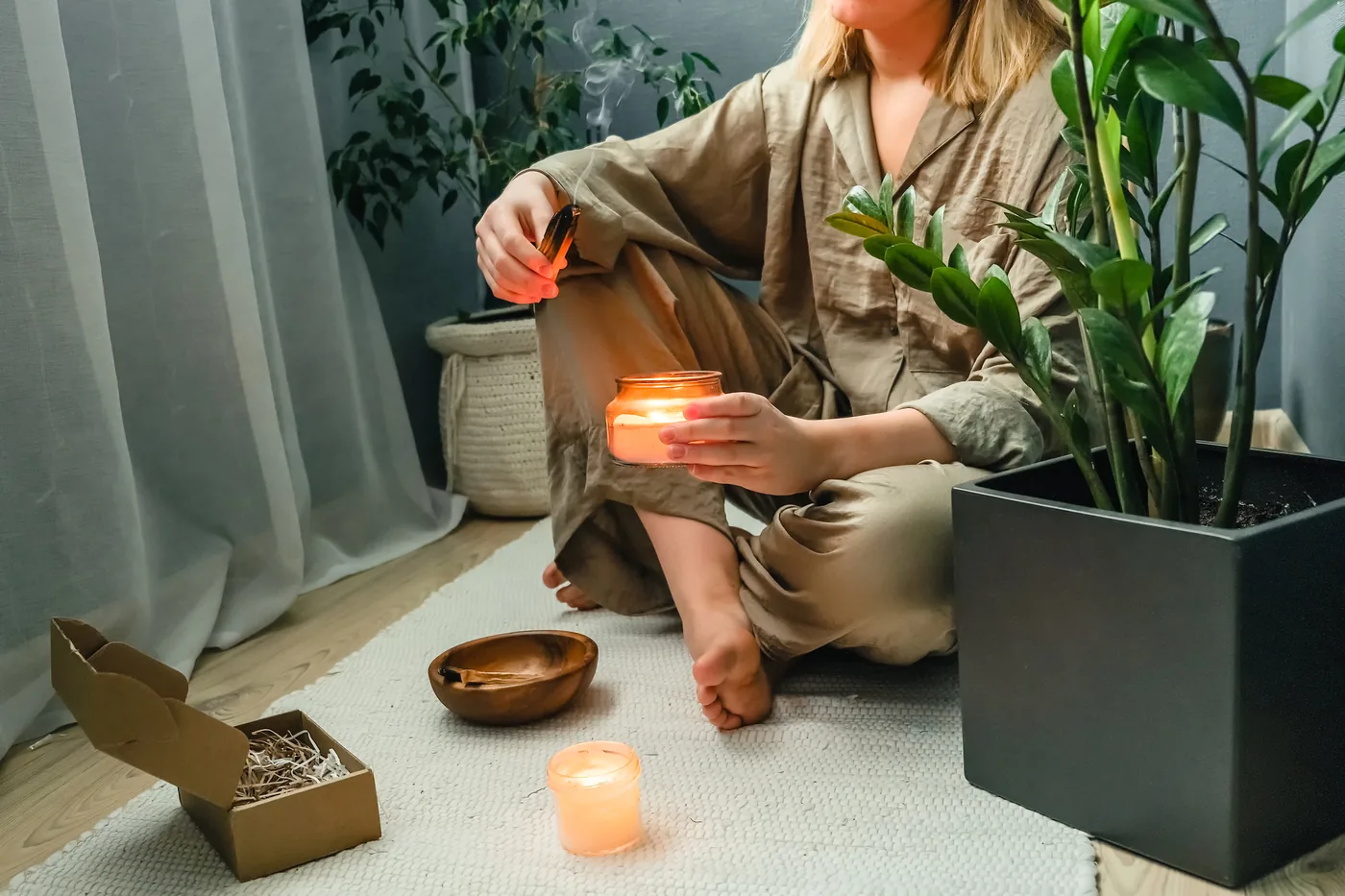
There is probably one in your house already. A shelf with your grandmother's photograph and a small dish of shells from a beach you loved. The corner where the candle lives. The windowsill that somehow only ever holds a few particular objects, and which you have never quite been able to clear because it would feel wrong. Nobody built it deliberately and it has no name, and it is doing almost exactly what a home altar has done in nearly every culture that has ever kept one.
Almost Everyone Has Done This
The impulse to set aside a small place in the house and treat it differently is close to universal, and the similarity across traditions that never met is the interesting part.
Orthodox Christian homes keep an icon corner, often facing east, sometimes called the beautiful corner, and it is the first thing a visitor greets. Hindu households keep a shrine, from a whole small room to a shelf, where a lamp is lit and water and flowers are offered. Japanese homes have kept a butsudan for the family's ancestors and a kamidana high on the wall. Chinese households keep an ancestor altar with incense and offerings of fruit. Catholic homes across Latin America and southern Europe keep home altars, and once a year build the ofrenda for the dead with photographs and marigolds and the foods those people liked. Jewish homes mark the doorway itself with a mezuzah, touched in passing.
Different theologies, different centuries, no contact between many of them. And the form comes out nearly identical every time: a designated surface, set a little apart or a little above, holding objects chosen for meaning rather than use, plus one small repeated action. A light. Water. Smoke. A word said.
When something is arrived at that many times independently, it is usually solving a real problem.
What the Place Is Doing
You can take this apart without reducing it, and understanding the mechanism tends to make people more willing to try it rather than less.
The first thing a fixed place does is remove the decision. Anything that depends on remembering to do it competes, every single day, with everything else, and eventually loses. A physical place that always holds the same objects does the remembering for you. You do not have to summon the intention; you walk past it and the intention is already there, waiting where you left it.
The second thing is that a place holds a state. Rooms and corners carry associations, and a specific spot used repeatedly for one thing begins to produce that thing on arrival. This is why the bed is a poor office and why the corner where you have sat quietly two hundred times starts to settle you before you have done anything at all. The place begins doing part of the work.
The third is that objects hold what we cannot carry continuously. A stone from a particular shore, a ring that belonged to someone, a photograph, a feather. None of these has power in itself, and everyone knows that. What they have is the ability to keep something present without you having to hold it in mind, and to make it available in a second when you look at them. Memory, love and grief are all too heavy to carry at full weight through a Tuesday. An object lets you put them somewhere specific and visit.
And the fourth is that it draws a boundary. A house has no natural edges to the day. A small place with a small ritual makes an inside and an outside: this minute is different from the minutes on either side of it. That is most of what ritual has ever been for, and it is why the actions are so consistently the same across traditions. Lighting something changes the room. Water is poured and gone. Smoke rises and disperses. Each of them marks a moment as having been marked.
It Does Not Require Belief
This is worth saying plainly, because it is what stops most people.
You do not need to belong to a tradition to keep a place like this, and you do not need to decide what you think happens when you sit at it. Plenty of people who describe themselves as entirely secular keep a shelf with their parents' photographs on it and stand there sometimes, and they are not doing something dishonest or borrowed.
If you do belong to a tradition, it will have its own form for this, older and richer than anything assembled from scratch, and that form is worth learning from the people who keep it rather than improvising.
And if the word altar is the obstacle, drop it. Call it the shelf. What matters is that a place exists, that it is not used for the post, and that you go to it.
How to Make One
Small, real, and yours. The most common mistake is building something impressive that turns out to be someone else's.
Choose the place before the objects. A windowsill, a shelf, the top of a chest of drawers, a corner of a bookcase. Somewhere you pass daily rather than somewhere impressive, and somewhere you can stand or sit comfortably for two minutes.
Clear it completely first. The clearing is part of it. A surface that has been emptied and wiped is already different from the surface it was an hour ago.
Add something living or from the outside. A cutting from the garden, a stone, a shell, a pine cone, water in a small glass. Every tradition includes something from the natural world, and it is the element that keeps the place from becoming a display case.
Add something that carries a person. A photograph, a letter, a small thing that belonged to someone. This is the part that usually surprises people with how much it does.
Add a light. A candle, or an electric one if the house has small children or an unreliable memory. Lighting it is the action that most reliably starts the thing and blowing it out is the one that ends it.
Keep it to one small action. Light the candle and stand there for the length of ten breaths. That is enough, and it is more than most people manage on most days. An elaborate practice designed on an enthusiastic Sunday is a practice that will be abandoned by the second week of the month.
Let it change. Bring something in from each season. Take out what has stopped meaning anything. A place like this goes stale when it is treated as finished, and stays alive when it is tended.
Keep it out of the traffic. Not in a place where keys and post will accumulate, because they will, and the day the shelf becomes a surface is the day it stops being anything.
Two Ways It Goes Wrong
Both are common and both are quietly fatal.
The first is that it becomes decoration. It is arranged beautifully, it is photographed, and it is never actually used. There is nothing wrong with it being lovely, but the point is not the arrangement. The point is that a person stands in front of it. An unused altar is a still life.
The second is that it becomes an obligation. A daily practice adopted with resolve turns, in about three weeks, into one more thing being failed at, and then the shelf starts producing guilt every time it is passed, and eventually it gets cleared. Keep it small enough that you would still do it on a bad evening. Miss a week and come back without ceremony. This is not a streak.
The Oldest Piece of Furniture
Long before there were buildings for this, there were households doing it: a corner, a light, a few objects, somebody standing there for a moment before getting on with the day. The formal versions came later and grew out of the domestic one, not the other way around.
What it gives is not complicated. In a house given over almost entirely to function, where every surface is for something and every room has a job, it puts one small place that is not for anything. A place to leave what you are carrying, or to remember somebody, or to say thank you to nobody in particular.
Look around tonight and find the shelf you have already half made. Clear it, put three things on it that matter, and light something. Then stand there for ten breaths before the day takes you back.



Loading comments…